
Secrets Of Bolshoi Zayatsky Island – Mysterious Stone Labyrinths Of Unknown Purpose And Origin
A. Sutherland - AncientPages.com - One of the most isolated and mystical places of the northern region, is the Solovetsky Archipelago that comprises six islands in the western part of the White Sea, of Russia's Far North. Traces of a human presence from as far back as the 5000 B.C. can be found on these islands covering 300 square kilometers, but about the oldest inhabitants of the islands, very little is known.
Particularly interesting is the Bolshoi Zayatsky (Big Zayatsky) Island dated to the 3rd millennium BC and once occupied by prehistoric residents who built sacred sites, villages, and irrigation systems. However, not much is known about their life, beliefs, and religious rituals.

Today the site is sparsely populated and people live a simple life, but the Bolshoi Zayatsky - with a large number of ancient stone mazes - has been attracting scientists and enthusiasts for many years with its mysteries.
The Bolshoi Zayatsky island makes it stand out among the many similar empty northern islands.
It is believed that the mysterious people of Bolshoi Zayatsky, left a group of 13 – 14 stone labyrinths on 0.4 km 2 area of one small island, as many as 850 heaps of boulders containing bones, a great variety of petroglyphs, and many places of worship.
Anzer Island, for example, which is also a part of the Solovetsky Archipelago, has only four labyrinths and 38 cairns, disposed in three irregular rows along the seashore.
Totally, on the Solovetsky Islands, there have been preserved more than 30 stone labyrinths.

For some reason, the intricate patterns of stones, scattered around the Big Zayatsky island appeared in the distant past.
Several theories have been proposed to explain the labyrinths' true purpose.
According to one theory, supported by the argument that almost all the mazes are located on the coast, their creators were the northern seafarers exploring the cold realm of waters today known as White Sea.
Another suggestion is that they may have represented a border between this world and the underworld.
Could the formations be related to the spiritual beliefs of the ancient inhabitants of Bolshoi Zayatsky and even another small island of the archipelago?
Professor Alexander Kuratov, one of the researchers who investigated the formations, says that
"... labyrinths on the Solovetsky Islands are the spiral-shaped figures, it is a system of tangled passages, walls of which are laid out with boulders. Near 30 labyrinths of different size and form were discovered on the Solovetsky Islands during the last 100 years of research.
Spiral that twists from left to right or from right to left is a foundation of most labyrinths. The “Horse Shoe” shape of the labyrinths depends on how many twists spiral has and on principal of the way it untwists with further transformation of its constitution. The amount of “horse shoes” formed by spiral and additional elements of construction provide different degrees figure complexity.
Labyrinths are not very tall – about 40 centimeters high, they are often located on the ground right by the sea and covered with lichen, moss, heather, and small bushes. Labyrinths have no distinct orientation, their exits-entrances are pointed to south-east, south, south-west and west, most of the times to the sea.
Labyrinths could be used not only as burial grounds for the tribes that lived along the White Sea, but for the tribal rituals as well..." (A. Martynov, “Ancient trails of Solovetsky Islands”)

All the labyrinths on Bolshoi Zayatsky were built with boulders gathered locally, and are concentrated on the western side of the island, while its eastern part is covered by a large collection of stone formations, of which many depict the sun with radial spokes.
The age of labyrinths is estimated to approximately 3000 BC but they can be much older.

Both very large and small designs of boulders vary in size and pattern, but most of them represent a single or double helix maze that has only one entrance, which is at the same time exit point. The smallest labyrinth measures around six meters in diameter with the largest being 25.4 meters in diameter.
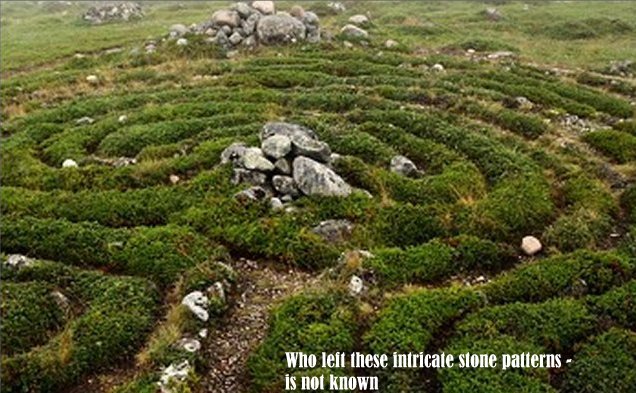
The rows of boulders form spirals, with some consisting of two spirals, described as resembling two serpents with their heads in the center. The entrances to the labyrinths are mostly on the south and while there are five different settings, they each have only one entrance/exit point.
There may be many different theories and speculations but still, how, when, and for what purpose the island's stone formations were created - are questions that remain unanswered by researchers.
The Bolshoi Zayatsky's labyrinths - continue to remain a mystery.
Written by – A. Sutherland AncientPages.com Staff Writer
Copyright © AncientPages.com All rights reserved. This material may not be published, broadcast, rewritten or redistributed in whole or part without the express written permission of AncientPages.com
UNESCO
https://whc.unesco.org/en/list/632/
Wikipedia
More From Ancient Pages
-
 Something Unexpected Stopped Mongol Hordes From Conquering Europe
-
 Gigantic Viking Age Burial Ground With Artifacts And 50-Meter-Long Shipwreck Unearthed In Tvååker, Halland, Sweden
-
 World-Famous Temple Of Bel In Palmyra, Syria – Digitally Reconstructed
-
 Ancient Temple Complex Dated To Nanzhao Kingdom Unearthed In Southwest China
-
 Amergin: First Druid And ‘Wondrously Born’ Son Of Mil, Founder Of Poetry, Was Judge In Irish Mythology
-
 Mysterious Sumerian Queen Puabi And Her Magnificent Underground Burial Complex – Many Followed Her To Afterlife
-
 Chilling Tale Of The Tailor And Odin’s Wild Hunt – Why The Norse God Warns Against Going Out On Christmas Eve
-
 Largest Ever Human Family Tree: 27 Million Ancestors Mapped
-
 Discovery Of Roman Settlement, Workshops And Artifacts Will Shed Light On Their Life In Northern England
-
 Vindelev Treasure Re-Writes Ancient History – World’s Oldest Runic Inscription Of God Odin Found On Ancient Gold Pendants
-
 One Of The Biggest Gold Treasures Ever Discovered In Denmark Is 1,500-Year-Old
-
 2,000-Year-Old Roman House Discovered In Malta
-
 Taranis – Celtic God Of Wheel And Thunder Resembled Roman God Jupiter
-
 Secrets Behind 2,000-Year-Old Roman Water Management Revealed
-
 First AI-Based Method For Dating Archaeological Remains Developed By Researchers
-
 Mysterious Visitors From Other Realms And Enigma Of Atmospheric Phenomena
-
 Archaeological Mystery Of Laos Megalithic Jars Continues – New Attempt To Solve The Riddle
-
 Ancient DNA Analysis Shows How The Rise And Fall Of The Roman Empire Shifted Populations In The Balkans
-
 Prehistoric ‘Cinema’ – Unique Karelian Rock Carvings With Special Light Effects
-
 Mysterious Giant Rock Face Discovered On B.C’s Central Coast – Natural Or Man-Made Structure?

