
Fearsome Sekhmet: Lion-Headed Egyptian Goddess And Sister Of Ptah
A. Sutherland - AncientPages.com - Known in ancient Egypt as Sekhmet, she was frequently portrayed with a lion head surmounted by a uraeus and a solar disk.

Black granite statue of Goddess Sekhmet excavated in Thebes in Ramesseum 1405-1367 BCE (Late 18th_Dynasty). Egypt Penn Museum. Image credit: Mary Harrsch - CC BY-SA 4.0
Like many other Egyptian goddesses, Sekhmet had two contradictory aspects to her complex personality.
As the lion-headed goddess, the fearsome Sekhmet was destructive and dangerous, perfectly conforming to her name, which means "powerful" or "the female powerful one."
But this remarkable deity was also known to have a healing and protective role.
Sekhmet - the sister of Ptah, to whom she eventually got married, was believed to be the daughter of the sun god Ra and one of the most important manifestations of the "Eye" of Ra.
According to a myth, when Ra became old, he learned that humans began plotting against him, so he decided to send the fearsome Sekhmet to punish them by breathing fire.
Sekhmet was a weapon of vengeance, created from the fire in Ra's eye, and the purpose of this creation was only one: the destruction of those who disobeyed Re. As the goddess of healing, Sekhmet had the power to ward off diseases; she was even called "Sekhmet, mistress of life."
This aspect of Sekhmet's personality was prevalent among many Egyptian kings who considered her a powerful military patroness and a symbol of their strength in the battles they fought.
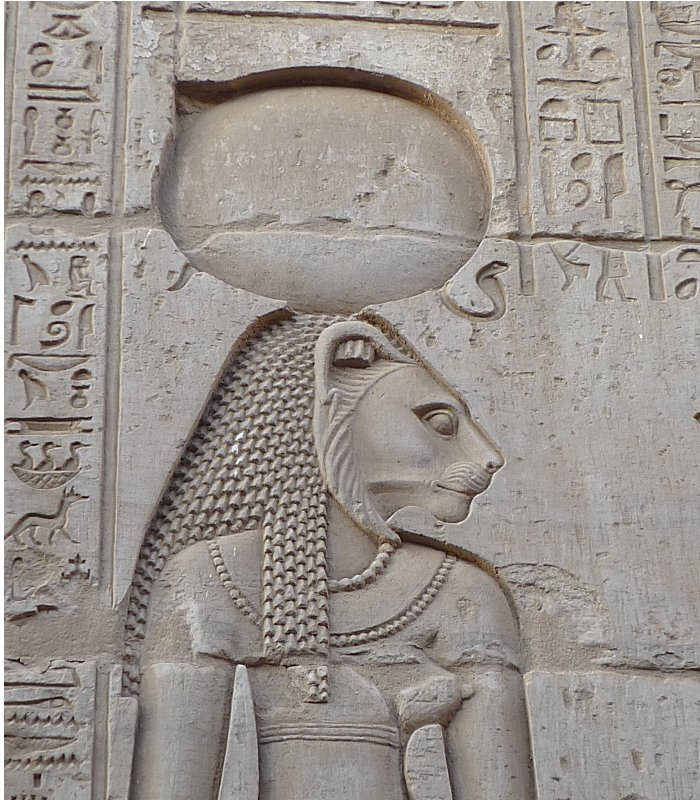
Wall relief of Sekhmet, Kom Ombo Temple, Egypt. Image credit: I, Rémih - CC BY-SA 3.0
Sekhmet was their spirit, present with them everywhere like the hot winds from the desert, which were said to be the "breath of Sekhmet."
Queens, priests, priestesses, and healers called her. Her power and strength were needed everywhere. Sekhmet was "The Incomparable One".
Her personality - often linked with other deities - was very complex. Some researchers suggest that the mysterious Sphinx represents Sekhmet, and many legends and myths say she was present at the time of the creation of our world.
Sekhmet was often closely related to Hathor, a woman with a bovine head, the goddess of love, and the deity of dance, music, and happiness, and linked with Mut, the great mother and queen of the gods and the Theban goddess.
She was known as the goddess with many names; she was, for example, "The Devouring One," "Warrior Goddess," "Lady of Jubilation," "The Beautiful Light," and "Protectress of the Divine Order," "The Beloved of Ptah," just to name a few.
Her main cult center was in Memphis, but she also had many temples in other locations across Egypt.
"It is believed that Amenhotep III (1390-1352) had 730 statues of Sekhmet erected in his mortuary temple in Western Thebes.," write Candace C. Kant and Anne Key in "Heart of the Sun: An Anthology in Exaltation of Sekhmet."
"It is thought that there was one seated and one standing Sekhmet for each day of the year, possibly to soothe Her or to invoke Her protection at the most unstable times of the day, sunrise and sunset…."
These impressive statues were carved from hard, black granite (diorite) and depict the powerful Sekhmet standing or sitting with a papyrus scepter. The rite of "appeasing Sekhmet" was performed by her priests to battle diseases and epidemics. At the same time, she feared that she might be harmed, especially since "the seven arrows of Sekhmet" were believed to bring troubles and bad fortune.
Many spells and small amulets were used for protection against her wrath.
Written by – A. Sutherland AncientPages.com Staff Writer
Updated on February 25, 2024
Copyright © AncientPages.com All rights reserved. This material may not be published, broadcast, rewritten or redistributed in whole or part without the express written permission of AncientPages.com
More From Ancient Pages
-
 Mystery Of The British Pompeii Deepens – Bronze Age Settlement Destroyed By Dramatic Fire
-
 Mysterious 2,000-Year-Old Lost City Of Natounia May Have Been Found!
-
 Ancient Sound Of Stones – Acoustics At Stonehenge Tested By Scientists
-
 House Of Plantagenet – How Hatred, Revenge And Jealousy Transformed History
-
 Death Of Norse God Balder And Loki’s Mischief That Led To Destruction In Ragnarok
-
 Giant Circular Roman Burial Site With No Bones Discovered – Was It A Cenotaph?
-
 Has The Legendary Viking Stronghold Jomsborg Finally Been Found?
-
 Triglav (Trzygłów) – Powerful Three-Headed Slavic God Of Vigilance, Sea Storms Who Supervised Sky, Earth, And Underworld
-
 Proof That Neanderthals Ate Crabs 90,000 Years Ago Is Another ‘Nail In The Coffin’ For Primitive Cave Dweller Stereotypes
-
 Satellite Images Of 66 New Roman Army Sites Show More Clues About One Of The Empire’s Most Infamous Conflicts
-
 Jure Grando – First ‘Real’ Historical Vampire Case Documented
-
 Vast Network Of Previously Unknown European Bronze Age Megastructures Discovered
-
 Crusader-Era Sword Discovered At Previously Unknown Burial Site In Finland
-
 ‘Impossible’ Ancient Egyptian Visit Troubles Historians
-
 Old Cannon Found At Construction Site
-
 DNA From Doggerland That Separates The UK From Europe – New Study
-
 Skulls and inscriptions on three rings found by archaeologists in Wales
-
 Unique Ancient Gold Cloth Found In The Necropolis Of Saint-Pierre-l’Estrier Is The Largest Antique Piece Found To Date
-
 Mysterious People Who Appeared Out Of Nowhere
-
 Cyprus’s Copper Deposits Created One Of The Most Important Trade Hubs Of The Bronze Age

