
Why Was Constantinople Called New Rome?
A. Sutherland - AncientPages.com - Constantinople became a new Rome, and the Emperor Constantine the Great celebrated the inauguration of his new capital city, and the name of the town originates from his name.
In 330 AD, he split the Roman Empire into two parts: Eastern and Western, and the western half centered in Rome while the eastern half centered in Constantinople (City of Constantine).
![Map of Constantinople (1422) by Florentine cartographer Cristoforo Buondelmonti[39] is the oldest surviving map of the city, and the only one that predates the Turkish conquest in 1453.](https://www.ancientpages.com/wp-content/uploads/2020/03/constantinople14.jpg) Map of Constantinople (1422) by Florentine cartographer Cristoforo Buondelmonti is the oldest surviving map of the city and the only one that predates the Turkish conquest in 1453. Source
Map of Constantinople (1422) by Florentine cartographer Cristoforo Buondelmonti is the oldest surviving map of the city and the only one that predates the Turkish conquest in 1453. Source
After restoring the unity of the Empire, Constantine the Great introduced many governmental reforms and increased financial resources for the Christian church.
Then, he identified the site of Byzantium - a small Greek port - as the new center of the Empire and the seat of government, officially known as Nova Roma ('New Rome').
Rome, which had been the capital for over a thousand years, was too far from the frontiers of the Empire, and it might have seemed unimaginable to propose that ancient Rome be moved to another location.
Constantine's dedication of the new city was most probably the most significant moment of his reign. The new capital had a perfect strategic location; it was standing on a piece of land projecting into the Bosphorus, the narrow strait of water dividing two continents: Europe from Asia.
Constantinople could control the major trade routes between these two continents, as well as the passage from the Black Sea to the Mediterranean.
New Coins Struck And Greek And Roman Art Moved To 'Second Rome'
The 'New Rome' (Nova Roma) was built over six years and inaugurated on May 11, 330, and new coins were struck by Constantine I to commemorate the founding of Constantinople.
In many ways, the new city was an almost exact copy of the old and famous eternal city of Rome. Like Rome on the Tiber River, it was also located on seven hills and divided into fourteen administrative districts.

Coin struck by Emperor Constantine I to commemorate the founding of the ‘second Rome.’ Source
However, it was still much to do preparing the new capital's interior. Buildings began to appear in great haste, and Constantine ordered many marbles, columns, and tiles to be transported from Roman temples to the new capital. The best works of Greek and Roman art were used for decorations of streets and squares.
It was essential to give the new city the most impressive look possible. After all, his 'New Rome' was beginning its life as an imperial metropolis.
Many Similarities And One Significant Difference Between Two Rome Cities
The main difference between these two cities was that Constantinople was a Christian city with numerous basilicas and churches. From the beginning, it symbolized the break with Rome's pagan past.
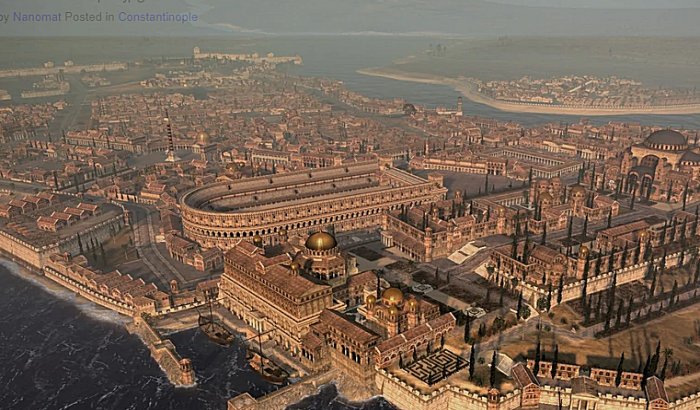
The emperor stimulated private building by promising householders gifts of land from Asiana and Pontica – two of the four major administrative divisions of the Eastern Empire.
On May 18, 332, he announced that, as in Rome, free distributions of food would be made to the citizens, and thus, he encouraged settlement in the city.
Yet, at first, the Empire's new Rome did not have all the dignities of old Rome. It possessed its senate, a proconsul, but no praetors, tribunes, or quaestors authorized to investigate and handle murders.
There was also a lack of several other principal offices responsible for the city's temples, sewers, monuments, aqueducts, and other public works. Soon, however, the 'second Rome' grew prominent, wealthy, and densely populated.
For 1,000 years, under the Byzantine emperors, it was the intellectual, religious, and commercial center of the Greek-speaking world.
Today, Constantinople is Istanbul, the most populous city in Turkey and the country's economic, cultural and historic center, but its old name is still remembered.
Written by – A. Sutherland - AncientPages.com Senior Staff Writer
Copyright © AncientPages.com All rights reserved. This material may not be published, broadcast, rewritten or redistributed in whole or part without the express written permission of AncientPages.com
Expand for referencesReferences:
Norman F. Cantor, Civilization of the Middle Ages
Stephen Turnbull S. and Dennis Peter, The Walls of Constantinople AD 324–1453
More From Ancient Pages
-
 Enigma Of Mount Ararat – Researchers Are Determined To Reveal The Truth To The World
-
 Massive Head Of Hercules Pulled From The Antikythera Shipwreck
-
 Huge Jars Unearthed In Kultepe, Turkey
-
 Human Body Has Gone Through Four Stages Of Evolution – New Study
-
 Strange Mist, Unexplained Vanishings And Other Bizarre Incidents – What Is The Connection?
-
 Odd Ancient Dwellings Of The Snake People – Clues From Biblical Lands – Part 2
-
 Ancient DNA Reveals Origin Of First Bronze Age Civilizations In Europe
-
 Lothal – ‘City of Dead’ – One Of The Most Prominent Ancient Places In Danger To Be Forgotten
-
 Unique Find: Sacred Gate Found At The Minoan Palace Of Archanes In Crete
-
 Scientists Decipher 2,300-Year-Old Chemistry Formulas Revealing Ancient Metallurgy Was More Complex Than Previosuly Thought
-
 Surprising Discovery – Decline Of Classic Maya Cities Is A More Complicated Story Than Previously Thought – Researchers Say
-
 300,000-Year-Old Weapons Reveal Early Humans Were Woodworking Master
-
 Almost Unknown Ancient Greek Text Rewrites History Of Poetry And Song
-
 Francis Drake, Queen’s Pirate And One Of The Founders Of English Naval Force
-
 Fascinating Portable Art From Torre Cave, Gipuzkoa – One Of The Most Complete Specimens From The Entire Iberian Peninsula
-
 Homo Erectus Was Too Lazy And Went Extinct
-
 You Can Visit The Tomb Of Jesus – 3D Virtual Tour Opens Soon
-
 Viking Age Horse Bridle Found Under The Ice 2,000 Meters Above Sea Level
-
 ‘Green’ Saudi Arabia Was Home To A 350,000-Year-Old Human Settlement
-
 Gilded Coffin Of Nedjemankh, Priest Of Ram-God Heryshef Recovered By Egyptian Authorities

