
Sedna: Inuit Goddess Sacrificed By Selfish Father Fearing For His Own Life
A. Sutherland - AncientPages.com - Unlike American Indians, the Inuit people of Canada and Greenland have not in their cultural legacy many mythological stories from the time before the appearance of humans.
The Inuit people believed in the divinity of the sea and all the animals that dwelled in it. In many myths and legends of Arctic culture, Sedna is the highly honored deity and plays an important role, no matter the versions of her story and the diversity of her names given her by different Inuit groups.
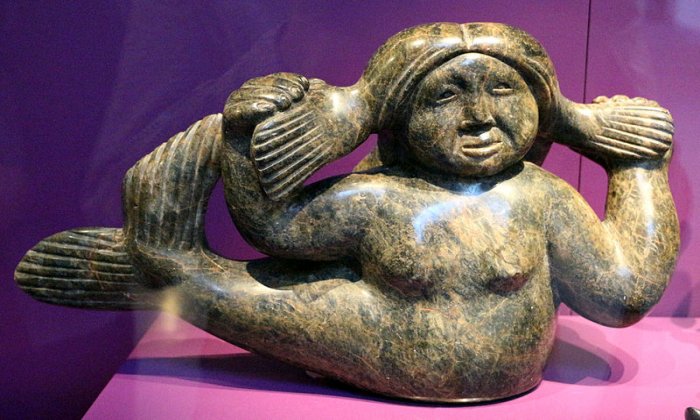 Sculptures in the National Museum of Finland. Image credit: Sailko - CC BY 3.0
Her story was widely distributed in many versions across Canada and Greenland.
In Inuit mythology, Sedna is the daughter of two giants who lived a very long time ago at the beginning of the world. She is a great spirit-goddess also known as the Mother of the Sea or Mistress of the Sea, and the progenitor of all sea creatures. She rules over the sea world, controlling all sea mammals.
Her father, Anguta, created the earth, the sea, and the heavens, while Sedna populated the sea with animals, and so she became the most powerful force in Inuit life.
According to one legend, she was a beautiful maiden, that one day was carried off by a raven, which wanted her to be his bride. In another version, the raven is replaced by a handsome mysterious hunter with an outfit made of furs, and his face was mysteriously covered. Sedna’s father explained that the man wanted a wife his daughter would be a good and capable companion, capable of sewing and cooking. The mysterious man accepted and took Sedna in a boat to their new home, which as the man said, was located on a beautiful island full of huts and people. When they arrived she saw nothing except a few stones, a cliff, and loons. From now on her only food would be raw fish.
For the first time, the man exposed his face, and at that moment Sedna realized that he was a raven (in another version, he was a young loon), who could disguise himself whenever he wanted.
“I used my power to transform myself into a human after I fell in love with you,” said the young loon.
“Otherwise, you would not have come away with me.”
Unhappy to live on the island, after a few days, she began to scream and calling her father, hoping her voice would reach him one day. He finally arrived and took Sedna to her true home.
When Sedna’s loon-husband came home, he wanted to know where his wife was. “Her father came and took her away,” the birds cried. He quickly disguised himself as the human, jumped into his kayak to chase Sedna. In the meantime, after several hours on the sea, they spotted a bird flying in the distance, It was the spirit bird and at that moment, Sedna knew that her husband had found her, using another disguise.
Her father tried to drive him away with the oars but the ocean was becoming more violent, and the man failed. The spirit-bird was seeking revenge, and the old man knew he must appease the angry spirit. There was only one way to satisfy the creature – to throw his daughter overboard into the sea.
Once her father had made this horrible sacrifice, Sedna struggled to keep her head above the water as giant waves washed over her. For a moment she was able to grip the gunwales of her father’s kayak but the old man was so frightened that he cut away her half-frozen fingers.
When at last she was able to grip the gunwales of her father’s kayak, he was seized with fear. “I must do it,” he cried, “the spirit-bird makes the sea angry and demands your life.”
Sedna’s body slowly disappeared beneath the icy waters. Her fingertips became the small fishes and seals; her middle joints – the larger sea animals. Finally, her last joints became walruses and whales.
Her grief-stricken father returned home. The old man lay down on a thick pile of caribou hides inside the little tent, which was his and Sedna’s home for many years. During the night, giant waves of another storm reached the little tent where Sedna’s old father was sleeping. When the last powerful wave returned to the sea that night, it took the old man with it, down to Sedna’s home at the bottom of the sea.
Now, they together live at the bottom of the sea, and Sedna is a great spirit-goddess of the sea. She rules over the sea waters and all the animals that live there and is said to control the weather in the sea. Sedna has the power to either provide or destroy, and reigns over a vast realm where human souls, including her father’s, were imprisoned as punishment after death.
Far back in time, in case of impending hunger, the Arctic shamans often traveled across the sea and went into trance to come down to Adlivun, Sedna’s underwater home, and the Inuit underworld, to negotiate with the goddess and plead with her for food for people. Sometimes, Sedna was angry, denied their requests, and sent them back to the surface.
Next time, when she was in a good mood, she promised that hunters would have food for their families during the harsh winter seasons.
Written by – A. Sutherland - AncientPages.com Senior Staff Writer
Copyright © AncientPages.com All rights reserved. This material may not be published, broadcast, rewritten or redistributed in whole or part without the express written permission of AncientPages.com
More From Ancient Pages
-
 Sightings Of Mysterious Walking Children And Ominous Beings In California’s Cursed Forest
-
 Portus: History Of Ancient Roman Hub Of Commerce – Reconstructed With New Methods
-
 Mysterious Abaj Takalik Of Guatemala And Intriguing Relationship Between Olmec and Maya
-
 Bizarre Towering Pillars Of Externsteine: Myths, Legends And Sacred Rituals From Times Long Gone
-
 65 Byzantine-Era Tombs Unearthed In Stratonikeia – World’s Largest Marble City
-
 Underwater Robot Investigates Edo Period Decorative Tiles Off Shizuoka, Japan
-
 King Khufu’s 4,600-Year-Old Solar Boat Has Been Transported To The Grand Egyptian Museum
-
 Mystery Of The Demon Wall In Sauherad Church Finally Solved
-
 Discovery Of 1500-Year-Old Celestial Observatory Dated To Sassanian Empire
-
 On This Day In History: Battle Of Dormans Was Fought – On October 10, 1575
-
 Unique Page From Rare Illuminated Manuscript And Thousands Of Treasures Found Under The Floor Of Oxburgh Hall
-
 Archimedes From Syracuse – Master Of Science Whose Legacy Still Remains Powerful
-
 Madagascar Cave Art Hints At Ancient Connections Between Africa And Asia
-
 Rare Intact Etruscan Tomb With Remains Of Four Individuals Resting On Carved Stone Beds
-
 Challenging Prehistoric Gender Roles – Women Were Hunters Too – Not Just Men
-
 Sigurd Fafnirsbane – Legendary Dragon Slaying Warrior And His Magical Sword
-
 Ancient Reptilian-Like Humanoids Hold Secrets Of Mankind’s Origin
-
 Uncovering Ancient Secrets Hidden In China’s Dunhuang Caves
-
 Second Gate Of Bazira And Unique Artifacts Discovered In The Ancient City Of Alexander The Great
-
 Thousand year old Pagan warrior tomb discovered in Poland

