AncientPages. com - Unique, prehistoric rock art drawings have been discovered in the Andriamamelo Cave in western Madagascar.
I was part of a team that discovered and described these ancient treasures. They’re the first truly pictorial art, depicting images of nature with human-like and animal-like figures, to be seen on the island. Until recently, rock art in Madagascar had only yielded a few sites with basic symbols.
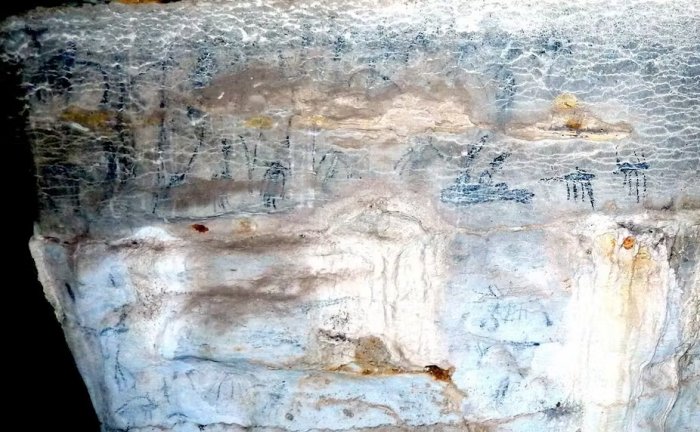
Andriamamelo cave art panel. Image credit: David Burney, Professor of Conservation Paleobiology, National Tropical Botanical Garden, and Adjunct Professor, University of Hawaii
The dramatic discoveries contained several surprises, including hints at some remarkable cultural connections.
First, scenes depicted in some cases linked up fairly directly to Egyptian religious motifs from the Ptolemaic period (300-30 BCE).
Second, other inferences from symbols and writing on the walls showed connections to the Ethiopian and Afro-Arab worlds.
Finally, prevalent symbology and motifs evoked a two-millennia-old cave art style from Borneo.
An additional realm of surprises: at least three extinct animals of Madagascar (thought to have been extinct for many centuries) may be depicted – a giant sloth lemur, elephant birds and a giant tortoise.
It has long been believed – and evidence has confirmed – that the people, language, and culture of Madagascar are rooted in distant ancient connections to Borneo, an island in south-east Asia, combined with strong influences from continental eastern Africa.
However, who the first Malagasy were, when they arrived, and what they did after that, are all hotly debated topics.
Though our findings are speculative, any information that might be derived from the Andriamamelo Cave evidence is of considerable interest to the reconstruction of Malagasy early history.
Connections beyond Madagascar
Our research group – including Malagasy scientists from local institutions, and American, British and Australian specialists – visited the site near the village of Anahidrano on the north-west edge of the 17,100-hectare Beanka protected area in 2013.
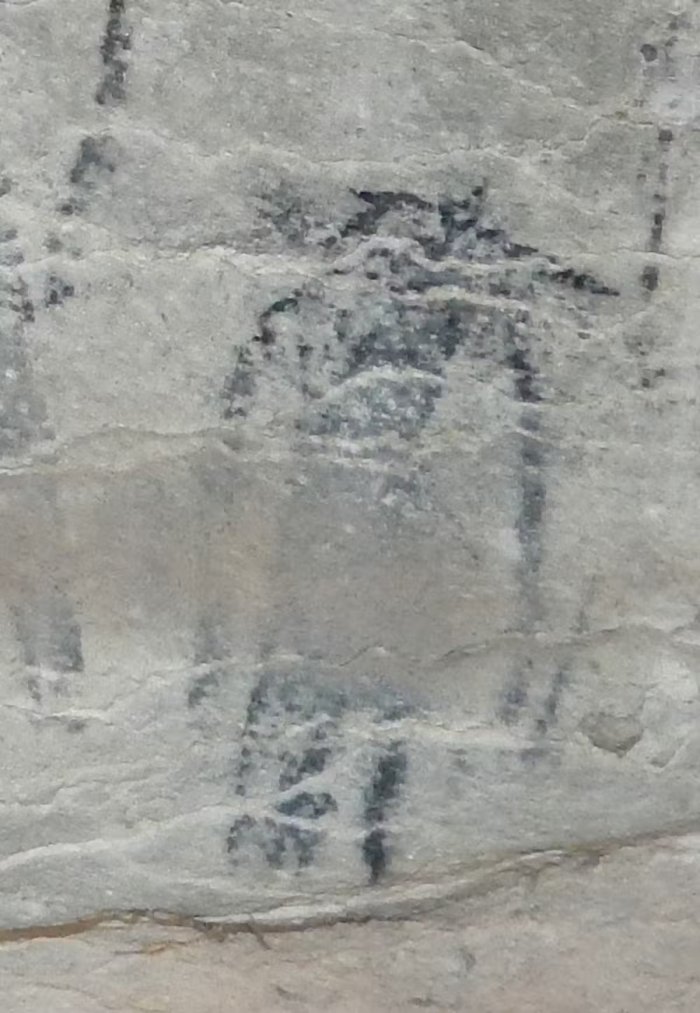
Anubis. Image credit: David Burney, Professor of Conservation Paleobiology, National Tropical Botanical Garden, and Adjunct Professor, University of Hawaii
Our team spent several days recording the images, surveying and mapping the entire cave, searching for associated archaeological sites, and interviewing local villagers regarding the art. It took several years, however, to search through relevant literature and museum archives to confirm the uniqueness and significance of what we’d found.
We made digital copies and hand-drawings of 72 cave-art objects. These were drawn in black pigment and included 16 animals, six human forms, two human-animal hybrid forms, two geometric designs, 16 examples of an M-shaped symbol, and many other patterns and indistinct forms.
Egyptian connections are hinted at in eight major images, including a falcon (Horus); the bird-headed god Thoth; the ostrich goddess Ma`at and two human-animal figures which were similar to Anubis – an ancient Egyptian god usually depicted as a man with a canine head.
The ubiquitous and mysterious M-figures demand explanation: we suggested, after searching many relevant alphabets, that it is a perfect match for only one, the letter “hawt” (?) in the ancient Ethiopian Amharic alphabet, pronounced “ha”.
Surprisingly, though, we also found this symbol in cave art from Borneo thought to be about 2,000 years old, and in no other cave or rock art throughout the Indo-Pacific region. In some Austronesian languages (the diverse language family that extends from Malagasy on the west to distant Hawaii and Rapa Nui in the Pacific), the word “ha” is a term for the “breath of life”.
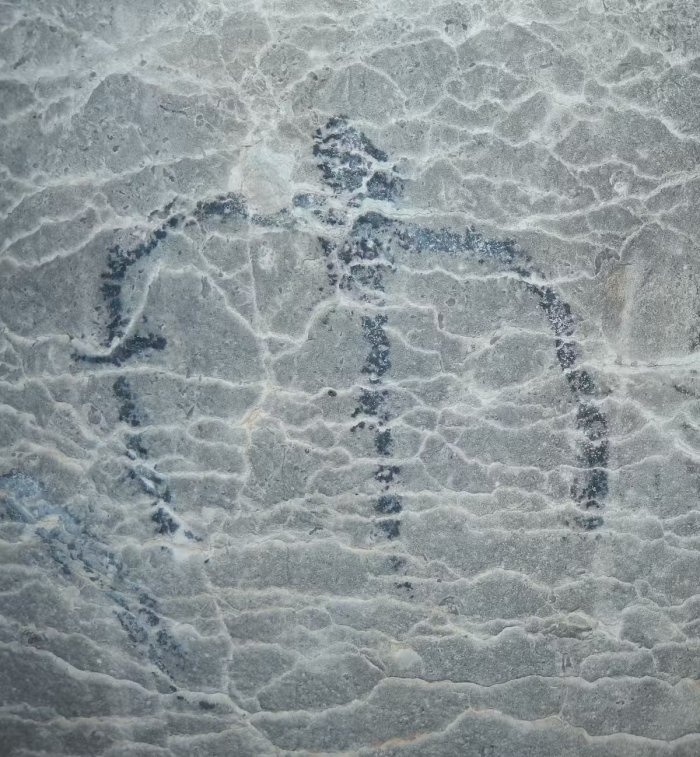
M figure. Image credit: David Burney, Professor of Conservation Paleobiology, National Tropical Botanical Garden, and Adjunct Professor, University of Hawaii
All these possible connections remind us that Madagascar’s people, language, and culture are in themselves syncretic, blending African and Asian influences to produce a unique Malagasy people.
The richly detailed and diverse art is notable also for what it doesn’t show.
No Christian, Muslim or Hindu symbolism is depicted, and no relatively modern motifs such as the Latin alphabet, cars, airplanes or flags. Even the ubiquitous zebu (cattle), the culturally paramount symbol of the last thousand years or more in Madagascar, are absent.
When and whose
It’s hard to know exactly when these drawings were made. Direct dating of cave art is notoriously difficult, and proved so in this case as the black pigment was made from dark inorganic minerals with only a small component of charcoal we could use for radiocarbon dating.
The presence of extinct animals, and the lack of modern motifs and the alphabet used in modern Malagasy, weigh heavily against the notion of a recent origin for the art.
We suspect that the art is about 2,000 years old – dating back to the time of Cleopatra or before, based on the religious motifs. If it is, that is remarkable and useful to know because it may provide evidence for who colonised Madagascar and when.
If, on the other hand, a set of pre-Christian religious beliefs has survived for centuries or even millennia among certain ethnic groups in very remote areas of the immense island – retaining recognisable influences from Egypt, Ethiopia and Borneo – that would be perhaps more remarkable. Village informants hinted at that possibility, by insisting that the “sorcerer” pictured was a member of a mysterious group of “Vazimba” or “Bosy”) who lived in the forest nearby.
So, whose art is this? We wish we knew, but clues are mostly lacking. The only possible writing, besides the M-figures, is a line of faint script in the lower right corner of this rock-art extravaganza.
Our best guess is that the legible middle six of eight characters, inferred to be sorabe, archaic Malagasy writing in Arabic script, may say “D-A-NT-IA-R-K”.
Does that refer to Antiochus IV Epiphanes? This king of the Seleucid Empire (western Asia) in the Ptolemaic period built a large navy, conquered much of Egypt in 170 BCE, and sent exploring and trading expeditions down the Red Sea and the east African coast. Ivory traders in that period spread Roman goods as far south as ports in Tanzania south of Zanzibar, to trade with Azania.
Until more art or relevant archaeological evidence turns up for ancient African and Asian influences in Madagascar, we can only speculate.
Written by , Professor of Conservation Paleobiology, National Tropical Botanical Garden, and Adjunct Professor, University of Hawaii
Provided by The Conversation
This article is republished from The Conversation under a Creative Commons license. Read the original article.