
Monstrous Nomoli Figures Left By Unknown Culture That Vanished Long Ago
A. Sutherland - AncientPages.com - The so-called Nomoli figures were found in Sierra Leone, West Africa.
The Nomoli are mysterious stone figures from 2,500 years to approximately 15,000 BC and even 17,000 BC. They seem to prove the existence of an advanced ancient civilization in West Africa.
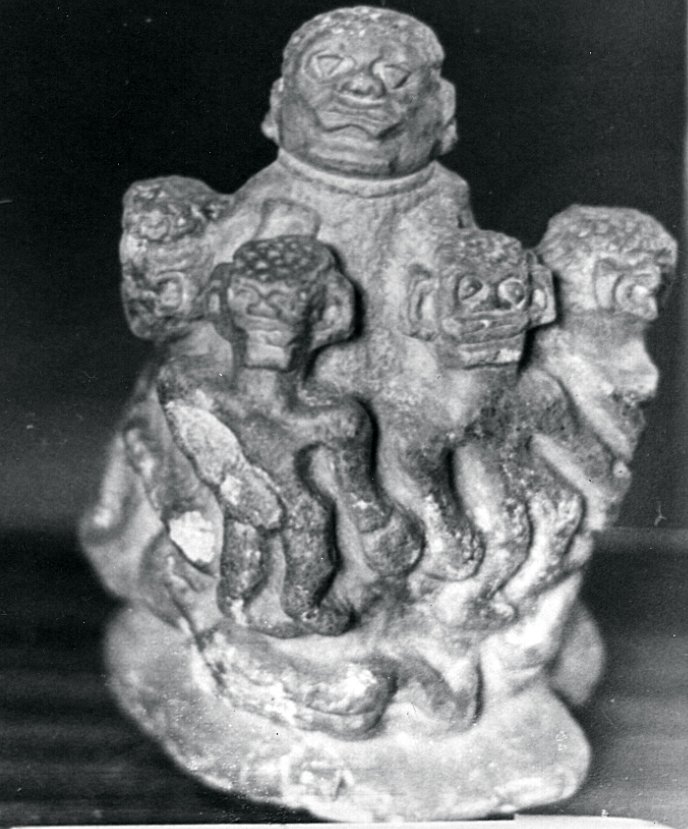
Nomoli (Musée national de Sierra Leone). Image credit: — Soapstone "Nomoli" figure from Sierra Leone (West Africa) - CC BY-SA 2.0
People of Africa also have memories of the giants who once lived on Earth. African legends describe these mighty beings as courageous and strong men with shining eyes, and their voices could be heard from one town to another.
An exciting discovery was made when a small metal ball was found in a hollow space inside the Nomoli figurine.
A legend tells that:
"They wandered without let or hindrance to places where no man had ever been before. One could not look them in the face because their eyes were so bright that it hurt one's own eyes to look at them. It was like looking at the sun."
Another legend says about divine creatures banned from the celestial empire and sent to Earth, which leads us to a representation of the "fallen angels" mentioned by various cultures.
This civilization, capable of reaching very high melting temperatures, also used the right tools for modeling perfectly spherical objects like those found inside the figures.
An analysis by the Museum of Natural History in Vienna, Austria, revealed that it is made from chrome and steel.
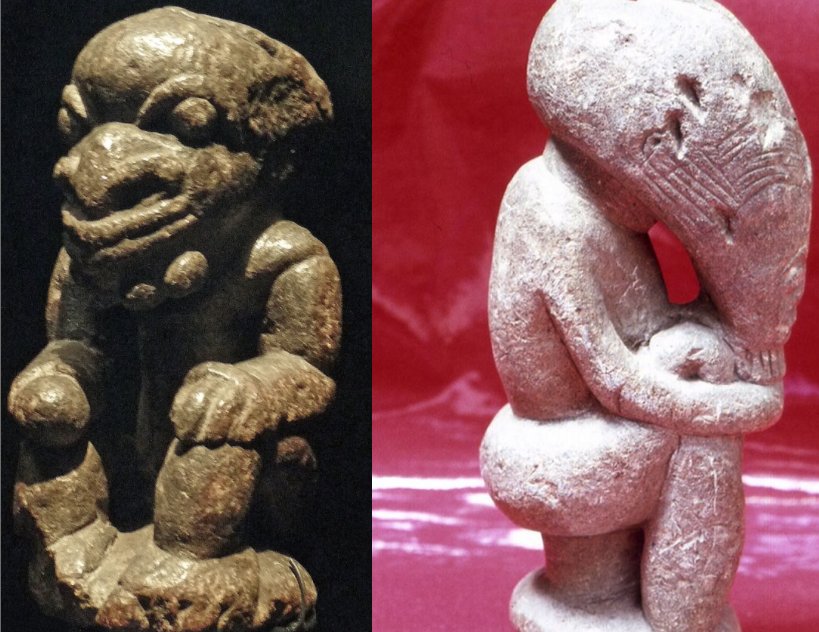
Left: Nomoli people, Mende, Sierra Leone; Right: Nomoli - Soapstone "Nomoli" figure from Sierra Leone (West Africa). Image credit: John Atherton, photo: British Museum, London, June 1970. - CC BY-SA 2.0
The earliest known production of steel is a piece of ironware unearthed in Anatolia (Kaman-Kalehoyuk) and is about 4,000 years old. How did it get there? And much more important - where did the metal come from?
The Somali - some were discovered at depths of 50 meters - depict mostly different human races from the so-called Caucasian to Negroid or their heads. Still, sometimes they resemble semi-human or semi-animal "monsters" and animals like monkeys, leopards, and elephants.
Some figurines depict lizards with human heads, and human figures with heads disproportionate to the rest of the body are usually shown in squatting or kneeling positions; one of the most common depictions represented by the Nomoli is a frightening-looking adult with a child.
Most Nomoli figures were made of soapstone or diverse kinds and colors of steatite, from dark green to light yellow-brown and almost white.

The Michael C. Rockefeller Memorial Collection, Bequest of Nelson A. Rockefeller, 1979 - CC0 1.0
The stone contains a high percentage of iron available in various parts of Sherbro Island in the Atlantic Ocean, located in Bonthe District off the Southern Province of Sierra Leone, West Africa.
Additionally, it is worth mentioning that none of these oral traditions indicates that the territory - now inhabited by the Mende - was previously occupied. It raises some critical questions: were there any earlier inhabitants?
Who were they? And what happened to them? Some scholars claim that these earlier inhabitants were the manufacturers of the mysterious Nomoli figurines carved in soapstone and found throughout the area now inhabited by the Mende people.
Those who sculpted the Nomoli figurines probably once occupied much of the present-day territory of the Mende, but according to ancient sources, they were pushed coastward.
Written by – A. Sutherland - AncientPages.com Senior Staff Writer
Updated on March 9, 2023
Copyright © AncientPages.com All rights reserved. This material may not be published, broadcast, rewritten or redistributed in whole or part without the express written permission of AncientPages.com
Expand for referencesReferences:
Basil Davidson, The African Genius
British Museum, London
More From Ancient Pages
-
 Mystery Of The Lost Underground City Of The Grand Canyon
-
 Ruins Of The Ancient City Of Palmyra Documented – What Remains After The Fall Of The Assad Regime
-
 Magnificent Chamber Graves Of Four Scandinavian Warriors Discovered In Poland – The Piast Dynasty In New Light
-
 Discovery Of Second Viking Site Point Rosee In North America Could Re-Write Ancient History
-
 Faces Of Queen Nefertiti And King Akhenaten Reconstructed Using Artificial Intelligence
-
 Strange Ancient Sky Phenomenon – It Was Not A ‘Natural’ Space Object – Scientist Said
-
 Ancient Hittite Temple Dedicated To The Goddess Of Night To Be Unearthed
-
 Non-Tobacco Plant Identified In Ancient Pipe Using New Technology
-
 On This Day In History: Ferdinand Magellan Reached Pacific And South American Strait – On Nov 28, 1520
-
 Ancient Mysteries In The Amazon Jungle – Strange White Men With Glowing Eyes – Part 1
-
 Ancient Mothers Cared For Kids Better Than Previously Thought
-
 On This Day In History: King Louis XVI Of France Was Put On Trial For Treason – On Dec 11, 1792
-
 Ancient Bizarre Experiments Conducted In Mysterious Underground Temple
-
 Vedic God Indra: Ruler Of Heavens And Tough Warrior Who Kills Evil Serpent Vritra
-
 Seven Fires Prophecy Of The Anishinaabe People And The Future Of The Turtle Island – Are Humans Standing At The Crossroads?
-
 On This Day In History: Mathematician And Astronomer Simon Marius Independently Rediscovered Andromeda Galaxy – On Dec 15, 1612
-
 Ancient DNA Reveals Surprising Stories About Migrations And Genetic Mixing Of Our Ancestors
-
 Tower Of Babel Story As Told By The Choctaw Indians And The Cherokee
-
 On This Day In History: Army Of Tsar Alexander I Of Russia Enters Paris – On March 31, 1814
-
 Unknown Aspect Of Human Evolution Discovered Through Ancient DNA Study

