
Amanirenas – Fearless Queen Of Kush Who Defeated Ancient Romans
Ellen Lloyd - AncientPages.com - She was blind in one eye. but it didn’t stop her from gathering an army and attacking Roman Egypt.
The conflict between her kingdom and Romans had lasted for five years, and it was time to end something about it, turning the outcome of the war in her favor. So, when the time was right, she made a decision and launched an attack on Egypt.
Who Was Queen Amanirenas?
Amanirenas was a courageous one-eyed queen of Kush who ruled from approximately 40 BC to 10 BC.
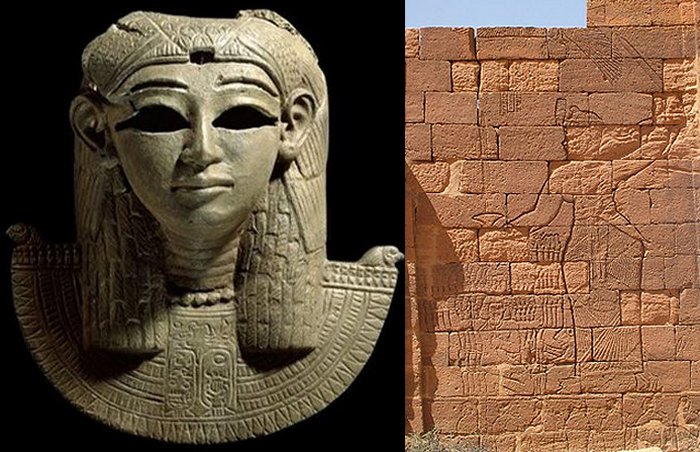
Left: Queen Amanirenas. Credit: solarey.net - Right: Wall relief of Queen Amanirenas. Credit: egyptsearch.com
Kush was an ancient kingdom in Nubia, located between the Sudanese and southern Egyptian Nile Valley. This beautiful kingdom has been greatly overshadowed by Egypt and its magnificent buildings, famous pharaohs, and astonishing ancient artifacts unearthed in the land of the pyramids. However, in ancient times, there was also a sophisticated civilization living in the kingdom of Nubia.
As we mentioned in another article published on Ancient Pages, “there are many pyramids in Sudan or even more than in Egypt but they cannot be compared with those of Egypt in magnitude, though they are much more artistic.”
There are more than two hundred pyramids at the site of Meroe, the southern capital of the Napata and Meroitic kingdom. Meroe flourished between 800 BCE – c. 350 CE.
Unfortunately, only ruins remain of these once splendid pyramids, and today the ancient kingdom of Nubia is almost forgotten by history and neglected by archaeology.
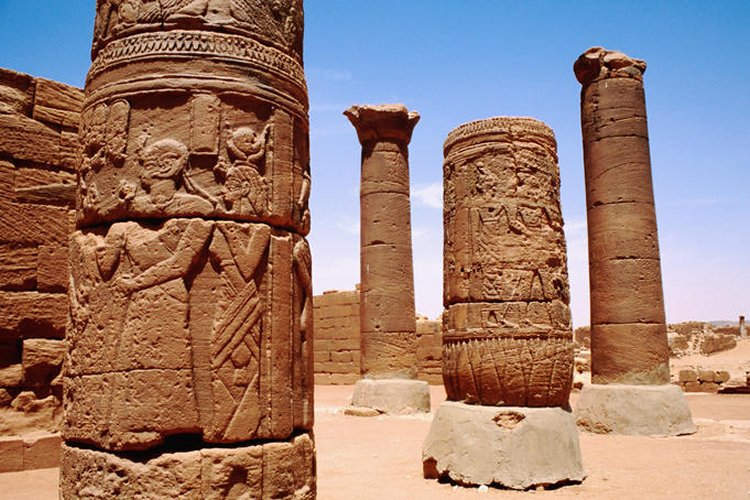
After 308 BC, the Nubian kings also began to build the first pyramids at the cemetery of Meroe, located between the 5th and 6th cataracts.
Amanirenas, who was a famous Kandake, a term used for "queen" or possibly "royal woman" ruled during the Meroitic period, a culture developed that from the Twenty-fifth Dynasty of ancient Egypt, which originated in Kush. During her reign, there was an ongoing conflict with Romans who were in control of Egypt. Her husband had died in a battle and she fought the Romans with the help of her son.
On September 2, 31 B.C, the fleet of Roman Mark Antony and Cleopatra, queen of Egypt met the fleet of Octavian leader, Emperor Augustus. This historical event is known as the battle of Actium.
The fleet of Antony and Cleopatra was defeated and the toe of them fled. Octavian executed Cleopatra’s son, Caesarion, and annexed Egypt into the Roman Empire.
The Kushite Army Attack Ancient Romans
Kush was a much smaller kingdom than Roman Egypt. Queen Amanirenas and her army used the element of surprise when they launched their first attack. They waited until Aelius Gallus, the Prefect was away on a campaign and then, they struck. The Kushites captured two major Roman cities, Syene and Philae, they took captives and expanded their borders.
As a trophy, her army returned with a bronze depiction of Augustus' head, the soldiers had taken from a statue of the Roman emperor. This was a trophy Queen Amanirenas appreciated. According to Neil MacGregor author of the book A History of the World in 100 Objects, she took it and “buried the severed head of the glorious Augustus beneath the steps of a temple dedicated to victory.” The British Museum is now in possession of the artifact.

The Head of Emperor Augustus was brought back and hidden beneath a temple in Nubia. Credit: Wikipedia, CC BY 2.5
However, Queen Amanirenas and her Kushite warriors could not enjoy a long period of glory. The next year, they were driven out of Syene by the new Roman Prefect Gaius Petronius.
Petronius was annoyed and didn’t appreciate being constantly threatened by the Kushites. Emperor Augustus was furious and ordered the Roman army to take control of the rivaling kingdom. Petronius’ army pushed far into the Kingdom of Kush until they finally reached Napata, an ancient city founded by Tuthmosis III in the 15th century BC after his conquest of Nubia.
The Romans took thousands of Nubians and sold them as slaves. Much of Napata was destroyed and there were many casualties. But Queen Amanirenas had no intentions of surrendering to the Romans.
Needless to say, that the Kushites and the Romans clashed again, but this time, Petronius was better prepared when Queen Amanirenas and her forces attempted to seize Primis. The Kushites failed and instead of fighting the two parties started to negotiate. In time, they reached an agreement that was beneficial to them both and a peace treaty was signed in the year 21/20 B.C. The Kushites had not much to complain about. The Romans left Primis and the Meroites were exempted from having to pay tribute to the Emperor.
As a result of this agreement, the relationship between Roman and Kush remained peaceful for a long time. Queen Amanirenas’ fight with the Romans lasted five years, but that time was never wasted.
One can say that by not giving up, Queen forced the Romans to reconsider their situation and re-evaluate their position in the region.
Of course, Queen Amanirenas was not the only fierce female warrior in Nubia. Queen Amanishakheto defeated a Roman Army sent by Roman Emperor Augustus.
Women were very powerful in the kingdom of Nubia. As mentioned in our earlier article, Amanitore, for example, was also a warrior queen, like her mother, grandmother, great-grandmother, and so on, before her.
History has shown that Nubian queens were not afraid of war nor were they easily intimidated.
Written by Ellen Lloyd – AncientPages.com
Copyright © AncientPages.com All rights reserved. This material may not be published, broadcast, rewritten or redistributed in whole or part without the express written permission of AncientPages.com
Expand for referencesNeil MacGregor - A History of the World in 100 Objects
László Török - The Kingdom of Kush: Handbook of the Napatan-Meriotic Civilization
More From Ancient Pages
-
 Tomb Of Christopher Columbus Finally Found But There Is One Problem With His Body
-
 2,250-Year-Old Iron Age Settlement Discovered Near Upton-Upon-Severn
-
 Amazing Photos Of Ancient Ruins Hidden Under Thessaloniki Metro Revealed By Archaeologists
-
 A 1,500-Year-Old Holy Well Probably With Healing Water – Discovered In Bulgaria
-
 Bastet: Protector And Punisher – She Was Among The Most Majestic Egyptian Deities
-
 Excavations Reveal Massive Building And Invaluable Ceramics In Ancient City Of Poseidonia
-
 Mediterranean Hunter-Gatherers Relied On Marine Resources More Than Previously Thought
-
 Why Pharaoh Seti I’s Tomb Had To Be The Most Glorious And Largest Ever Built In Valley Of The Kings
-
 Modern Humans Carrying The Neanderthal Variant Have Less Protection Against Oxidative Stress
-
 Anglo-Saxon Warlord’s Grave: Archaeologists And Metal-Detectorists Work Together
-
 Remarkable Discovery Of A 19th-Century Boat Buried Under A Road In St. Augustine, Florida
-
 ‘Armenian Stonehenge’: 30 Unknown Stones In Carahunge Complex – Surveyed
-
 Evidence Of An Ancient Roman Oracle Cult Found In Ostia, Italy
-
 31,000-Year-Old Skeleton Missing Foot May Show Oldest Amputation
-
 Treasure Hoard Of Rare Gold Coins From The Crusader Conquest Discovered In Caesarea, Israel
-
 ‘Umeda Graves’ Dated To Edo Period Discovered At Osaka, Japan
-
 Imet: A Long-Forgotten Ancient City In Egypt’s Eastern Nile Delta – Discovered
-
 Map Of Hidden NT Landscape Where First Australians Lived More Than 60,000 Years Ago
-
 Graves Dated To Achaemenid Or Parthian Empire – Found In Iran
-
 Mysterious 11,000 – Year-Old Tower Of Jericho: Was World’s First Skycraper A Symbol Of Power Or An Ancient Time-Keeping Device?

