
Cerberus – Giant Multi-Headed Dog Guards The Underworld Of God Hades In Greek Mythology
Ellen Lloyd - AncientPages.com - Cerberus is a famous monster in Greek mythology. Often described as a giant three-headed dog, Cerberus guards the gates of the Greek underworld, ensuring that no one escapes from the realm of Hades, the god of the dead and the king of the underworld.
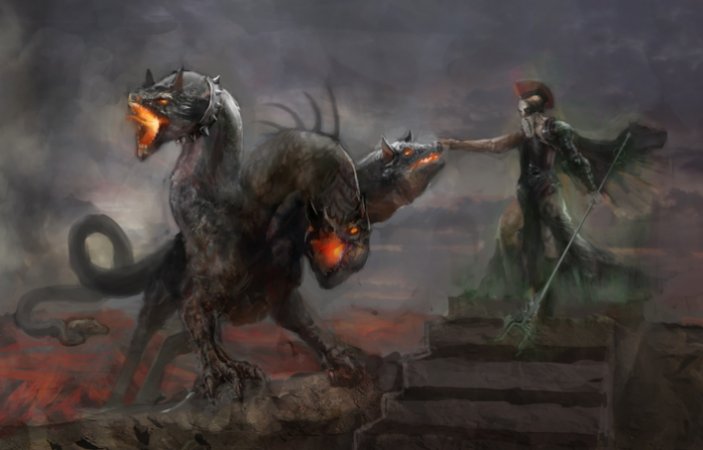
Cerberus guarded the underworld, the realm of God Hades. Credit: Stock photo
Stories of Cerberus are mentioned in both Greek and Roman mythology. The depiction of this multi-headed creature depends on the ancient source material. In most cases, Cerberus is described as having three heads, a serpent for a tail, and snakes protruding from parts of his body. Each of the heads is uglier than the other. In some myths, the three heads represent the past, present, and future.
Multi-headed animals are often encountered in ancient myths and legends. In Hindu mythology, for example, we learn about the legendary Uchchaihshravas, a divine, seven-headed flying horse of God Indra. However, in other ancient accounts, such as Hesiod's Theogony, Cerberus has as many as 50 heads, and Pindar (c. 522 – c. 443 BC), an ancient Greek poet from Thebes, gave the monster as many as 100 heads.
Cerberus Predates Ancient Greek Gods And Goddesses
There are many myths about Cerberus, and this guardian dog is mentioned in the Orpheus legend and the 12th labor of Hercules.
As a primordial being predating the Greek gods and goddesses, Cerberus is a unique creature in Greek mythology. According to some Greek myths, Cerberus is associated with Hydra. Cerberus was said to be the offspring of Echidna and the snake-bodied Typhon.
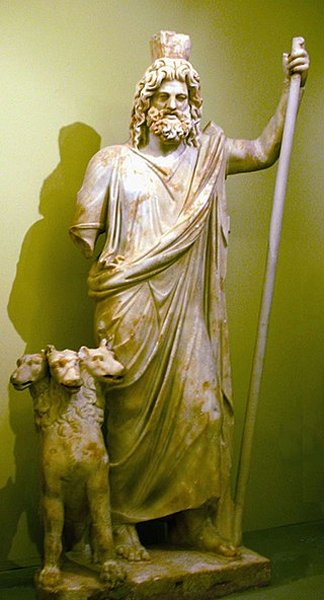
Cerberus and Hades/Serapis. Heraklion Archaeological Museum, Crete, Greece. Credit: Wikipedia, CC BY 3.0
According to Theogony 313, the Hydra is the child of Typhon and Echidna. The characteristic of the Hydra was that if someone cut off one of its heads, it would grow back. The Hydra also had extraordinary teeth that could raise skeletons from the dead.
Cerberus As Guard Dog Of The Underworld
Though described as a monster, Cerberus was undoubtedly dangerous and attacked everyone except spirits, but he was a watchdog and only performed his duty.
"Cerberus' saliva was exceedingly toxic; wherever it fell upon the ground, it would cause aconite to spring. Newcomers were advised to carry baklava (honey cakes) with them as they entered the underworld, as Cerberus would spitefully bite the shades as they entered," Theresa Bane wrote in her book Encyclopedia of Beasts and Monsters in Myth, Legend, and Folklore.
It was almost impossible to pass through the gates to the underworld because Cerberus savagely consumed anyone trying to do so. His job was to prevent everyone from returning to the land of the living. As described earlier in Ancient Pages, Orpheus defeated death, descended into the underground kingdom, and left it alive. Determined to bring back his beloved bride, Eurydice, who had stepped on a poisonous snake whose venom killed her, Orpheus courageously entered the realm of Hades, carrying only his lyre. When Orpheus encountered Cerberus, he started to play on his lyre, and the dog fell asleep.
Cerberus closed his six eyes and dreamt of another life when he had been a real dog. He recalled days before being captured and trained to work as a guardian for the dead in his dreams. While Cerberus was sleeping, Orpheus passed over him and descended to the underworld.

Cerberus, with the gluttons in Dante's Third Circle of Hell. Credit: William Blake, Wikipedia
Cerberus lay down, closed his six eyes, lolled his three tongues, and went to sleep to dream of the days he had been a real dog before being captured and changed and trained as a sentinel for the dead. Orpheus stepped over him and went through the gates.
In Virgil's Aeneid, the hero Aeneas did something similar. He put Cerberus to sleep by giving him drugged cookies. Heracles also managed to pass Hellhound, but only by using force.
Cerberus In Art And Literature
The memory of this Hellhound has been long-lived—the earliest depiction of the Greek monster dog dates from the sixth century BC. On a Corinthian cup (c. 590–580 BC) from Argos, Cerberus is depicted with just one head and snakes rising from his head and body. The Hellhound is sometimes seen in Roman art with a large central lion head and two smaller dog heads on either side.
Cerberus is presented as a vicious creature that rips, rends, and flays the souls around him with his teeth and claws. In Dante's Inferno, Cerberus is mentioned in the Third Circle of Hell. There, he is the guardian and keeper of the Circle of Gluttony.
Sir Arthur Conan Doyle's famous Hound of the Baskervilles and Stephen King's rabid St. Bernard, Cujo, also remind us of the legendary ancient Greek hellhound Cerberus that the future generations have never forgotten.
Updated on February 6, 2024
Written by Ellen Lloyd – AncientPages.com
Copyright © AncientPages.com All rights reserved. This material may not be published, broadcast, rewritten or redistributed in whole or part without the express written permission of AncientPages.com
Expand for referencesMore From Ancient Pages
-
 On This Day In History: Vlad II Known As Vlad Dracul (‘Vlad The Dragon’) Was Born – On August 30, 1400
-
 Strange Tuxtla Statuette And Its Undeciphered Inscription – An Epi-Olmec Puzzle
-
 Controversial Unexplained Ancient Mystery In Mongolia – Horrifying Sight – Part 2
-
 Axum: Mysterious Megalithic Towering Obelisks In Ethiopia
-
 Ancient Secrets Of John Dee And The Enochian Apocalypse Examined
-
 Why We Celebrate Saint Lucy’s Day – The Bringer Of Light And Patron Of The Blind
-
 Mystery Of The Hidden Shoes Discovered In Ancient European Houses – What Is Behind This Bizarre Tradition?
-
 Aurelian Walls Built By Emperor Aurelian Who Tried To Lead Roman Empire Out Of The Crisis
-
 On This Day In History: Earthquake In Pompeii, Italy Occurred – On Feb 5, 62 AD
-
 How Ancient Seascapes Shaped The Genetic Structure Of European Populations
-
 Longest European Burial Mound Pre-Dating The Egyptian Pyramids Discovered In Czechia
-
 Face Of Very Old “Vampire” Buried In Connecticut Reconstructed
-
 Baffling Unexplained ‘Alien’ Condition – Evidence Of Unknown DNA?
-
 Stunning Well-Preserved Larger Than Life Statue Of Hercules Discovered In Philippi, Greece
-
 Earliest Evidence Of Humans Using Fire To Shape The Landscape Of Tasmania
-
 Ancient Race Of Star Worshippers And Secret Message Stored In Unusual Monument
-
 Magical Ring Of Gyges And Its Power To Be Invisible At Will
-
 First Time A Meteorite Killed A Person In Known History Revealed In Old Documents
-
 3,000-Year-Old Female Statue Unearthed In Turkey
-
 Why Did King Solomon Hide Advanced Technology In A Secret Place? – The Great Deception – Part 2

