
Axum: Mysterious Megalithic Towering Obelisks In Ethiopia
A. Sutherland - AncientPages.com - The Kingdom of Aksum (Axum), also widely known as the Aksumite Empire, was an ancient civilization developed in one of the oldest continuously inhabited parts of the world – Ethiopia.
Many ancient references to this remarkable kingdom can be found in the famous works of Homer and Herodotus.

The Aksumite Empire, which existed from about 100 to 940 AD and had its height about 1st century AD, was a place of commerce and participated in trade contacts between the Roman Empire and ancient India.
The Aksumites controlled the entire region south of the Levant.
In her book 'Ethiopia - Culture Smart: The Essential Guide to Customs & Culture,' Sarah Howard writes:
"...Signs of the first civilization in the area appeared halfway through the first millennium BCE. The stone palaces and buildings at Yeha, twenty miles north of Axum, along with numerous other sites, reveal a rich culture very similar to that in Saba, southern Arabia, in their religion, language, and architecture.
By 300 BCE, the Kingdom of Axum was born—a rich trading nation with a foot on both sides of the Red Sea, routes to Egypt both inland and by the Red Sea, and trails to the south, where valuable commodities could be obtained.

Axum's obelisk- a false door. Image credit: jammingglobal.com
The Axumites spoke a Semitic language similar to the liturgical language of Ge'ez, which they originally wrote in a Sabaean script; they worshipped many gods with Sabaean names, also identified with Greek gods, and they minted coins.
They built impressive stone palaces and erected tall stone stelae (pillars, or vertical tablets)—one of them, at 520 tons and 108 feet (33 meters) high, is the largest stone object known to have been worked by men...."
The region the Aksumites inhabited was relatively remote. This location prevented them from conquest, in contrast to other civilizations in Mesopotamia and the Near East located at the crossroads of Asia, Europe, and Africa and surrounded by several competing and often dangerous states.
The Aksumites developed a high level of craftsmanship and were the only African culture credited for minting coins, mining precious metals, and producing unique artifacts and pottery.
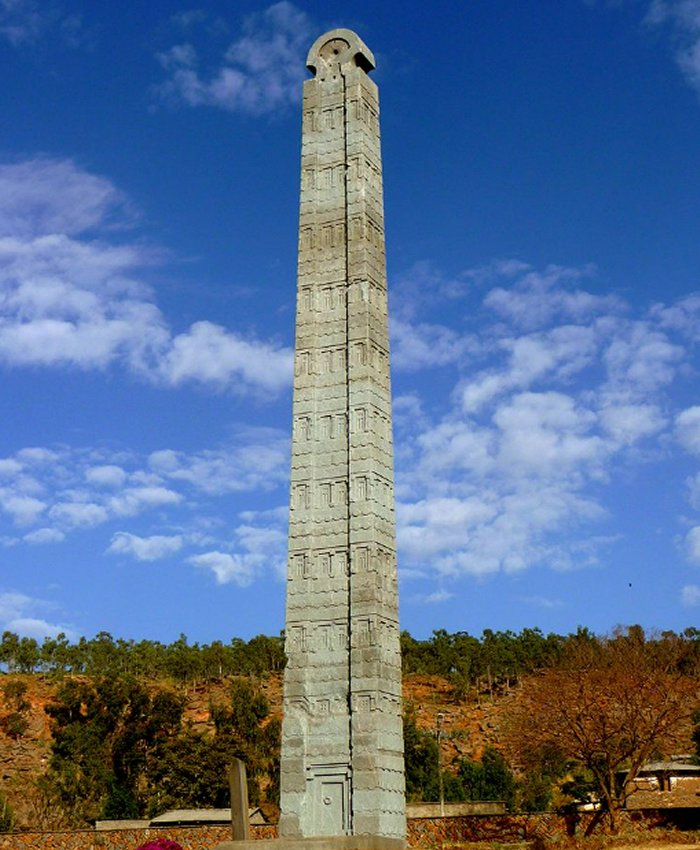
The Rome Stele (also known as the Aksum Obelisk) in Aksum (Tigray Region, Ethiopia). Image credit: Ondrej Zvacek - CC BY 2.5
These ancient people also created their alphabet. However, one of their most prominent achievements is creating magnificent and gigantic obelisks honoring the kingdom's emperors. The central towering obelisk of Axum is believed to be 1,700 years old.
It is made of granite and weighs 160 tons. Its ornamentation consists of two false doors at the monument's base and a window-like decoration on the obelisk's all sides.
These gigantic structures - skillfully fastened beneath the ground – were meant to symbolize the prosperity of the great civilization that prospered for a millennium. They may have also been created for religious purposes before Christianity appeared in the region.
The erection of such enormous and perfectly cut monuments must have been difficult for their builders. Could the Aksumites be credited for this impressive job, as they are credited for mining metals, minting coins, and making pottery?
Could the obelisks, at least some of them, be much older and precede the existence of the Aksumite Empire?
Written by – A. Sutherland AncientPages.com Staff Writer
Updated on December 08, 2022
Copyright © AncientPages.com All rights reserved. This material may not be published, broadcast, rewritten or redistributed in whole or part without the express written permission of AncientPages.com
Expand for referencesReferences:
Howard S. 'Ethiopia - Culture Smart: The Essential Guide to Customs & Culture
More From Ancient Pages
-
 Home Of Jesus’ Apostles Found In The Lost Biblical Town Bethsaida
-
 This Lunar Year Will Be The Year Of The Rabbit Or The Year Of The Cat, Depending On Where You Live
-
 Three Fun Paradoxes Created By Ancient Greek Philosophers To Puzzle Over
-
 Middle Iron Age And Roman Period Buildings And Relics Discovered In Bedfordshire, UK
-
 Hayk – Legendary Patriarch And Founder Of Armenia Who Defeated King Bel Of Babylon
-
 LIDAR Discovery Of Ancient City With 10,000 Mounds On The Pacific Island Of Tongatapu
-
 Mysterious Water Indians: Brotherhood Of Semi-Divine Beings Described As Half Men And Half Fish
-
 Ancient Copper Ingots Are Unlocking Iron Age Secrets
-
 New Discoveries In Underwater Excavations Of Sunken Cities Of Canopus and Heracleion
-
 Curious Ancient Prairie Mystery In Washington Scientists Cannot Solve – Maybe You Have An Idea What Happened?
-
 Mysterious Mermaid Mummy Investigated By Scientists
-
 Unexpected Discovery Of Secret Underground Chamber Reveals Mysterious Neo-Assyrian Rock Panel
-
 Is The Tomb Of Genghis Khan Hidden And Protected In The Khentii Mountains Because Some Fear It’s Cursed?
-
 Secrets Of The Gods – Why The Papyrus Of Manetho And His Pre-Dynastic King List Upset Egyptologists
-
 Ancient Secrets Of John Dee And The Enochian Apocalypse Examined
-
 Fascinating Accounts Of Incredible Vehicles, Cosmic Cities In Vedic Literature
-
 Did The Viking Blood Eagle Ritual Ever Happen Or Was It A Misunderstood Story?
-
 Creepy And Unusual Ancient Skull Found In Small Crypt Investigated By Scientists But Can They Solve The Mystery?
-
 Sacred Ancient Texts Reveal Who Really Aligned The Oldest Monuments To The Stars
-
 Sumerian Clay Brick With Inscription In Honor Of God Enki Returns To Iraq

