
Long History Records Of Medicine In Mesopotamia And Sumer
A. Sutherland - AncientPages.com - Medicine has a long history in the Middle and Near East. The earliest known medical records go back to the ancient Mesopotamia and begin in Sumer about 3,000 BC.
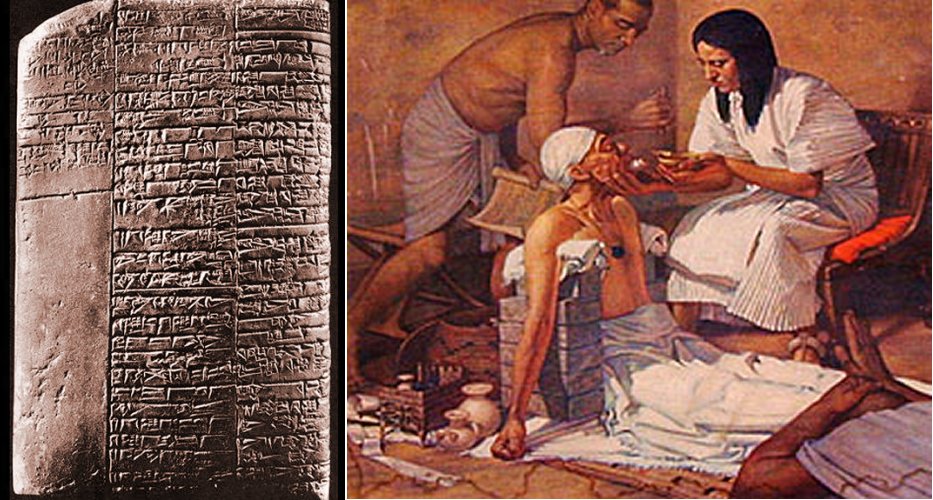
Left: Sumerian medical clay tablet - Medical clay tablet from Nippur dated to about 2200 BC is considered the oldest known Sumerian medical book. 2200 BC. Source: Samuel N. Kramer, History begins at Sumer; Right: Treatment of a patient.
Among the more than 30,000 surviving cuneiform tablets, approximately a thousand of them deal with medicine and medical practices of the Sumerians.
Many of the tablets comes from the ancient city of Uruk (2,500 BC) but most of this knowledge recorded on more than 600 tablets, comes from the famous library of Ashurbanipal at Nineveh (668 BC), Assyria.
The “Treatise of Medical Diagnosis and Prognoses” is one of the largest and the oldest (around 1,600 BC) sources recorded on 40 tablets collected and studied by the French scholar R. Labat.
It contains a mixture of several centuries of Mesopotamian medical knowledge of pediatrics, gynecology and convulsive disorders, neurology, skin diseases, fevers and many more, with descriptions of accurately observed symptoms. Some of the treatments (such as certain bleedings) can be easily compared to those applied even today.
The Greek historian Herodotus in the fifth century BC claimed that the Babylonians had no physicians and this claim is definitely incorrect.
See also:
Hammurabi: Great King Of Babylon And His Code Of Justice
Shamash: Mesopotamian God Of Sun, Truth, Justice And Healing
Assyrian King Ashurbanipal’s Great Library With Thousands Of Cuneiform Tablets
Nippur – Holy City Of God Enlil And One Of The Oldest Cities Of Sumer
The existence of a profession of medicine is well attested throughout Mesopotamian history including the famous ‘Laws of Hammurabi of Babylon’ regulating the practice of medicine, fixing medical fees, and the penalties for failure, which were severe.
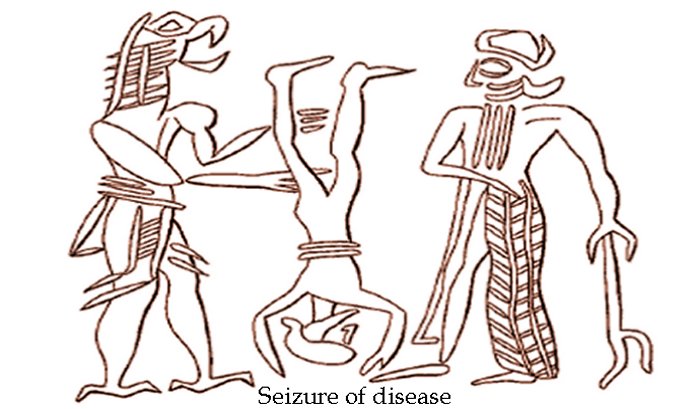
God of underworld, Nergal instructs a lion-demon in the punishment of a sinner; it’s a graphic interpretation of seizure of disease from a cylinder seal of the Old Babylonian Period.
'.. A doctor was to be held responsible for surgical errors and failures. Since the laws only mention liability in connection with “the use of a knife,” it can be assumed that doctors in Hammurabi’s kingdom were not liable for any non-surgical mistakes or failed attempts to cure an ailment. […] both the successful surgeon's compensation and the failed surgeon’s liability were determined by the status of his patient.
‘… if a surgeon operated and saved the life of a person of high status, the patient was to pay ten shekels of silver. If the surgeon saved the life of a slave, he only received two shekels. However, if a person of high status died as a result of surgery, the surgeon risked having his hand cut off. While if a slave died from receiving surgical treatment, the surgeon only had to pay to replace the slave..."
There were two kinds of doctors: the Asu - herbal practitioner skilled in using minerals and a variety of resins, spices and plants with antibiotic and/or antiseptic properties.
The medical library of Ashurbanipal, for example, had lists of more than 250 vegetable substances and over 120 minerals substances with ascribed medical properties and how they have been used to treat certain illnesses.
Asu treated wounds by washing, bandaging and creating the first plaster derived from a mixture of medical and herbal ingredients, which were very important for medical treatment.
Another doctor was the Asipu (Ashipu) - a healer who had to determine which god or demon was causing the patience’s illness and whether the illness was the result of some error or sin of the patient. Diverse spells and charms were usually prescribed by the Asipu.
There were also specialized surgeons with medical background and veterinarians (who also could be either Asu or Asipu). Dentistry was practiced by both kinds of doctors and both may have also assisted at births.
The doctors used a physical examination of the patient and checked temperature, pulse and reflexes. All medicines in Mesopotamia were made by women.
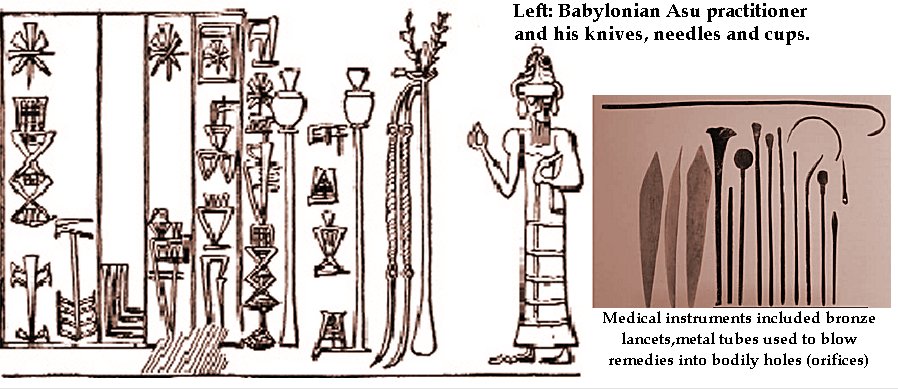
A practical knowledge of many herbal remedies, as well as some surgical knowledge existed in ancient Mesopotamia; the causes of diseases were not entirely understood.
The Sumerians believed that not only the people but also the gods could be ill and the Sumerian writings mention the case of the chief physician, god Enki and his disease treated by the goddess Ninhursag.
Among ordinary people, many diseases were often ascribed to the work of gods, demons and had names such as 'the hand of a ghost’, ‘the hand of god’, 'the hand of Istar’ (Inana)', 'the hand of Samas (Utu)' or ‘the hand of the demon Lamashtu is upon her’. Lamashtu, was an awful she-demon of disease and death and the daughter of the supreme god Anu,
Certain demons and evil spirits acted as the representatives of gods, for the punishment of sin.
Especially illnesses, which could today be regarded as ‘psychological’ were considered as the world of demons or result of sorcery.
Later, the Babylonians made several advances in medicine. They recorded medical history of the patients in order to diagnose to be able to diagnose and treat illnesses. Diverse pills, creams and herbal mixtures based on syrup and honey, were widely used.
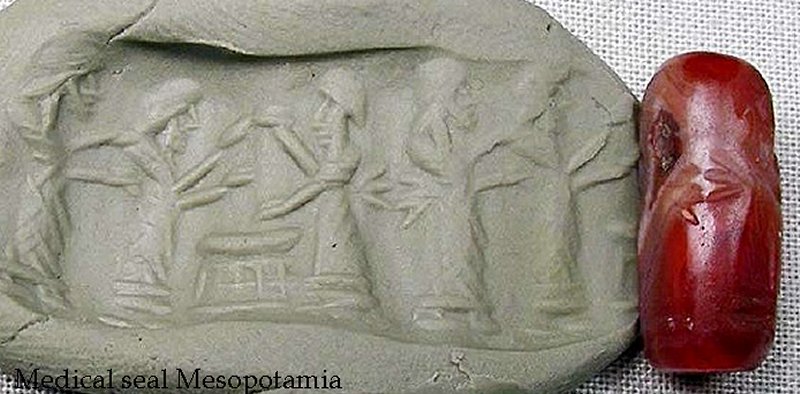
Clay tablets covered with cuneiform signs and seals that were used by doctors of ancient Mesopotamia give us important clues to early knowledge of medicine in this region of the world.
Much of this information is still valid and used even today in some of modern medical prescriptions.
Written by – A. Sutherland AncientPages.com Staff Writer
Copyright © AncientPages.com All rights reserved. This material may not be published, broadcast, rewritten or redistributed in whole or part without the express written permission of AncientPages.com
Expand for referencesReferences:
U.S. National Library of Medicine
Gabriel R. A. Man and Wound in the Ancient World
Tiner J. H. Exploring the History of Medicine
More From Ancient Pages
-
 Roman Shipwreck Carrying Enormous, Rare Cargo Of 1,800-Year-Old Marble Artifacts Found
-
 Central European Prehistory Was Highly Dynamic – New Study Shows
-
 Ancient Egypt: The Eldest Sons Traditionally Held Significant Power And Authority – New Study
-
 Unraveling The Secret History Of King Arthur And Robin Hood
-
 Ancient Temple Dedicated To God Zeus Discovered In Sinai, Egypt
-
 Kylfings – Unknown Warriors Mentioned On Norse Runes – Were They Members Of The Varangian Guard?
-
 DNA Study Of Ice Age Survivors Reveals A Surprise About The Gravettian Culture
-
 Sumerian Stele Of The Vultures: Oldest Known Historical Records Carved On Limestone
-
 Mysterious Bones May Re-Write History Of North America – Humans Were Present On The Continent 10 Times Earlier
-
 Roman Cosmetics Shop Discovered In The Ancient City Of Aizanoi, Turkey
-
 Diver Says He Found Mysterious Underwater Ancient Tomb, Ruins And Artifacts Of An Unknown Advanced Civilization
-
 Large Palace Discovered At Mayan City Of Kulubá In Yucatan, Mexico
-
 6,000-Year-Old Vast Settlement With Tools And Granite Structures Unearthed In Sotta, Corsica In France
-
 Ancient Mystery Of The Oghars – An Unusual And Little-Known Lost Race
-
 Mama Pacha: Respected And Feared Supreme Goddess Of The Andean People
-
 Surprising Evidence Of 12,000-Year-Old Unknown Advanced Secret Knowledge Held By Elite Individuals – The Connection – Part 2
-
 On This Day In History: ‘Earl of Northumberland’ Thomas Percy Executed Because He Was Catholic – On August 22, 1572
-
 Map May Confirm The Legend Of The Mysterious Lost Sunken Welsh Kingdom Of Cantre’r Gwaelod In The Black Book Of Carmarthen
-
 World’s Oldest Mosaics Of Biblical Jonah And The Whale Discovered
-
 Strange Ancient Measurements Of The Earth Revealed – Ancient Texts And Physical Evidence Examined

