
Ancient Egyptian Cosmetics – Why Was It So Important To Both Men And Women?
Conny Waters - AncientPages.com - Ancient Egyptians had several achievements in chemistry and cosmetology. They produced creams, perfumes, and facial colors. They created beautification techniques, and special soap to wash corpses as part of mummification.
The use of cosmetics was very important in ancient Egypt and makeup was used by both men and women.
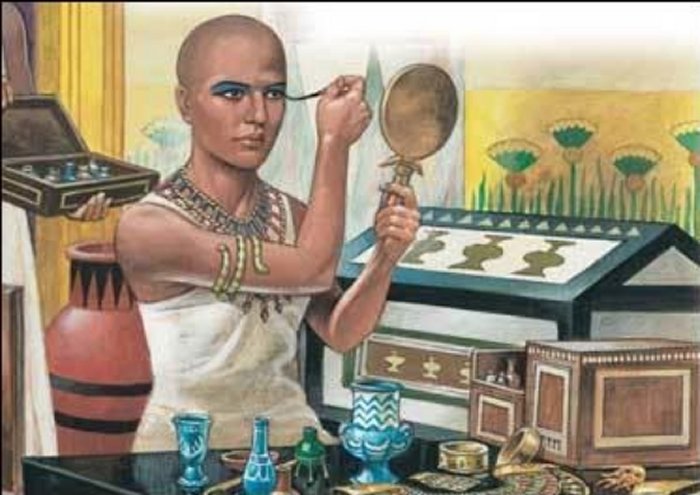
4,000 years ago, the Egyptians used some kind of toothpaste or bleach (a person with bleached teeth looks healthier), which was made from ground pumice added to soap, scrubs, and other natural cosmetic recipes to provide exfoliation to the skin.
Makeup was once an important part of everyday life in Egypt and it was not only used to look better. There was a much more important purpose behind the use of cosmetics in ancient Egypt. Cosmetics was sacred to ancient Egyptians and used not only for aesthetic purposes but rather for magical and religious purposes.
Frescoes discovered in ancient Egyptian temples illustrating daily life reveal men often wore makeup. In fact, it’s almost impossible to find a portrait of an ancient Egyptian whose eyes are not decorated.
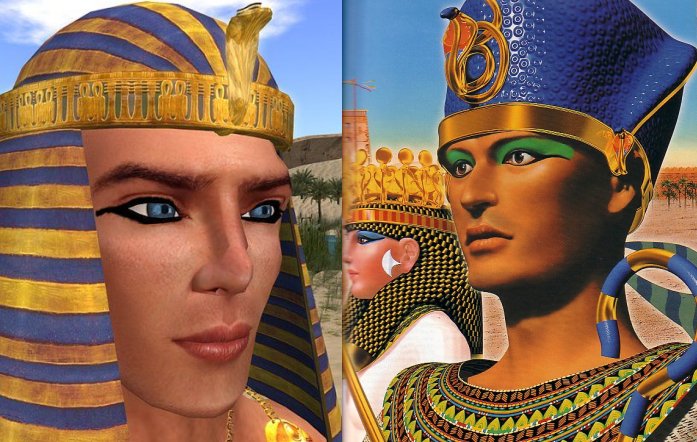
Men wore makeup in ancient Egypt.
During all periods and dynasties, eye makeup was a daily prerequisite for both men and women.
The use of cosmetics differed slightly between social classes. Higher class and wealthier individuals could afford more make-up.
Ancient Egyptians used a variety of cosmetics such as eye makeup, rouge, and perfumed oils that softened the skin and prevented burning in the sun and damage from the sandy winds. Galena powder possesses disinfectant and fly-deterrent properties. It is believed to offer the eyes protection from the intense sun.
In Ancient Egypt, the image of an individual often acted as a substitute for the body in the afterlife. Therefore, in funerary paintings, both males and females are shown in their best clothes, wigs, and makeup.
Ancient Egyptians often shaved their head because of lice infestations. People wore wigs made of real human hair that was adorned with flowers and braid.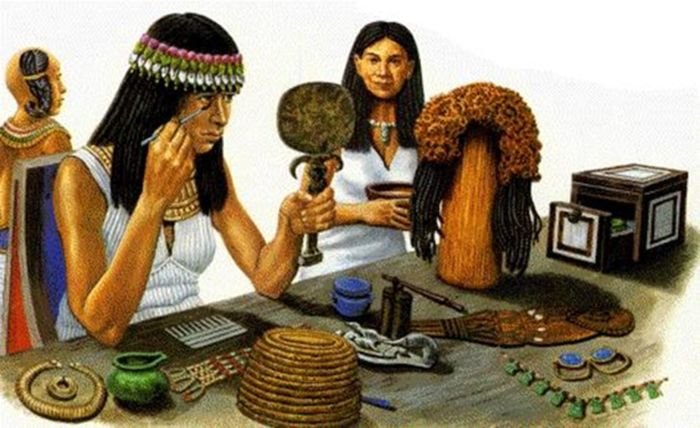
Makeup tools and accessories were very important too. Precious oils were stored in cosmetics jars made from glass, faience ceramics, and stone. The mirror was made of bronze and often carved in the form of an Egyptian goddess.
Ancient Egyptians used a variety of pigments to adorn the face. Most important of all was kohl, which was used to line the eyes. Kohl came from two sources: a green eye paint made of mineral malachite and a black liner derived from galena, a form of lead ore. Women used red ochre to form a light blush for cheeks and lips, while henna was used to paint the nails and dye the hair.
Cosmetics had also a religious resonance. The ancient Egyptians regarded beauty as a sign of holiness. In the holy sanctuary of the temple, the god was anointed with makeup as a symbol of celestial regeneration. This took place every day.
Written by Conny Waters – AncientPages.com Staff Writer
Copyright © AncientPages.com All rights reserved. This material may not be published, broadcast, rewritten or redistributed in whole or part without the express written permission of AncientPages.com
More From Ancient Pages
-
 On This Day In History: Berlin Opened For One Day – On Dec 20, 1963
-
 Unusual Archaeological Finds On Small Pacific Islands May Provide Evidence Of Intriguing Mythical Beings
-
 8,000-Year-Old Human Skeletons Found In Neolithic Village Of Slatina, Bulgaria
-
 Draupnir: God Odin’s Magical Ring That Could Multiply Itself
-
 The Colored Skeletons Of 9000-Year-Old Çatalhöyük (Catalhoyuk), Turkey – New Examination
-
 525-Million-Year-Old Fossil Defies Textbook Explanation For Brain Evolution
-
 Nine-Headed Bird: Mythical Creature Worshiped In Ancient China
-
 The Aztec Sun Stone And Medusa Reveal An Intriguing Connection – Surprising Discovery – Part 1
-
 Ensisheim Meteorite Is The Oldest Meteorite With A Precise Date Of Impact
-
 Ancient European Buildings Form A Sacred Symbol When Viewed From The Air – Scientist Reveals
-
 Restoration Of Valuable 4th Century Silk Tunics Attributed To St. Ambrose Takes Place In Milan
-
 Rare Gladiator Tombs Found In Ancient City Of Anavarza In Southern Turkey
-
 The Sistine Chapel Cypher – Secret Messages In The Art Of Michelangelo
-
 Decoding The Mysterious Medieval Pearl Manuscript
-
 Ancient Burial Site Flagstones In Dorset Is Older Than Stonehenge
-
 New DNA Study Of The Red Lady Of El Mirón Who Lived 19,000 Years Ago
-
 8,600-Year-Old Bone Needles Found In Denizli Closely Associated With Old Textile Tradition
-
 Ancient Egyptians Observed Algol’s Eclipses – Cairo Calendar Analyzed
-
 Old Norse Settlers Traded Walrus Ivory With Kyiv – Spectacular Archaeological Finds Reveal
-
 Levänluhta People Could Survive Fimbulwinter Thanks To Their Diverse Livelihoods

