
Canopic Jars: Funerary Tradition Of Ancient Egyptians And Their Beliefs In Afterlife
A. Sutherland - AncientPages.com - Ancient Egyptians sincerely believed in the afterlife, and a complex ritual set of burial customs was necessary to ensure an afterlife.
Mummification was an essential part of this ritual. All vital internal organs had to accompany the deceased to the underworld to be reborn. However, the dead's heart was never among the organs chosen for preservation in canopic jars.
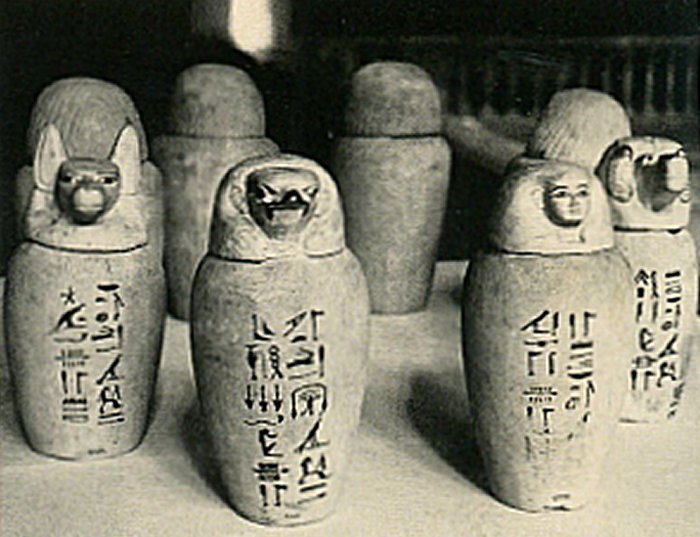 Limestone canopic jars with the heads of Qebesenuef, Duamutef, Hapy, Imsety. Originally these jars were decorated with human heads. Image credit: Egyptian Museum, Cairo
According to Egyptian beliefs, this precious organ was the source of wisdom and the seat of memory and emotions of the human being.
Therefore the heart was always left inside the mummified corpse for use in the afterlife. Canopic jars were ritual vessels containing internal organs removed from the deceased's body during mummification.
Their name, "canopies," comes from Canopus, an ancient Egyptian city in the Nile Delta, where they were first discovered. According to Strabo, Canopus was the pilot of a ship that belonged to King Menelaus of Sparta during the Trojan War.
Ancient legend says Canopus received a fatal snake bite during his stay on the Egyptian coast. In the vicinity of this tragic place, king Menelaus had erected a temple dedicated to Canopus, and a city of Canopus developed around this place.

Canopic jars of Tutankhamun; 1333–1323 BC; alabaster; total height: 85.5 cm; Egyptian Museum (Cairo). - http://www.egyptarchive.co.uk/html/cairo_museum_49.html - Copyrighted free use
The canopies were usually made of calcite (alabaster), wood, limestone, and sometimes ceramic and earthenware. Four canopies were always placed in the burial chamber near the coffin.
Each canopy protected a different organ.
Clay canopies with flat covers and only sometimes covered with texts were already known during the Old Kingdom.
Later, in the Middle Kingdom, they were adorned with human heads.
In 1320-1085 BC (the Ramesside Period) and during the 19th and 20th dynasties, the canopies were adorned with the heads of four Horus sons. They were the guardians of the intestines of the deceased.

Canopic jars of Ruiu; 1504–1447 BC; painted pottery; Metropolitan Museum of Art (New York City). Image credit: English: Rogers Fund, 1935 - CC0 1.0
These four gods were the baboon-headed Hapy, who guarded the lungs (protected by Nephthys). The human-headed Imsety guarded the liver (and who was himself guarded by Isis); the jackal-headed Duamutef guarded the stomach (often protected by Neith); and the falcon-headed Qebesenuef, guardian of the intestines (who was often protected by Serket).
The earliest reference to these four gods can be found in the "Pyramid Texts." They were the children and, simultaneously, the "souls" of Horus and the "friends of the king." They assisted the deceased monarch in his journey to the sky ("Pyramid Texts").
Jean-François Champollion, a French scholar, philologist, and orientalist, deciphered Egyptian hieroglyphs. He contributed much to our knowledge about ancient Egypt and the jars linked to the funerary cult of ancient Egypt.
Written by – A. Sutherland AncientPages.com Staff Writer
Updated on January 21, 2023
Copyright © AncientPages.com All rights reserved. This material may not be published, broadcast, rewritten or redistributed in whole or part without the express written permission of AncientPages.com
Expand for referencesReferences:
Erman A. A Handbook of Egyptian Religion
Colin Macfarquhar C. Gleig G. Encyclopædia Britannica: Or, A Dictionary of Arts ..., Volym 4
More From Ancient Pages
-
 Confucius: Philosopher, Educationist And Great Intellect With A Noble Morality
-
 Unexplained Encounters With A Mysterious Being In South Dakota Reported – Why Is This Happening?
-
 Hel – Loki’s Terrible Daughter And Goddess Of The Land Of Dead
-
 Story Of David And Goliath Linked To Horvat Qeiyafa In The Valley Of Elah, Israel
-
 Ancient City Of Knossos – A Cosmopolitan Hub Of The Minoan Civilization And Culture
-
 Secrets Of Benjamin Franklin’s Paper Money Deciphered By Scientists
-
 Tomb Of Maia, Tutankhamun’s Wet Nurse In Egypt’s Saqqara Opens To Public
-
 Ancient Egypt Life and Death in the Valley of the Kings Death
-
 Evidence Of An Advanced Ancient Civilization In Texas That Mysteriously Disappeared
-
 Great research of Polish archaeologist working at rock art site in Kondoa, Tanzania
-
 Aboriginal Creation Story Of Marala Was True – World’s Largest Dinosaur Footprints Confirm Ancient Creation Myth
-
 Previously Unknown Early Christian Church Unearthed In Ancient City Of Artaxata
-
 Sobek: A 2,500-Year-Old Mummified Nile Crocodile – On Display At The British Museum
-
 Is An Ancient Temple Dedicated To The Lioness Goddess Repit Hidden In The Cliffs Of Athribis?
-
 Did The Plague Of Athens Come From Egypt Or Is It A Myth?
-
 DNA Taken From Cement On Hairs Belonging To Ancient Mummies Shed Light On South American Ancestry
-
 Mysterious Ancient Village In A Prehistoric Anomalous Zone – Unexplained Sightings And Sounds – Part 1
-
 Circular-Shaped 4000-Year-Old Wooden Henge Discovered In Yorkshire, Historic County of Northern England
-
 Three Ancient Tombs Of High-Ranking Officials Discovered In Luxor, Egypt
-
 Mysterious Nine Worlds Of Yggdrasil – The Sacred Tree Of Life In Norse Mythology

