
Sophisticated Lenses Of Minoans Discovered In The Sacred Idaion (Ideon) Cave
A. Sutherland - AncientPages.com - The Minoans appeared to have possessed remarkable technologies; one of them was the creation of tiny, wonderful seals, which were skillfully carved out of soft stones, ivory, or bone.
Many such seals have been unearthed on Crete and more than 6,500 of them, stamped with more than 600 different and sophisticated designs, have been discovered at Phaistos.

A gold signet ring and its impression. Ashmolean Museum. Image credit: Andree Stephan - CC BY 3.0
Undoubtedly their creation required extraordinary skills of craftsmen and special tools.
Researchers have long wondered about technologies used by the ancient people. How, for example, did they make these tiny, microscopic engravings?
In her "Catalogue of Engraved Gems" Gisela Richter writes that the technique of gem engraving was known to the Minoans.
"It is important to know that only soft stones and metals can be worked for freehand with cutting tools; the harder stones require the wheel technique," she writes in her book.
This technique was known to the Minoans "who learned it perhaps from the Babylonians, by whom it was practiced at least as early as 1500 BC.
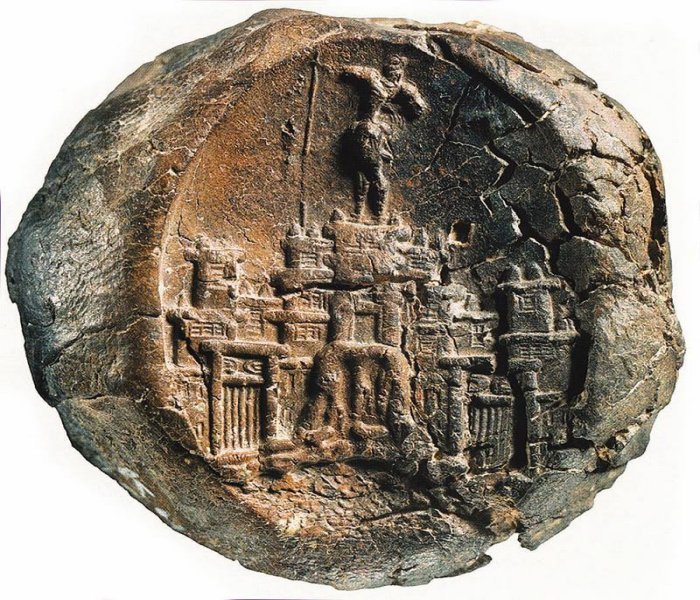
The Minoan object called "The Master's Seal" depicts a multistore building complex above the hill of Kasteli and a figure of a young man, perhaps a worshiper. Chania of Crete - 1600 BC. Image via Swedish Institute of Athens.
In "Selected Writings and a Bibliography," A. Hyatt Mayor writes that "the ancients knew and used the phenomenon of magnification…"
No doubt, in order to carve very small objects required special tools or at least one tool to magnify the surface with which the carver worked, especially if this surface was almost microscopic or "as tiny as a baby's thumb-nail."
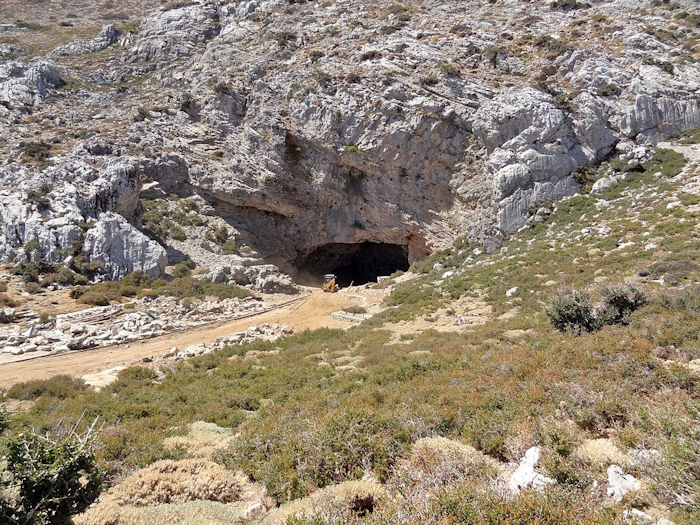
At the entrance to the Ideon Cave can be seen the altar cut in the rock. Credit: Olaf Tausch - CC BY 3.0
"About 1600 BC, the Minoans invented seals of a double convex shape – the so-called lentoid gems that look like pills an inch or less across and half as thick. Before engraving the design on one side, both sides were probably polished…"
"When a Minoan craftsman polished a lentoid blank…, he had in his hand as good a short-focus lens as the man was to possess until Galileo's time…" (A. Hyatt Mayor).
The Minoans most probably used a great variety of magnifiers for their microscopic craftsmanship.
For example, in Minoan Crete, seals have been found with a complex carving on lentoid stones. The lentoid shape was one of the most commonly recovered seal shapes from Minoan Knossos on Crete dating to the Bronze Age.
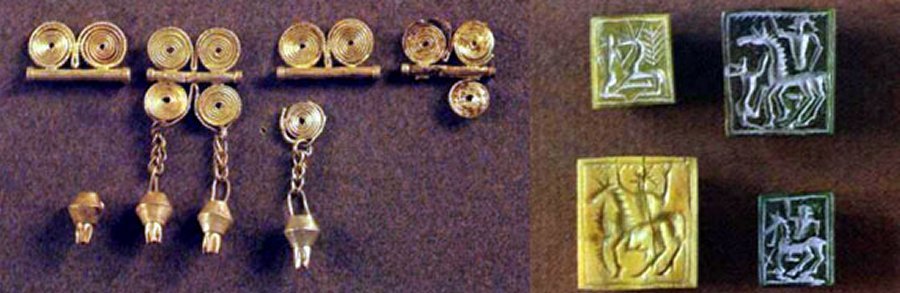
Finds from the Ideon Cave. Left: A piece of gold jewelry - Right: Ivory seals. Image via Explore Crete
In his book "The Lost Empire of Atlantis: History's Greatest Mystery Revealed", Gavin Menzies writes that "one lens found on Crete can magnify up to seven times with perfect clarity…and many of the lenses had been discovered hidden in a sacred cave, known as 'the Idaion cave' (or "Ideon Andron") located on Mount Ida, the highest mountain in Crete, slightly northwest of Kamares, above the barren plateau of Nida.
It is one of the greatest cave sanctuaries in Crete, as important as the major Greek temples. It flourished in antiquity (4000 BC to the 1st century AD).
The Ideon Cave was famous for being where Zeus, the Father of the Gods, was born and grew up….
This cave may have also held a secret of enigmatic seals of Crete and perhaps we can wonder as Menzies does:
"What the Minoans have written on them? Were they navigation instructions? Were they maps of the stars or perhaps only ownership details? Some of the minutely inscribed seals seemed to show stellar constellations, like Orion…"
Updated on February 7, 2022
Written by – A. Sutherland AncientPages.com Staff Writer
Copyright © AncientPages.com All rights reserved. This material may not be published, broadcast, rewritten or redistributed in whole or part without the express written permission of AncientPages.com
Expand for referencesRichter, Catalogue of Engraved Gems
Menzies, The Lost Empire of Atlantis: History's Greatest Mystery Revealed
More From Ancient Pages
-
 Missing Pieces Of The Magnificent Golden Tree Of Lucignano Discovered
-
 New Genes May Explain Why Humans Got Such Big Brains
-
 31,000-Year-Old Skeleton Missing Foot May Show Oldest Amputation
-
 Bacho Kiro Cave: Genomes Of The Earliest Europeans – Sequenced
-
 Perplexing Accounts Of Ancient People Who Demonstrated Incredible Powers Of The Human Mind
-
 Head Of The Great Sphinx Was Changed – It’s The Gateway To A Secret Underground City– Historians Suggest
-
 Bastet: Protector And Punisher – She Was Among The Most Majestic Egyptian Deities
-
 Mystery Of Charterhouse Warren’s Early Bronze Age Site Solved By Scientists
-
 Camazotz: ‘Death Bat’ Vampire God In Ancient Maya Beliefs
-
 Anchor Church Caves – Has The Home Of Anglo-Saxon King Eardwulf And Saint Hardulph Been Found?
-
 47,000 Years Of Aboriginal Heritage Was Destroyed In Mining Blast – Results From Juukan Gorge Show
-
 Archaeological Discoveries At Fort San Juan Reveal Hidden History Of Conquistadors In American South
-
 World’s Oldest Recorded Solar Eclipse Re-Writes History Of Egyptian Pharaohs
-
 ‘Long-Lost’ Troy Story Depicted On Roman Mosaic In Rutland, UK
-
 Giant Hrungnir Who Lost The Race And Engaged In A Deadly Duel With Mighty Thor In Norse Mythology
-
 Why Was The Iron Age Village Near Elgin In Scotland Suddenly Abandoned And Burned Down?
-
 Forbidden Ancient Manuscripts Almost Erased From History – Secret Teachings Of Mysterious Founder – Part 1
-
 7,000-Year-Old Underwater Road Discovered In Adriatic Sea Off Korcula Island
-
 2,500-Year-Old ‘Dragon Bed’ Restored By Chinese Archaeologists
-
 Discovery Of World’s Oldest Fortresses Reshapes Our Understanding Of Hunter–Gatherers

