
First Pay Toilets Were Invented In Ancient Rome In 74 A.D.
Conny Waters - AncientPages.com - The history of the world’s oldest pay toilets can be traced to ancient Rome. Emperor Vespasian was not only the founder of the Flavian dynasty after the civil wars that followed Nero’s death and the initiator of the Roman Colosseum. He was also the man who introduced the first public pay toilets in 74 A.D.
As previously mentioned in our article, the history of bathrooms is thousands of years old and can be traced to ancient Scotland.

Urine tax was common in ancient Rome. Credit: Son of Groucho - Flickr - CC BY 2.0
Around 8,000 B.C., inhabitants of the Orkney Islands built the first latrine-like plumbing systems for carrying wastes away from the home.
However, ancient Romans went further and found a somewhat odd way of making money on public “waste.”
History records several bizarre ancient taxes, and one of them was the urine tax.
In ancient Rome, human urine was a valuable commodity. Urine was used for a variety of reasons, such as tanning, laundering, and even teeth brushing!
Emperor Vespasian (r. A.D. 69-79) and Emperor Nero (r. A.D. 54-68) discovered a golden opportunity to profit from pee. They levied a tax on the acquisition of urine. The result of the urine tax led to the popular Latin phrase Pecunia non alet which means Money does not stink.
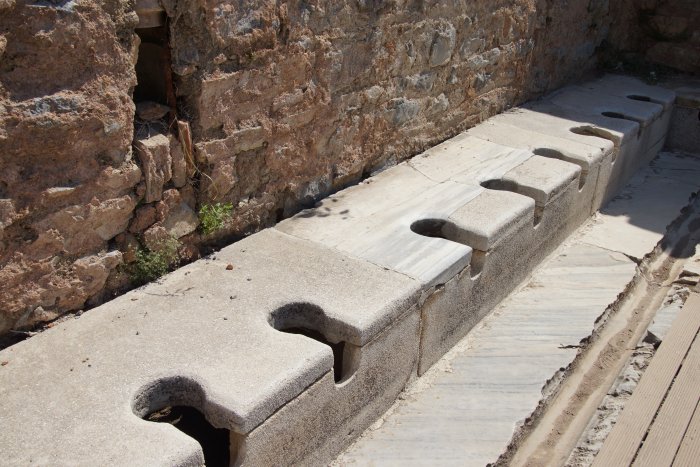
Ancient Roman toilets. Credit: Adobe Stock - cascoly2
Emperor Vespasian, who built the Colosseum, was the first to introduce pay toilets in the city of Rome.
Before the first public toilets were introduced, ancient Romans urinated into pots that were emptied into cesspools.
In 74 A.D., Emperor Vespasian re-introduced the urine tax and ordered the construction of public pay urinals, where the waste would be collected and sold as a source of ammonia, which was used for tanning leather and cleaning clothes.
Public urinals are no longer common in Italy, but they are still known as Vespasiani to this day.
In modern times, John Nevil Maskelyne (1839-1917) is credited with the invention of a pay toilet.
John Nevil Maskelyne was an English stage magician, inventor, and a descendant of the Astronomer Royal Nevil Maskelyne.
In the 19th century, Maskelyne invented a lock for London toilets, the insertion of a penny coin to operate it, hence the euphemism to "spend a penny".
Like much of the world, pay toilets were once common in the United States. The majority of pay toilet locks were manufactured by one company, Nik-O-Lok, which charged 10 cents per use. By 1970, America had over 50,000 pay toilets. By 1980, there were almost none because many people felt pay toilets were an unethical infringement on basic human rights.
It took some years, but CEPTIA was successful, and pay toilets were banned in several states.
In Europe, on the other hand, pay toilets are a very common sight. Paying to use a public WC is a European custom that annoys many Americans.
Updated on January 11, 2024
Written by Conny Waters – AncientPages.com Staff Writer
Copyright © AncientPages.com All rights reserved. This material may not be published, broadcast, rewritten or redistributed in whole or part without the express written permission of AncientPages.com
Expand for referencesMore From Ancient Pages
-
 New Path For Early Human Migrations Contradicts A Single ‘Out Of Africa’ Theory
-
 Was Prehistoric Baghdad Battery A Unique Find Of The Ancients? – Did Its Manufacturers Discover Electricity By Accident?
-
 Strange Mummies Of Venzone: Ancient Bodies That Never Decompose Remain An Unsolved Mystery
-
 What Can Archaeology Tells Us About Climate Change?
-
 Priam’s Treasure – Authentic Trove From Homeric Troy Or Deception?
-
 Unique Ancient Roman Cavalry Swords Found In Cotswolds, UK
-
 Scientists Decipher 2,300-Year-Old Chemistry Formulas Revealing Ancient Metallurgy Was More Complex Than Previosuly Thought
-
 Ancient City Was Discovered Underground In Antalya’s Demre District
-
 3.6 Million-Year-Old Rare Skeleton Of Human Ancestor Revealed By Researchers In South Africa
-
 Legend Of Baku – The Dream Eater – Was It An Ancient Supernatural Being?
-
 On This Day In History: Maltese Rebellion Took Place – On Sep 8, 1775
-
 Rare 2,500-Year-Old Scythian Bone Sceptre Discovered In Bulgaria
-
 Identity Of Anti-Christ And Number 666 Revealed By Ancient History Professor
-
 On This Day In History: American Astronomer Edwin Hubble Announced Existence Of Other Galaxies – On Dec 30, 1924
-
 Height Differences Among Neolithic People Was Caused By Environmental Stress Not Genetics
-
 Ancient Giants In Ecuador Were Killed By Fire From The Sky – Indian Legends Reveal
-
 Why Were Conch-Shell Trumpets So Important To The Ancient Chacoan Society?
-
 Rene Descartes – Independent French Thinker And His Main Ideas
-
 Ancient Nessebar – 3,000-Year-Old History Of Many Civilizations
-
 Intriguing Connection Between Ancient Curse Tablets And The Book Of Revelation Discovered

