
26,000-Year-Old Footprints In Chauvet Cave: Oldest Evidence Of Human-Canine Relationship
Ellen Lloyd - AncientPages.com - Humans and dogs have shared a special relationship for thousands of years. Dogs are our companions, trusted friends, and family members. They bring joy into our lives, which has been the case for ages.

The Chauvet Cave in France contains plenty of remarkable paintings between 20,000 and 30,000 thousand years old and of great historical importance. Many scholars believe that the images found in the Chauvet Cave mark the emergence of a recognizable consciousness.
Interestingly, none of the hundreds of glorious Chauvet paintings show wolves. However, this intriguing ancient cave preserves something exciting: the footprints of a human child about four-and-a-half feet tall and many prints of large canids and bears.

A replica of the remarkable Chauvet Cave. Image credit: Stéphane Compoint
Many consider these footprints the world's oldest evidence of the human-canine relationship.
First spotted in 1994 by Jean-Marie Chauvet, the cave's discoverer, the footsteps stretch perhaps 150 feet and sometimes cross those of bears and wolves.
The steps lead to the so-called room of skulls, where several bear skulls have been found. In a few places, there is evidence that the boy slipped on the soft clay floor, though Garcia says the prints show the boy was not running but walking normally.
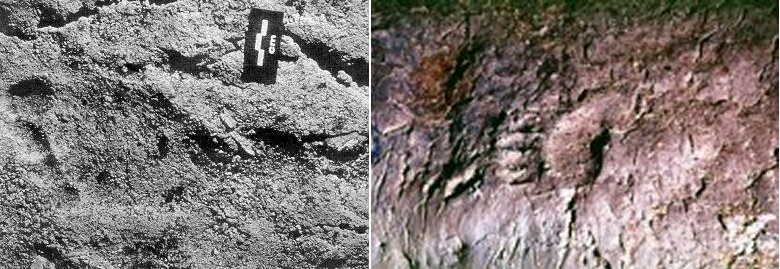
Caveboy left footprints in the clay of time.
The boy appears at one point to have stopped to clean his torch. The charcoal has been dated to about. 26,000 years ago.
The discovered canid prints have a shortened middle digit on the front paw: a characteristic of dogs. Garcia suggested that the child and a large dog might have explored the cave together.
The prints from the Chauvet Cave, like nearly all footprints thus far discovered in Palaeolithic caves, are from bare feet. This has led scholars to speculate that people of the time either left footwear at cave entrances or carried them.
Prehistoric art expert Paul Bahn notes that depictions of carnivores, including wolves or dogs and humans, are rare. Bahn conjectures that portraying wolves and humans might have been taboo.

Gallery of the Chauvet cave may depict a volcanic eruption. Left: general view; right: traced detail, with an overlaid charcoal painting of a giant deer species removed (lower right). D. Genty (left)/V. Feruglio/D. Baffier (right)/CC BY 4.0
Anne Pike-Tay of Vassar College offers another perspective. She observes that the scarcity of artistic depictions of carnivores parallels their absence in the fossil faunas of the Upper Paleolithic. If domesticated dogs were helping humans hunt, she speculates that they might have been placed in a completely different symbolic category from other animals.
"What if dogs were put in the 'human family' category as an extension of the hunter and, like humans, warranted no (or very few) painted or engraved depictions?" she wonders.
Updated on September 10, 2024
Written by Ellen Lloyd – AncientPages.com
Copyright © AncientPages.com All rights reserved. This material may not be published, broadcast, rewritten or redistributed in whole or part without the express written permission of AncientPages.com
Expand for referencesMore From Ancient Pages
-
 People Of Old Dongola Recycled And Dyed Clothes
-
 Huge Lost Ancient Underground City Of Samen Finally Reveals Its Secrets
-
 Roman Forum (‘Forum Romanum’) – The Heart Of Ancient Rome
-
 Underwater Artifacts Shed New Light On Battle Of The Egadi Islands Between Romans And Carthage
-
 Long-Lost Paleontological Site With More Than 100 Unique Fossils Re-Discovered In Brazil
-
 Ancient Glass Workshop Unearthed At Iron Age Of Němčice
-
 Ancient Knowledge About Horse Taming Is Rewriting Our Picture Of The Past
-
 1,000-Year-Old Palace Kitchen With A Cannonball Inside An Oven Found At Harput Castle In Elazig, Turkey
-
 Mystery Of The Ancient Unknown Mining Civilization In North America – Puzzling Archaeological Discoveries – Part 1
-
 Evolution Of Plague Over Hundreds Of Years In Scandinavia Documented By Scientists
-
 Tezcatlipoca: Enigmatic Aztec God Who Looked Inside People’s Hearts And Observed Their Deeds On Earth
-
 Steamship SS Mesaba Sent Warning To RMS Titanic In 1912 – Her Wreck is Now Identified
-
 Jew’s Harps: Old Musical Instruments Discovered In Altai Mountains
-
 Early Humans Were Probably Driven To Extinction By Climate Change- Study Suggests
-
 Fenrir Killed At Ragnarok By Vidar Who Avenged His Father Odin’s Death
-
 Mysterious 9,000-Year-Old Shaman Burial In Bad Dürrenberg – One Of Central Europe’s Most Spectacular Archaeological Discoveries
-
 Rare Discovery Of 8,500-Year-Old Human Teeth Used As Jewelry
-
 Sailing With The Phoenicians: Great Traders, Sailors And Navigators
-
 Impressive Marble Statue Of A Ram, An Ancient Christian Symbol For Jesus Discovered
-
 Lady Of Drunkenness And How God Ra Wanted To Teach Humans A Lesson

