
Stele Of Tell al-Rimah And Deeds Of Assyrian King Adad-nirari Against Rebellious Kings
A. Sutherland - AncientPages.com - Stele of Tell al-Rimah, dated to 796 BC, is a stone stela from the reign of the Assyrian king Adad-nigari III (810-783 BC) found in 1967 during archaeological excavations at the site of Tell al-Rimah in Nineveh Province, in northern Iraq near Jebel Sinjar.
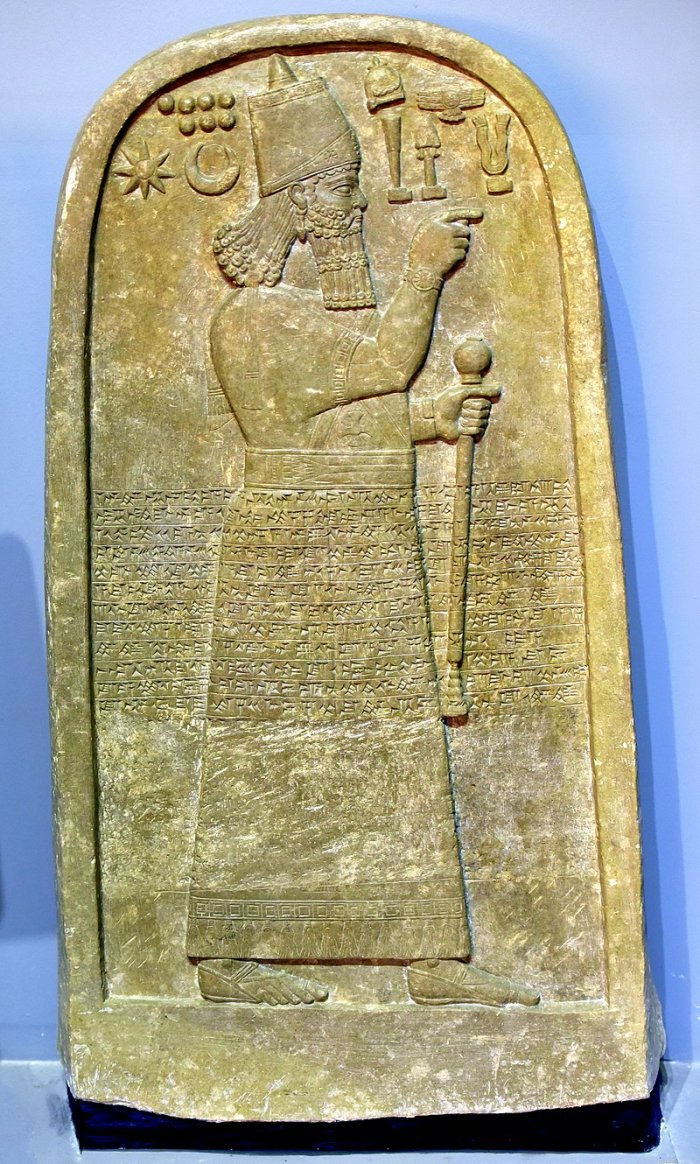
Stele of Adad-nirari III at the Iraq Museum. Image credit:
Based on general information, during the reign of Shamshi-Adad V, Shalmaneser III's successor, Assyria's influence in the West significantly waned, and the next monarch, Adad-Nirari III, reversed this trend with solid military campaigns.
It is seen in the Tel al-Rimah stele, which also depicts an image of the king with the inscription carved across his waist and religious symbols placed above him. Though the part of the inscription naming Nergal-fresh was erased after his downfall, it is still clear enough to read.
Made of a single slab of hard grey Mosul marble, the stele was found inside the cella of a small Neo-Assyrian temple beside the podium.
The discovered artifact is in an excellent state of preservation and completion. Its size is 130 cm (height) and 69 cm (width at the base). The stele's front side depicts King Adad-nirari III surrounded by divine symbols.
The lower part has an additional inscription of 21 lines of text. Part of the text (9 lines) was probably deliberately removed in antiquity.
The writing covering the skirt of the king's figure is slightly less than life-size. No traces of paint were visible on the stele when it was unearthed.
In the same shrine, archaeologists also discovered two pairs of lion heads made of softer and lighter limestone, used as column bases.
Adad-nirari, a son and successor of King Shamshi-Adad V, was very young at the time of his accession because his mother, Queen Shammuramat, was highly influential for the first five years of his reign.
Some have identified his mother with the mythical Semiramis from Greek myths; however, many historians confirm the existence of Assyrian queen Shammuramat, wife of Shamshi-Adad V of Assyria and mother of Adad-nirari.
The text on the stele begins with a dedication to the storm god Adad (lines 1-2), after which these will be the name of Adad-nirari III and his genealogy (line 3).
Further described are military expeditions of the king to the West, including the submission of tribute to him by the King of Mari from Damascus, King Joash (Assyrian Iu'asu) of Samaria, and the inhabitants of Tyre and Sidon (lines 4-12).
Some fragments of the text say:
[1] To Adad, the greatest god, powerful noble of the gods, first-born son of Anu, unique, awesome, lofty, the canal inspector of heaven and earth, who rains abundance, who dwells in Zamahu, the great lord, his lord.
[2] Adad-Nirari, mighty king, king of the universe, king of Assyria, son of Šamši-Adad, the king of the universe, king of Assyria, the son of Šalmaneser, the king of the four quarters.
[3] I mustered my chariots, troops, and camps; I ordered them to march to the land of Hatti. In a single year, I subdued the entire land of Amurru and Hatti. I imposed upon them tax and tribute forever.
[4] I received 2,000 talents of silver, 1,000 talents of copper, 2,000 talents of iron, 3,000 linen garments with multicolored trim - the tribute of Mari' - of the land of Damascus. I received the tribute of Jehoash, the Samarian, of the Tyrian ruler, and the Sidonian ruler.
[5] I marched to the great sea in the West. I erected a statue of my lordship in the city of Arvad, which is in the midst of the sea. I climbed Mount Lebanon, and I cut down timbers: 100 mature cedars, material needed for my palace and temples.
Another part of the text (lines 13-20) is the part of the inscription, which was removed later but initially mentioned Nergal-erish, the king's disgraced governor, whose name was removed from the royal monuments. Nergal-erish must have fallen out of favor with the king.
The text was probably dated to 797 BC or later, as one of the titles related to Nergal-erish, is the title of governor of Hindanu (now, Tell Jabiriyah), an Old Babylonian-Neo-Assyrian city (ca 1800-600 BC), which Nergal-erish governed in 797 BC.
The text ends with a curse directed against all who want to remove stele's written curse (line 21).
The site of Tell al-Rimah was occupied in the third millennium BC. Still, it flourished particularly during the Old Babylonian and Mitanni periods of 2000 BC and in the Neo-Assyrian period. At various times, Tell al-Rimah has been linked with either Qatara or Karana, known cities in that area during the second millennium.
The stele is historically associated with ancient Israel because a part of the inscription has Adad-Nirari's boast that he subdued "the entire lands of Amurru and Hatti."
He imposed taxes and tribute upon their leaders. Listed among the kings providing tribute is the Israelite king Joash (later buried in Samaria with the kings of Israel.) Biblical Verses- 2 Kings 13-10–25
Today, the monument is located in Baghdad's National Museum of Iraq.
Written by – A. Sutherland - AncientPages.com Senior Staff Writer
Updated on July 26, 2023
Copyright © AncientPages.com All rights reserved. This material may not be published, broadcast, rewritten or redistributed in whole or part without the express written permission of AncientPages.com
Expand for referencesReferences:
Oates, David. “The Excavations at Tell al Rimah, 1967.” Iraq 30, no. 2 (1968): 115–38
M. C. Tetley, The Reconstructed Chronology of the Divided Kingdom
More From Ancient Pages
-
 House Of Plantagenet – How Hatred, Revenge And Jealousy Transformed History
-
 On This Day In History: Edict Of Pistres ‘A New Law’ Against Viking Raids Issued – On July 25, 864
-
 Trapped 70,000-Year-Old Artifact Reveals Hidden Information About Early Humans
-
 Mysterious Sophisticated Gran Coclé Culture Reveals Its Ancient Secrets
-
 Was Organized Society A Disruptive Or Calming Force In Ancient Andes Populations?
-
 2,000-Year-Old Lost City Of Bassania Described By Roman Historian Livy Investigated By Archaeologists
-
 Ancient Objects Used In Unknown Celtic Ritual Discovered In Polish Lake
-
 On This Day In History: Knights Templars’ Jacques de Molay Burned At The Stake – On Mar 18, 1314
-
 Venus Cloacina: Roman Goddess Of Sewers And Drains
-
 Epi-Olmec: Undeciphered Isthmian Script Of Mesoamerica
-
 Spectacular Square-Headed Creature And 143 New Nazca Geoglyphs – Discovered
-
 New Underwater Discoveries Made Around The Antikythera Shipwreck
-
 Prehistoric Humans Recycled Old Stone Tools To Preserve The Memory Of Their Ancestors
-
 Why Did Sages And Shamans Repeatedly Visit The Mysterious Finnish Pirunkirkko Cave (Devil’s Church)?
-
 Etzanoa: Long-Lost Native American City Discovered In Kansas After 400 Years
-
 On This Day In History: Francis Drake Was Knighted After He Completed A Circumnavigation Of The World – On Apr 4, 1581
-
 Unknown Lost Civilization Of Ancient Megalithic Super-Builders In The Middle East – Can Prehistoric Rock Art Solve The Mystery?
-
 Sandstone Head Of A Bodhisattva Discovered Near Ta Nei Temple
-
 Two Rare Funerary Busts Rescued From Destruction In Palmyra – Restored In Italy
-
 Egyptians Mastered Medicine Thousands Of Years Ago

