
Buccaneers And Privateers Were Pirates – But What’s The Difference Between Them?
AncientPages.com - Piracy is widely regarded as the world’s oldest profession. Many of the most well known pirates in historical lore originate from a period known as the Golden Age of Piracy that started in the 1650s and continued to the 1730s.
Some historians have suggested that most plundering and looting took place over just a few short years from around 1716 to 1726. This coincided with the end of the War of the Spanish Succession which meant that fewer European navies occupied the seas in the area and a great many well-trained sailors found themselves out of work as a consequence.
Buccaneers and Privateers were two common pirate types.
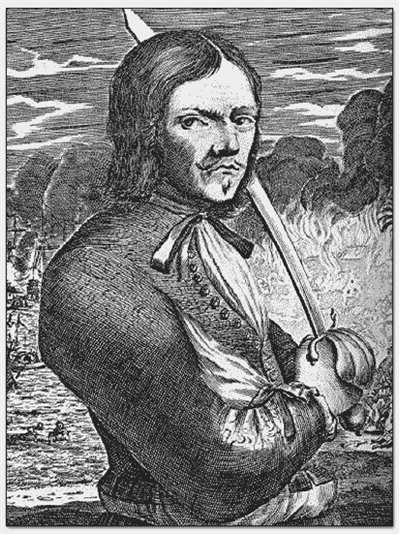
Jean-David Nau (c. 1635 – c. 1668), better known as François l'Ollonnais.
The Buccaneers were the semi-lawful sailors and soldiers who got their name from the word ‘buccaneer’ which describes the type of meat these men, mainly Frenchmen, used to sell to passing ships before they turned to a life of piracy in around 1650. The original buccaneers were hunters who lived on the island of Hispaniola in the Caribbean, but when the Spaniards drove them off their island they became pirates.
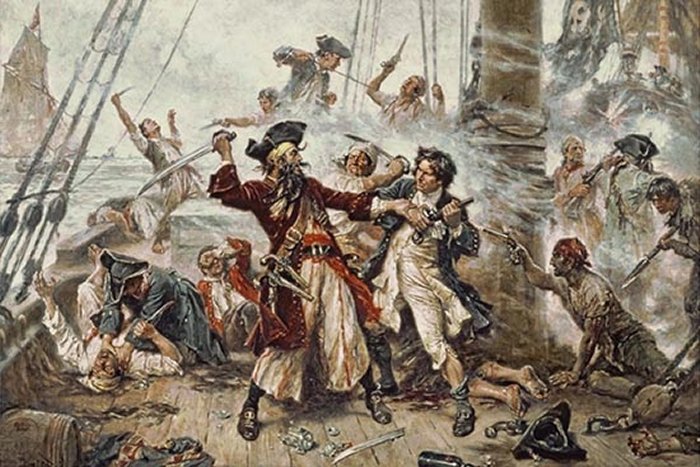
The painting Capture of the Pirate, Blackbeard, 1718, depicts the capture of one of the famous Buccaneers.
The Buccaneers attacked almost exclusively Spanish coastal towns and ships and they were supported by the English and all other nations at war with Spain. When English occupied Jamaica, providing a base for the buccaneers to launch theirs attack to Spanish settlements, the conflict inflated, as the rise of the Buccaneers.
In the eyes of the Spaniards the Buccaneers were just ordinary brutal criminals, but other nations saw them as heroes.
One of the most famous Buccaneers was Jean-David Nau (c. 1635 – c. 1668), better known as François l'Ollonnais.
He was born in France around 1635. As a young man he was sold to a master who took him to the Caribbean . From 1650 to 1660 he lived as servant on the Island of Martinique. However, L'Ollonais gained experience and confidence for all following achievements in his career. In 1660 he joined the Buccaneers stationed in Saint-Domingue and showed all his talent. Robbing and killing Spaniards was his occupation from that point till the end of his life.
L'Ollonais is said to have been extremely cruel.
See also:
Jolly Roger – Symbol Of Golden Age Piracy
When And What Was The Golden Age Of Piracy?
Why Did Pirates And Sailors Wear Earrings?
More Fascinating Ancient History Facts
The Privateers were more “legal” pirates. They were commissioned by the government of their country or wealthy individuals to attack and raid enemy ships in times of war.
So they were legally authorized to plunder and they carried with them a letter of marque which identified them as ‘legal’ raiders.

Sir Henry Morgan was a Welsh pirate.
One of the most famous privateers was Captain Henry Morgan, who fought for England against Spain in the 1660's and 1670's. With a privateering commission, Morgan sacked several Spanish towns, including Portobello and Panama City. He shared his plunder with England and lived out his days in honor in Port Royal.
Many Privateers often wanted a greater share than specified in their contract and they didn’t aks, they just took what they wanted. So, the line between privateer and outright pirate was often crossed.
It should be added that many Buccaneers considered themselves to be Privateers, with many carrying letters of marque which served as legal proof that they were sponsored by wealthy individuals and not operating as independent pirates.
Copyright © AncientPages.com All rights reserved. This material may not be published, broadcast, rewritten or redistributed in whole or part without the express written permission of AncientPages.com
Expand for referencesMore From Ancient Pages
-
 Fascinating Gigantic Creatures Today Totally Extinct 13,000 Years Ago Co-Existed With Early Americans
-
 Underwater Archaeologists Explore The Secrets Of Loch Achtily Crannog – Will They Find A Rare Medieval Settlement?
-
 Surprising Discovery Of Rare Turtle Statue Under Bayon Temple In Angkor, Cambodia
-
 Scotland’s Mysterious Ballachulish Figure Could Be Cailleach Bheithir – Ancient Hag Goddess Of Winds And Storms
-
 Pharaoh Psusennes I Buried In The Silver Coffin Inlaid With Gold
-
 60-Meter Longhouse Discovered Near Viking Ship At Gjellestad, Norway
-
 Unexplained Teleportation Cases Of People – Ancient Times – Part 1
-
 Easter Island’s Statues Reveal Bodies Covered With Unknown Ancient Petroglyphs
-
 Queen Mavia And The Tanukhids Launched A Massive Revolt Against Romans – But Why?
-
 Function Of “Chopping Tools” Found At Prehistoric Site Of Revadim Israel – Studied
-
 Mysterious Secret ‘Square’ Discovered Beneath Avebury Stone Circle
-
 On This Day In History: Sack Of Rome Took Place on May 6, 1527
-
 On This Day In History: National Hero Paul Revere Warns Of The British Coming – On Apr 18, 1775
-
 Has A Herculaneum Scroll Solved The Mystery Of Plato’s Death?
-
 Mystery Of Ancient “Magical” Mirrors – Some Of The Strangest Objects In The World
-
 On This Day In History: Chaldean Account Of The Deluge Translated And Presented For The First Time – On Dec 3, 1872
-
 World’s Oldest Dala Horse Discovered In Sweden
-
 Unusual Ancient Winged Half-Human And Half-Animal Divine Creature With Supernatural Powers
-
 University Of Warsaw Archaeologists Return To Study Large Ancient City Of Ptolemais
-
 Evidence Of Copper Processing Unearthed At Archaeological Site In Oman

