
What Was Life For Ancient Viking Children?
Ellen Lloyd - AncientPages.com - Like most children of the ancient world, Viking children did not have much time to enjoy their childhood. Work, learning, duties, and responsibility started at a very early age and there was not much time for playing games, but this does not mean it was boring to be a Viking child. It was simply different than it is today.

At the age of 10, ancient Viking children were considered adults and were required to follow in their parent's footsteps and acquire the necessary skills to adequately perform their mother’s or father’s job.
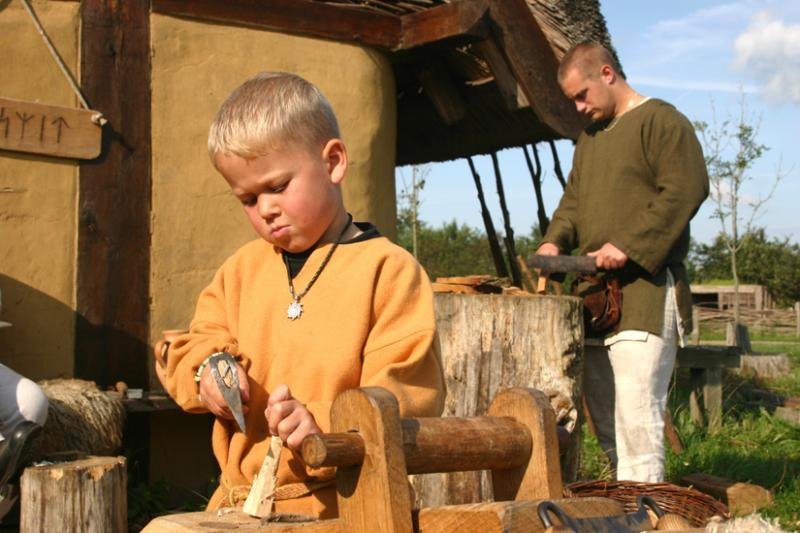
In ancient Norse times, the gender roles for boys and girls were quite defined. It was most common that boys worked on farms and girls did housework.
Viking children at the age of 10 were considered adults and they were required to learn the jobs and tasks that their parents did. The boys mainly worked on farms and the girls worked inside like their mothers.
Viking boys were expected to learn how to take care of themselves. This meant they must not only be good farmers, but also skilled warriors.
In order to learning farming, young boys were either working with their father, sent to a family relative, or a respected male in the ancient Viking society. There the boys learned how to plant, farm, raise livestock, and trade.

Ancient Viking children had to learn many things at an early age. Image credit: Thor News
They were also taught to fight using spears, swords, and axes. Some Viking boys, especially those of the richer families, learned to read and write the rune characters which were the Viking alphabet. Any Viking who could read and write was treated as a respected member of the Viking community.
Fighting was part of life, and just like many boys today, Viking boys also enjoyed a good fight. This was an excellent opportunity to improve one’s fighting skills and some hoped they could one day become great Viking warriors. A Viking boy caught fighting was not punished by his parents, unless he causes serious harm to his opponent.
The young Viking girl’s life was mostly focused on house duties. A Viking girl learned from her mother and grandmother how to keep run the household properly.
The girls were taught to cook, clean, prepare meals, make yarn and weave and sew. Girls were also taught farm work and tending animals as it was their duty to run a farm when the men were away.
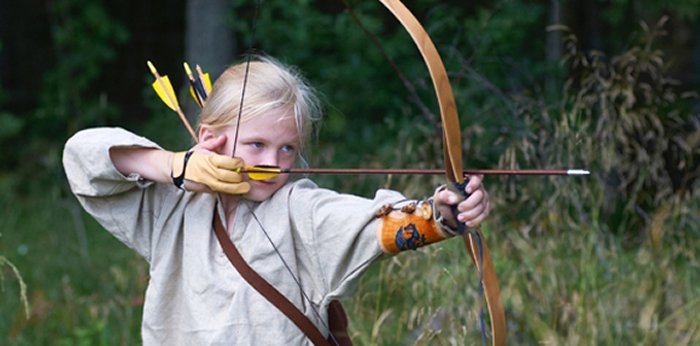
Stronger girls were also trained in the art of war. Image credit: Thor News
Strong girls were taught sword fighting and yes, there were a few female Viking warriors. Archaeologists have discovered artifacts depicting Viking women carrying spears, swords, shields, and wearing helmets, are found on textiles and brooches, and depicted as metallic figurines, to name a few. Archaeological discoveries reveal the importance of the Valkyries. In Norse mythology, the Valkyries were the choosers of the slain.
The Valkyries were females riding on horses armed with helmets and spears. They would decide who would die in battle and drift over the battleground to find their prey.
See also:
Viking Children Were Buried With Extremely Sharp Knives – Afterlife Tools To Be Used In Valhalla?
In old Norse times, there were no formal schools for children. Viking children could learn by listening to stories told by the elders or by practicing various tasks. How much you learned depended on your own curiosity to gain knowledge in certain areas. A Vikings child’s learning was gained through real living, being a part of the community from a young age, and growing through their natural roles in it.
Viking boys and girls got married very early. Life was an experience there was no real such thing as a formal school environment. Stories might have been told by older Vikings, lessons learned in passing, and trades would be learned by time and effort, but not in a typical school environment. Involvement in Viking society was crucial.
Written by - Ellen Lloyd – AncientPages.com
Copyright © AncientPages.com All rights reserved. This material may not be published, broadcast, rewritten or redistributed in whole or part without the express written permission of AncientPages.com
More From Ancient Pages
-
 King Solomon Was Invented As Political Propaganda To Unite People Of Judah – Scholars Argue
-
 Lost World Of Doggerland: Parts Of Britain’s Sunken Stone Age Atlantis Discovered
-
 Unexplained Accounts Of Mysterious Fires – ‘Burning’ Questions Remain Unanswered – Part 1
-
 Priceless 800-Year-Old Treasure Featuring Three Golden Lions Unearthed
-
 Untold Story Of The Glencoe Massacre In 1692 Revealed By Archaeologists In Scotland
-
 Unique 80 Bronze Age Artifacts Dated To Roman Campaign In The Alps In 15 BC – Discovered
-
 On This Day In History: Battle Of Sinop Took Place – On Nov 30, 1853
-
 Shinobi No Mono: The Shadow Warriors And Hattori ‘The Demon’ Hanzo Of Ancient Japan
-
 Interesting Relief Sculpture Of Pharaoh Hatshepsut Found At Swansea University
-
 Viking Treasures Discovered In Chamber Grave In Denmark
-
 Alexander The Great’s Biblical Connection
-
 Rare Ancient Drawings Offer Evidence Moluccan Boats Visited Australia From Indonesia?
-
 Unusual 2,500-Year-Old Face Urns Reveal Garments, Appearance And Jewelry Of Prehistoric People
-
 Rare Magic Mirror In Cincinnati Museum Has A Secret Hiding In Plain Sight
-
 Stone Slab c. 9,000-Year-Old Used In Making Fire Discovered Not Far From Jerusalem, Israel
-
 Extremely Unique Ancient Roman Arm Guard Found At Trimontium Fort – Restored And On Display For The First Time Ever
-
 Previously Uncounted Copies Of Newton’s Groundbreaking ‘Principia’ – Discovered
-
 What Can The Fate Of Ancient Cities Teach Us About Surviving Climate Change
-
 Oklahoma’s Ancient Mosaic Floor With Mysterious ‘Post Holes’ Could Re-Write History Of North America
-
 ‘Spectacular’ New Find: Roman Military Camps In Desert Found By Archaeologists Using Google Earth

