
Malignant Serpent God Apophis: Symbol Of Chaos And Forces Of Darkness
A. Sutherland - AncientPages.com - Apophis (also known as Apep) symbolized chaos and the powers of darkness. This huge snake was feared by the ancient Egyptians, who believed that he could bring Apocalypse.
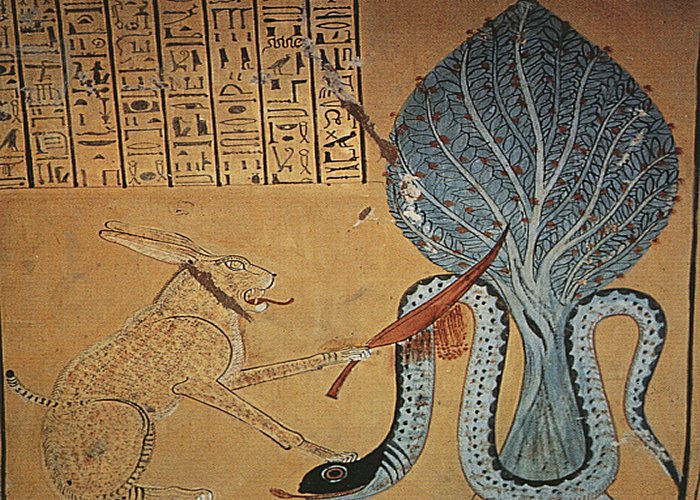
The sun god Ra, in the form of Great Cat, slays the snake Apep. Image credit: Eisnel - Public Domain
In Egyptian myths, snakes played an important, complex role but usually appeared as negative symbols of evil and chaos that caused the danger posed by their deadly bite. Fear of snakes was mainly widespread in the Delta, where they were abundant.
Apophis was frequently depicted on tomb walls in the New Kingdom and funerary papyri as a dangerous, giant serpent. Apophis, probably the 'Eater of Souls' and the great enemy of light and the sun god Ra was believed to dwell in the underworld.
The ancient Egyptian name of this gigantic night-demon serpent is Aaapef, but the Greek form Apophis is the most commonly used. According to some scholars, Apophis was a form taken by the god of darkness and evil, Seth.
Some early myths say that Apophis was primarily a sun god himself but had been cast off. Apophis' conflict with Ra is found in several mythic accounts; in one, it is said that each day, Apophis waited for Ra in Bakhu, the mythological mountain of the horizon, when the sunset, and according to another, the monster usually was lying hidden in wait to ambush the solar path of Ra, before dawn. Sometimes, his attempts to disturb Re resulted in storms and bad weather.
This god was not mentioned before the Middle Kingdom. For the time, the New Kingdom funerary papyri and depictions on tomb walls provided the most evidence of Apophis' existence. The story of Apophis birth dates to the second century BC and was discovered on the walls of Esna Temple, dedicated to the ram-headed creator god, Khnum, and located 55 km south of Luxor.
The goddess Neith (an archer goddess of the Delta) spat into the primeval waters, and Apophis sprang up from her saliva. Alternatively, Neith was the first being on the primordial mound, and she gave birth to the sun. Ra, blinded by his brilliance, could not see his mother when she called out to him, so he shed the tears that formed humanity and exerted the principle of duality: light could not exist without dark.
Therefore, immediately after the creation of the sun, the darkness, Apophis, was born as the antithesis of Ra from his tears. Some early myths say that Apophis was primarily a sun god himself but had been cast off.
This god was not mentioned before the Middle Kingdom (1975 BC to 1640 BC). For the time, the New Kingdom funerary papyri and depictions on tomb walls provide the most evidence of Apophis existence. During the New Kingdom (c. 1539–1075 BC), Apophis' battles against Ra were widespread. According to numerous tomb inscriptions, the defeat of this malignant serpent was an essential goal of most pharaohs.
Apophis was indestructible, but he was often depicted as being chopped to pieces, usually by Re, as a cat, one of the sacred animals in ancient Egypt. The Coffin Texts suggest that the snake could hypnotize attackers, and only the strongest of the gods, Seth, was unaffected by the magical stare of the creature.
Many temple scenes at Dendera, Deir el-Bahari, Philae, and Luxor depict a king striking a circular ball-like object, which is believed to represent the evil eye of Apophis'.
Like Seth, Apophis was associated with dangerous, terrifying natural events such as storms, unexplained darkness, and earthquakes. He was never worshipped but was included in numerous magical texts and rituals to fight his effects.
The" Book of the Overthrowing of Apophis", a typical ancient Egyptian spellbook contains many spells for fighting Apophis during Ra's nightly journey through the Duat. It also describes a ritual performed daily in the temple of Ra. According to it, Apophis was gashed and speared before every bone in his body was removed with red-hot knives. Then, his head, legs, and tail were singed, scorched, and consumed by fire. It was an ancient method to get rid of evil.
Written by – A. Sutherland - AncientPages.com Senior Staff Writer
Updated on Sep 26, 2023
Copyright © AncientPages.com All rights reserved. This material may not be published, broadcast, rewritten or redistributed in whole or part without the express written permission of AncientPages.com
Expand for referencesReferences:
Wilkinson, Complete Gods and Goddesses of Ancient Egypt,
Vernus, Lessing, The Gods of Ancient Egypt
More From Ancient Pages
-
 Why Was The Dmanisis Gora Fortress Community So Resilient In The Transition From The Bronze To Iron Age
-
 Disappearance Of Neanderthals: Were Inbreeding And Demographic Shifts Responsible?
-
 Secrets Of Bolshoi Zayatsky Island – Mysterious Stone Labyrinths Of Unknown Purpose And Origin
-
 Halicarnassus’ Monumental Tomb Built With Shining Stones Belonged To Carian Ruler Mausolus
-
 On This Day In History: Reginald Walter Bonham Was Born – On Jan 31, 1906
-
 Man Following Sinister Green Light Discovers Mysterious Ancient Artifacts And Strange Mummies In Secret Cave
-
 Dwarfie Stane: Mysterious 5,000-Year-Old Rock-Cut Tomb On Dark Enchanted Island Of Hoy, Scotland
-
 What Was Lex Salica?
-
 How Individuals With Disabilities Were Treated During The Late Middle Ages – Advanced Techniques Give Answers
-
 Administrative Centre Dated To 2181–2055 BC Unearthed In Kom Ombo, Upper Egypt
-
 Study Of Ancient Skulls Sheds Light On Human Interbreeding With Neandertals
-
 A Well-Preserved Lararium Shrine Discovered At Pompeii
-
 Giant Ancient Egyptian Fortress Discovered Along The Route Of Horus In The Sinai Desert
-
 Stone Age Friendship Ornaments Examined By Scientists
-
 World’s Oldest Lunisolar Calendar May Have Been Discovered At Göbekli Tepe, Turkey
-
 Who Or What Is Behind These Unexplained Lights Following People Over Long Distances?
-
 42,000-Year-Old Shell Jewelry Workshop Unearthed At The Paleolithic Site In France
-
 4,000-Year-Old Serpent-Shaped Wooden Stick Unearthed in Southern Finland
-
 Cats Were Rare And Expensive During The Viking Age – Spectacular Discovery Reveals Why
-
 Gigantic Asipatra: Terrifying Mythical Monster Bird In Hindu Beliefs


