
Mythical Egyptian Bennu Bird And Deity
A. Sutherland - AncientPages.com - The Bennu is an ancient Egyptian deity linked with the sun, creation, and rebirth. It may have been the inspiration for the phoenix in Greek mythology.
According to Egyptian mythology, the Bennu was a self-created being. This being played a role in the creation of the world. It was said to be the ba of Ra and enabled the creative actions of Atum.

According to Egyptian mythology, the Bennu was a self-created being. The Egyptian meaning of the Bennu is 'palm tree' and also 'purple heron'. This bird is clearly associated with the Phoenix and its legend is associated with the Bennu. The Bennu bird has red and golden plumage and is the sacred bird of Heliopolis, one of the oldest cities of ancient Egypt. Sacred Bennu has been also interpreted as the reincarnation of the Gods Ra and Osiris. Heliopolis is referred to as the City of the Sun and is known as one of the oldest Egyptian cities.
The ancient Egyptians believed the Bennu created itself from a fire that burned upon a holy tree in the temple of Ra and yet others believed that it exploded from the heart of Osiris.
It was said to have flown over the waters of Nun that existed before creation, landing on a rock and issuing a call that determined the nature of creation. It was also a symbol of rebirth and was therefore associated with Osiris.
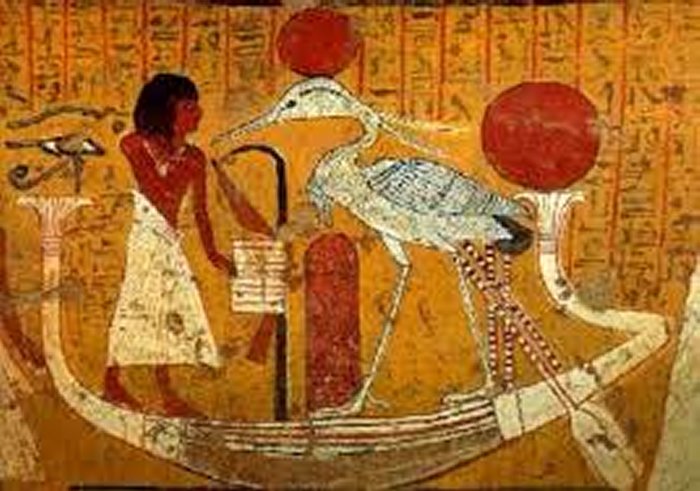
The Bennu was probably worshipped in their cult center at Heliopolis. Image via wikipedia
Some of the titles of the Bennu bird were "He Who Came Into Being by Himself", and "Lord of Jubilees"; the latter epithet referred to the belief that the Bennu periodically renewed itself like the sun. Its name is related to the Egyptian verb wbn, meaning "to rise in brilliance" or "to shine".
The Pyramid Texts refer to the yellow wagtail as a symbol of Atum, and it may have been the original form of the Bennu bird. New Kingdom artwork shows the Bennu as a grey heron with a long beak and a two-feathered crest, sometimes perched on a benben stone (representing Ra) or in a willow tree (representing Osiris). Because of its connection with Osiris, it sometimes wears the atef crown.

‘Benu’-bird (the Phoenix). Inerkhau ("Onuris appears" - Onuris was a Greek inflection of the name of the god Iny-Hor) who was the son of Hay and his wife was named Wabet. - here: worshipping the Benu-bird, the sacred phoenix wearing the Atef-Crown. Bennu bird - a symbol of resurrection.
A large species of heron, currently extinct, lived on the Arabian Peninsula in comparatively recent times; it may have been the ultimate inspiration for the Bennu. Reflecting this, the species was described as the Bennu heron (Ardea bennuides). Like Atum and Ra, the Bennu was probably worshipped in their cult center at Heliopolis. It also appears on funerary scarab amulets as a symbol of rebirth.
According to the Greek historian Herodotus, who wrote about Egypt in the fifth century BC, the priests at Heliopolis described the phoenix to him. They said it lived for 500 years before building its own funerary pyre and setting it alight.
The newborn offspring of the previous phoenix rose from the ashes of this fire and carried them to Heliopolis, depositing them on the temple's altar. Greek descriptions of the phoenix liken it to an eagle with red and gold plumage, reminiscent of the sun or of flames.
The name of the phoenix could be derived from "Bennu", and its rebirth and connections with the sun resemble those of the Bennu bird, although Egyptian sources do not mention the bird's death.
Written by A. Sutherland - AncientPages.com Staff Writer
Copyright © AncientPages.com All rights reserved. This material may not be published, broadcast, rewritten or redistributed in whole or part without the express written permission of AncientPages.com
More From Ancient Pages
-
 Mother, Father, Child, Marriage And Divorce In Viking Society
-
 Will-o’-the-wisp: Eerie Lights Over Swamps And Marshes That Frightened And Led People Astray
-
 Enigma Of Lycurgus Of Sparta – Great Reformer And His Foundation Of A Warlike Superior State
-
 Finds At Timna Valley Date Back To King Solomon-Era And Point To Sophisticated Ancient Society
-
 Hominins At Nyayanga, Kenya, Manufactured Oldowan Tools Primarily From Diverse Nonlocal Stones
-
 Unique 1,800-Year-Old Stone Sarcophagus Exposed In Ashkelon Building Site
-
 Mystery Of Viking Ship Burials In Hjarnø, Denmark And Their Unusual Design
-
 Ancient Mesopotamian City Lagash Reveals More Archaeological Secrets
-
 Teotihuacán: Enigmatic Birthplace Of The Gods And Its Obscure History
-
 Surprising Discovery Of Ancient Silver Coin Depicting Viking King Harald Hardrada In Hungary
-
 What Can The 3D Reconstruction Of The Principia At Novae Reveal About Roman Propaganda?
-
 Secrets Of Nanomaterial From The Middle Ages Examined By Scientists
-
 Karahunge – ‘Speaking Stones’ With Secrets – Remarkable Prehistoric Structures Of Armenia
-
 African Kingdom Of Axum – Ancient Ruins Of Early Churches Unearthed
-
 Vali – Son Of Odin, Who Avenged Death Of Balder And Survived Ragnarok
-
 On This Day In History: ‘Edict Of Nantes’ About Freedom Of Religion Issued By Henry IV – On Apr 13, 1598
-
 Ggantija Double Temple On Malta Is Older Than Stonehenge And Great Pyramid Of Giza
-
 Qanats: Ancient 3,000-Year-Old Underground Irrigation Canals Invented By People Of Persia
-
 Modern Humans Used Favorable Climatic Conditions On Their Long Way From Africa To Europe
-
 Strange Case Of The Italian Doppelganger – A Tragedy – Part 1

