
Lost Ancient Greco-Bactrian Kingdom Of 1,000 Cities
A. Sutherland - AncientPages.com - The Graeco-Bactrian Kingdom was located in the easternmost region of the Hellenistic world. This ancient kingdom covered Bactria (northern Afghanistan) and lands to the north (known in ancient times as Sogdiana, in present-day Turkmenistan, Uzbekistan, and Tajikistan).
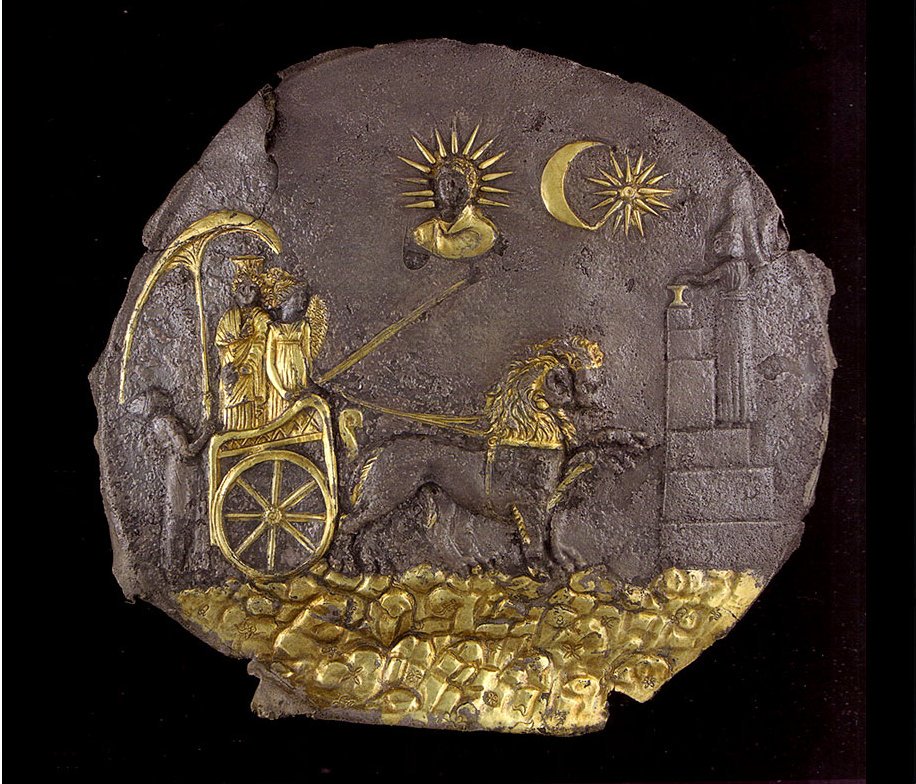 Silver plaque depicting the Greek goddess Cybele on a chariot is from a temple in Ai Khanum Afghanistan, 200 BC - Temporarily in Paris Musée Guimet. Image source - https://www.flickr.com/photos/28433765@N07/7102760363
For at least two centuries before Alexander arrived in 330 BC, Bactria had been a prized part of the Achaemenid Empire (559-330 BC) and, before that, the Median Empire (728-559 BC).
Greek prisoners captured in wars between the Achaemenids and Greeks during the 5th and 4th centuries BC were often exiled to Bactria and taken to Bactria.
When Alexander the Great and his army arrived in Bactria, many Greeks were already there. As a result, the Greek population grew more extensive in the region.
Bactrian Greeks were often employed by the Achaemenids in significant battles and conscripted by Alexander for his campaigns in the East.
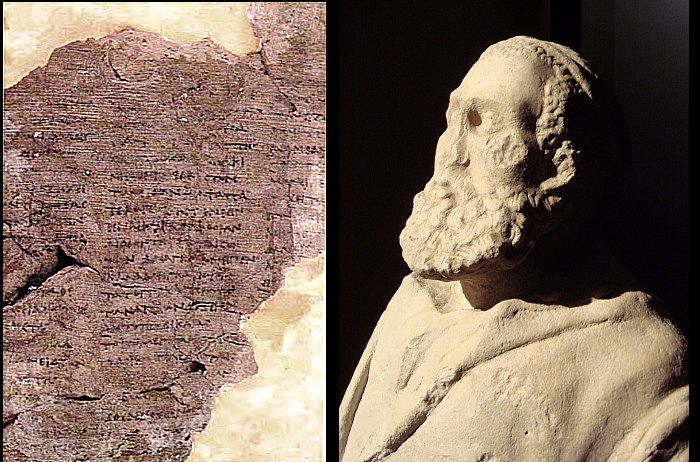
Left: Philosophical papyrus Ai Khanoum - Claude Rapin, 1992 (Non-creative 2D photograph of a 2nd century BCE papyrus.); Right: Sculpture of an old man, possibly a philosopher. Ai Khanoum, 2nd century BCE. Musee Guimet. Personal photograph 2006 - Public Domain
After the unexpected death of Alexander the Great, the situation in the region changed. Many of his Macedonian generals were left without a home. The kingdoms of the East were divided among Alexander, the Great's successors.
The government of Parthia was committed to Stasanor, a foreign ally because none of the Macedonians would deign to accept it. Subsequently, when the Macedonians were divided into parties by civil discord, the Parthians, with the other people of Upper Asia, followed Eumenes and went over to Antigonus when he was defeated.
After his death, they were under the rule of Seleucus Nicator and then under Antiochus and his successors, from whose great-grandson Seleucus they first revolted, in the first Punic war, when Lucius Manlius Vulso and Marcus Attilius Regulus were consuls.
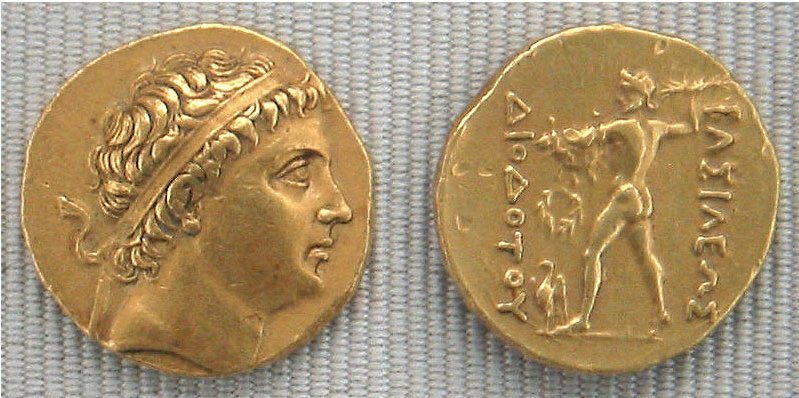 Gold coin of Diodotus I, Seleucid satrap of Bactria who rebelled against Seleucid emperor Antiochus and became the self-crowned ruler of the Greco- Bactrian kingdom. Image credit: National Library in Paris
For their revolt, the dispute between the two brothers, Seleucus and Antiochus, procured them impunity; for a while, they sought to wrest the throne from one another, but they neglected to pursue the revolters.
The ancient Greco-Bactrian kingdom first appeared in 250 BC. E when the satrap Diodotos (or Theodotus in Latin), governor of the thousand cities of Bactria, rebelled against his Seleucid ruler, Antiochos II assumed the title of king.
In the third century BC, the Greco-Bactrian kingdom became so powerful that it declared independence.
People from various nationalities, such as Persians, Indians, Scythians, and many nomadic groups, contributed to developing a unique kingdom. Greco-Bactrian art was known to be one of the finest at this time.
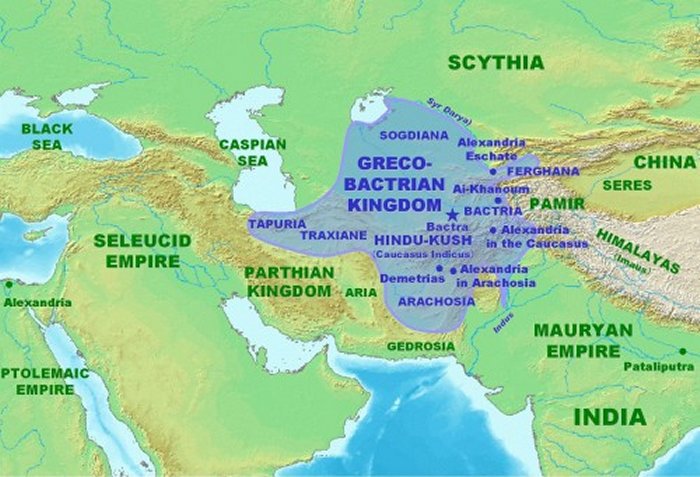 Greco Bactria Kingdom map -Approximate maximum extent of the Greco-Bactrian Kingdom circa 170 BC, under the reign of Eucratides the Great, including the regions of Tapuria and Traxiane to the West, Sogdiana and Ferghana to the north, Bactria and Arachosia to the south. Martinez-Sève, Laurianne (2020) "Afghan Bactria" in Mairs, Rachel , ed. The Graeco-Bactrian and Indo-Greek World (1st ed.), London: Routledge, pp. 218–219
The culture and vast wealth these nomadic warriors accumulated during their advance were documented by the jewelry, ceremonial weapons, and other treasure found at the Scythian-era site, Tillia Tepe, in northwestern Afghanistan, where five princely graves yielded some 20,000 pieces of gold.
The Greco-Bactrian kingdom became known as the empire of 1,000 cities, but sooner or later, everything ended.
In 126 BC, the Chinese chronicler Zhang Qian visited Bactria (known as Daxia in Chinese) and described a kingdom that had collapsed while its large population and urban infrastructure remained:
 Ancient ruins of the Greco-Bactrian kingdom. Image credit: Center For Environmental Management
"Daxia (Bactria) is located ... south of the Gui (Oxus) river. Its people cultivate the land and have cities and houses. It has no great ruler but only several petty chiefs ruling the various cities. The people are poor in using arms and afraid of battle, but they are clever at commerce. After the Great Yuezhi moved west and attacked Daxia, the entire country came under their sway.
The country's population is large, numbering some 1,000,000 or more persons. The capital is called the city of Lanshi (Bactra) and has a market where all sorts of goods are bought and sold."
The last Graeco-Bactrian king was Heliocles, who ruled 150-125 BC and moved his capital to the Kabul Valley.
Written by – A. Sutherland AncientPages.com Staff Writer
Updated on January 21, 2023
Copyright © AncientPages.com All rights reserved. This material may not be published, broadcast, rewritten or redistributed in whole or part without the express written permission of AncientPages.com
More From Ancient Pages
-
 Basajaun: Giant Blacksmith, ‘Lord Of The Woods’ And How People Learned Secrets Of Agriculture
-
 Mask Of Shame: Worn In Ancient Times As Punishment For Gossiping
-
 Helmet Of Meskalamdug – Sumerian King Of The First Dynasty Of Ur
-
 ‘Throughout All Days And Nights, Forever’: Could An 11th-Century Contract Show Same-Sex Marriage In Medieval Spain?
-
 Underwater Stone Age Village Habonim North Found Off Israel’s Carmel Coast Thrived During Climate Change
-
 Rock Stars: How A Group Of Scientists In South Africa Rescued A Rare 500 Kg Chunk Of Human History
-
 Stone Age Humans Unlocked The Glucose In Plants 40,000 Years Ago
-
 Sinister Mythical Dark Elves And Light Elves And Their Magical Ship ‘Skidbladnir’
-
 Traces Of Viking Raids Remain Visible In Modern Russian Economy And Politics
-
 Scotland’s Mysterious Ballachulish Figure Could Be Cailleach Bheithir – Ancient Hag Goddess Of Winds And Storms
-
 Surprising Discovery In Valsgärde Viking Boat Graves – Scandinavian’s Oldest Down Bedding Found
-
 Irrigation Works And Flood Protection Were Crucial For Defining The Golden Age Of Sumer
-
 Thousand-Year-Old Farming Techniques And Irrigation Systems Can Be Used To Mitigate Climate Change
-
 7,000-Year-Old Underwater Wall Discovered Off French Coast – Has The Mythical Submerged City Of Ys Been Found?
-
 Collection Of 59 Well-Preserved 26th Dynasty Coffins Unearthed In Saqqara Necropolis, Egypt
-
 Rare And Well-Preserved Inka Tunic Discovered In Chile
-
 Zawisza Czarny: Most Famous Polish Knight And The Quest For His Family Home
-
 Viking Artifacts Discovered In Canada Are More Mysterious Than First Thought
-
 Prehistoric Human Migration In Southeast Asia Driven By Sea-Level Rise – Study Reveals
-
 Mysterious Runic Inscription Found In Mighty Viking Ship Burial Surprises Archaeologists


