AncientPages.com - In 1061, two men, Pedro Díaz and Munio Vandilaz, signed a legal agreement in which they undertook to share the management of the house and church of Santa María de Ordes – most likely the current parish of the same name in the Ourense municipality of Rairiz de Veiga, in Northwestern Spain.
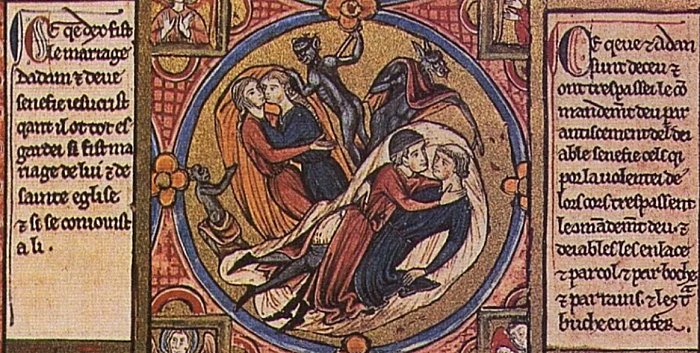
Illustration of two same-sex couples kissing, taken from Codex Vindobonensis 2554. Österreichische Nationalbibliothek, Vienna.
Judging by their surnames, the men were not relatives but rather, as we will see, friends.
So far, nothing strange or exceptional.
An everyday document
It was also unremarkable that two laymen who were not family decided what to do with assets that, today, we would define as ecclesiastical. Churches and monasteries were often part of the assets of the wealthiest families, who were completely free to decide what to do with them. At this time, the Church also lacked the power or the ability to unilaterally manage all of its material goods.
The text that details the agreement in question is preserved in the cartulary of the monastery of El Salvador de Celanova, one of the most important historical archives of the Hispanic world in the High Middle Ages, with a particularly rich and interesting number of documents. It specifies that both men were equal owners of the church.
It goes on to list the functions they were to share, a fairly standard inventory of the various tasks and duties carried out in the monasteries of early medieval Europe: looking after guests; directing, feeding and clothing servants; cultivating the lands and orchard. Lastly, and perhaps in reference to the horizontal aspirations of monastic societies, it is specified that both men should have the same rights to food, drink and clothing.
‘Throughout all days and nights, forever’
This is the point where the document begins to stray from what might be considered usual. Less usual but not for that reason unusual, since this text still fits within what has come to be defined as artificial kinship, a legal construct that has been documented throughout much of the early medieval European world.
This structure allowed people who were not related to agree to consider one another siblings, in order to defend each other or share property. Shared ownership and management are present in the case of Pedro Díaz and Munio Vandilaz, but it also specifies that this is to be done as “good friends, full of faithfulness and truth, throughout all days and nights, forever”.
This emotional passage, which goes far beyond the simple needs of documenting an agreement, has led some historians to see this as more than just another example of artificial kinship.
The first to open up this avenue of research was the American medievalist John Boswell (1947-1994). In his work The Marriage of Likeness: Same Sex Unions in Pre-Modern Europe – which covered same-sex unions from classical antiquity to the Middle Ages – he chose this document as one of those which, according to his hypothesis, concealed a loving, marital union between two men.
Spanish legal historian Eduardo de Hinojosa, who lived between the second half of the 19th century and the beginning of the 20th century, had previously commented on this document as an example of artificial kinship. Hinojosa’s interpretation differed from Boswell’s, which is not surprising, since the academic and cultural standards of his time were not favourable for delving into a history of emotions, sex or homosexuality.
Difficult to define
Boswell’s interpretation has been followed up by other contemporary historians, notably the Galician philologist and historian Carlos Callón. In his work Amigos e sodomitas (Friends and Sodomites) this document forms a cornerstone of Callón’s argument regarding the existence of romantic relationships between people of the same sex which were consensual and publicly recognised during the Middle Ages.
Although the task of interpreting the original document is not easy, what is certain is that the Middle Ages are far from the dark, backwards and savage era that some continue to imagine. It is important to remember that in the the Middle Ages there was even homoerotic literature, a fact that reveals a certain permissive attitude and recognition of loving and sexual relations between people of the same sex.
This document may therefore be a factual, non-literary example of a recognised same-sex union during the Medieval period.
Provided by The Conversation
This article is republished from The Conversation under a Creative Commons license. Read the original article.