
Sir Marc Aurel Stein: Famous Fascinating Expeditions To Ancient Places Of The Silk Road
A. Sutherland - AncientPages.com - Sir Aurel Stein (1862 – 1943), British archaeologist, explorer famous for his archaeological discoveries in Central Asia, was fascinated by the history of the Silk Road.
For many years, Stein conducted scientific and archaeological excavations in various Asian countries and a large part of the exhibits at the British Museum and British Library comes from Stein's exploration.
 Aurel Stein’s view of Mogao Cave 16, in Dunhuang, Gansu Province, China, with a number of manuscripts from Cave 17 bundled on the floor. After Aurel Stein, Serindia: Detailed report of explorations in Central Asia and westernmost China (Oxford: Clarendon Press, 1932), vol. 2, fig. 200
In March 1907, during his second expedition to Central Asia, Stein visited Dunhuang, an important city on the trade route known as the Silk Road, and learned about the Dunhuang Mogao grottoes.
Using a small bribe he convinced Wang Yuanlu, a Taoist monk to sell him 12 boxes of manuscripts, painted on silk. In June 1907 years Stein smuggled them out of Dunhuang, and in August 1908 took them from China.
In May of 1900, Stein began his first trip to western China and the Taklamakan Desert. This trip lasted nearly two years. He discovered beautiful Buddhist sculptures, paintings, and Sanskrit texts. At Niya - an archaeological site about 115 km (71 mi) on the southern edge of the Tarim Basin in modern-day Xinjiang, China, Stein found many priceless artifacts.
Among them more than 100 wooden tablets written in 105 CE, with clay seals, official documents written in an early Indian script. Other his discoveries included a carved stool, a mousetrap, a part of the guitar, a bow, and more.
The first expedition made him a famous man.

The ruins of a Han Dynasty (202 BC - 220 AD) Chinese watchtower made of rammed earth at Dunhuang.
Stein also visited the site known as the Limes Watchtowers, fortified encampments located north of Dunhuang in northwest China, along the edges of the Taklamakan Desert. They extend the wall completed by Emperor Qin Shi Huangdi (259-210 BC) in 214 BC as a barrier against the Xiongnu.
Under the Han Dynasty (206 BC-220 AD) the walls were carried over 1,600 kilometers to the west, to the easternmost edge of the Tarim Basin - where a series of mummies discovered in present-day Xinjiang, China.
The walls and beacon towers protected China's trade and military colonies and served as a base for expansion into Central Asia.
They were made of stamped clay and gravel, alternating with layers with wood, to protect against corrosion by wind-blown sand. They were completed in less than a century with water carried over huge distances.
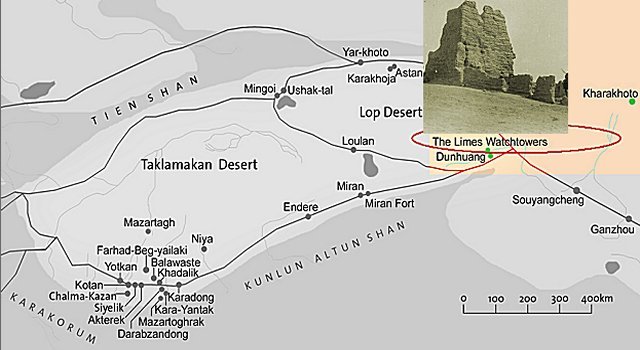
Location of the Limes Watchtowers, Sir Marc Aurel Stein' region of exploration.
Behind the walls lay a series of watchtowers in varying in size, some as much as twenty feet square and as lofty as 30-40 feet. These housed small numbers of soldiers who watched the desert and signaled to armies stationed at nearby Dunhuang through a system of couriers and fire signals.
In one case, Stein gives some details regarding the towers:
"The watch-tower, built entirely of regular courses of hard clay about four inches thick, with thin layers of tamarisk branches laid between them, still rose to over twenty-two feet. In order to give additional cohesion to the solid base measuring about twenty feet square, numerous wooden posts had been set in it vertically, and their ends were sticking out on the top.
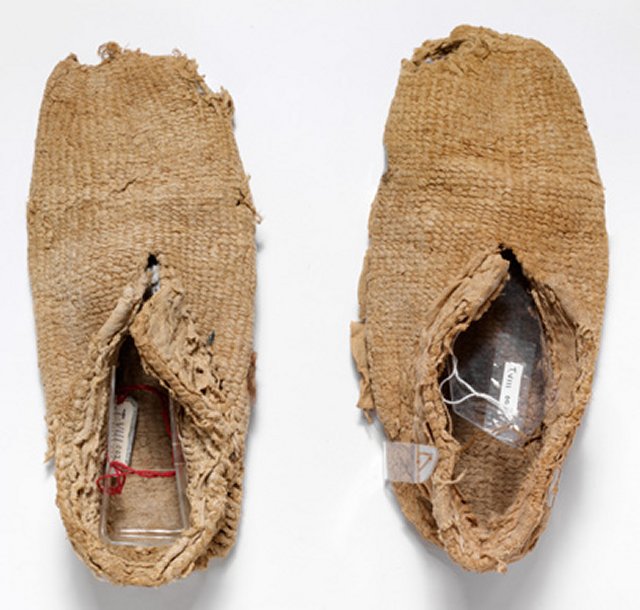
Pair of shoes. Central Asia. Western Han dynasty, 206 BC-10 AD. Plain weave in plant fiber, felted wool, and leather Width 12 cm x length 26.5 cm. Museum no. LOAN: STEIN.55 (T.VIII.002) © Victoria and Albert Museum, London
The wall once guarded by the tower had passed to the north of it, with a bastion-like projection at about six yards' distance.... "(Stein, II, p. 50)
Within the towers, Stein found an astounding range of artifacts, which provide a glimpse of garrison life and military operations under the Han Empire, including bronze mirrors, coarse pottery, tools, leather armor, weapons, shoes, and clothing.
Ancient documents included personal letters on silk and wood, military directives and supply lists, and treatises on a range of subjects, including medicine and astrology.
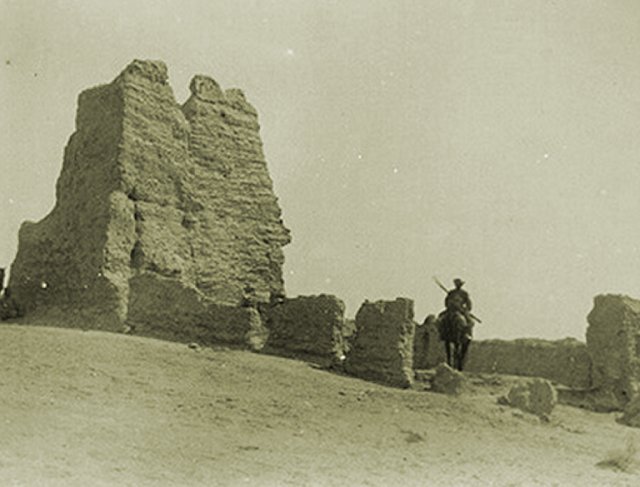
The Limes Watchtowers, Sir Marc Aurel Stein, 1914. Photo 392/28(479), © The British Library Board
Stein's third expedition was also fruitful. He contributed hundreds of artifacts, manuscripts, and silks to the British Museum.
He discovered ancient tombs, found lost ancient languages, unearthed the first printed book and much more. However, after Stein's expeditions, the Chinese denied any further excavations in their ancient sites. He and other foreign archaeologists robbed China of its history.
Written by – A. Sutherland AncientPages.com Staff Writer
Copyright © AncientPages.com All rights reserved. This material may not be published, broadcast, rewritten or redistributed in whole or part without the express written permission of AncientPages.com
Expand for referencesMore From Ancient Pages
-
 On This Day In History: William Penn – English Philosopher, Quaker And Founder Of Pennsylvania Was Born – Oct 14, 1644
-
 Sonar Images Reveal The Existence Of A 700-Year-Old Shipwreck At The Bottom Of Lake Mjøsa, Norway
-
 Ancient Human Remains Buried In Spanish Caves Were Subsequently Manipulated And Utilized
-
 Number Eight Powerful Symbol In Ancient Traditions Of Many Cultures
-
 DNA Study Of Ice Age Survivors Reveals A Surprise About The Gravettian Culture
-
 Archaeological Evidence Ancient Egyptians Visited South America
-
 Unusual Parcel With 500-Year-Old Horn Container Discovered In South Africa Sheds Light On Pre-Colonial Khoisan Medicines
-
 On This Day In History: The King James Bible Is Published For The First Time In London – On May 2, 1611
-
 Magical And Malicious Creatures That Prey Upon Yggdrasil In Norse Beliefs
-
 Aboriginal ‘Memories’ Of Australia’s Coastline Go Back More Than 7,000 Years
-
 Native American Tradition Of A Vision Quest – How To Enter The Spiritual World
-
 Intriguing Genetics: First Ancient Irish Human Genomes – Sequenced
-
 History Of Eyeglasses: One Of The Most Important Inventions Is Lost To History
-
 Mystery Of Prehistoric Gigantic Hill Figures Of England
-
 Massive Roman-Era Column Base Of Limestone Unearthed In The Foothills Of Mount Hermon, Golan Heights
-
 Mystery Of The Ancient Reptilian Gods Remains A Complex Subject – Alien Worlds – Part 2
-
 Traces Of Ancient Near East Civilization In America – An Out-Of-Place Ancient Inscription – Part 2
-
 Bones Of Giants Unearthed In Ancient Cave
-
 Impressive Ancient Underground Tombs And Chapels Unearthed In Saqqara, Egypt
-
 Unique 1800-Year-Old Roman Coin Unearthed On Southern Carmel

