
Mogao Grottoes, Dunhuang, China – Fascinating Statues, Manuscripts And Wall Paintings
A. Sutherland - AncientPages.com - The Mogao Grottoes, near the oasis town of Dunhuang in the Gobi Desert, China are where generations of Buddhist monks built hundreds of rock temples.
Many believe that Dunhuang (the town's name means "blazing beacon") is probably the most important historical site in China. Nearly five hundred grottoes remain, lined with painted clay sculptures and wall paintings that depict legends, portraits, customs, and arts of China.
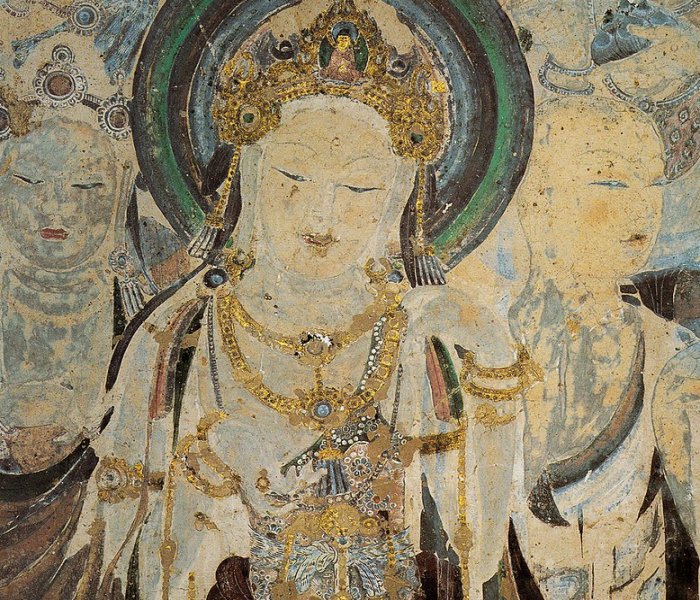
Mural of Avalokiteśvara (Guanyin), Worshipping Bodhisattvas and Mendicant in cave 57. Figures originally adorned with gold leaf. Early Tang. Image source
They were discovered at the beginning of the 20th century and over time they revealed an enormous treasure trove of Buddhist art in form of manuscripts, sculptures, painted scrolls, and wall paintings ranging in date from the 4th to the 14th centuries.
The cave temples preserve about 2,000 Buddhist sculptures, 45,000 square meters of murals, and more than 60,000 texts.

The figure of Maitreya Buddha in cave 275 from Northern Liang (397–439), one of the earliest caves. The crossed ankle figure with a three-disk crown shows influence from Kushan art. Image credit: - CC BY-SA 4.0
The Mogao Caves - tell a story of art and Buddhism that began more than 1,500 years ago.
Today, Princeton scholars and students - in collaboration with the Dunhuang Academy in China - are exploring the significance of the site in the history of China and this region.
Additionally, the site - the world’s largest repository of Buddhist paintings - also possesses many of China’s oldest Buddhist paintings. Ancient records say that in 366 CE, Buddhist monks began to carve the first caves into the cliff stretching about 1 mile along the Daquan River.
There is a beautiful story behind the creation of the "Caves of the Thousand Buddhas". It all started with a Buddhist monk Shamen Le Zun, who was traveling westwards towards Central Asia in search of the Buddhist truth.
One day, he had a vision of light and 1,000 Buddhas, which inspired him to carve the first cave in the middle of a desert oasis. After him, other monks joined him and carved their own caves; generations of Buddhist monks built hundreds of rock temples.

Mogao Cave 17 - This one-room cave temple was originally designed in the 9th century to memorialize the monk depicted in the statue, Hongbian, who died in the year 862. Photo courtesy of Dunhuang Academy
About 40 of them date from the Northern Wei-dynasty (385-557). More were added during the Sui-dynasty (581-618). Most of the caves were made during the Tang dynasty (until ca. 750), when Buddhism and the Silk Route were in their prime.
They are lined with painted clay sculptures and wall paintings that depict legends, portraits, customs, and arts of China. Caves in the complex came in every size. There were sleeping quarters, meditation niches, libraries, lecture halls, and halls to hold large ceremonies.
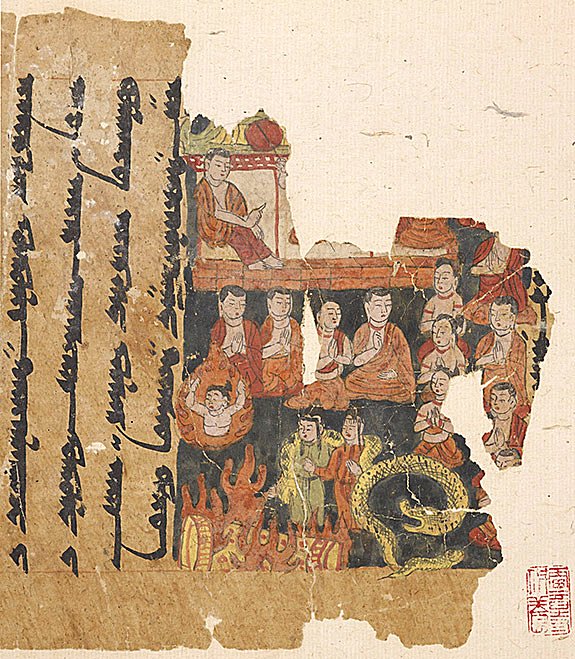
The text of this manuscript on karmic retribution contains dialogues illustrating the consequences in the next life of performing various deeds in this life. It is written in Old Uighur (or Old Turkish). The illustration depicts monks in prayer, a couple encircled by a serpent, and a sinner in flames. Credits: The East Asian Library and the Gest Collection, Princeton University
After 1000 AD, an incredible archive —with up to 50,000 documents, hundreds of paintings, together with textiles and other artifacts— had been sealed up in a chamber adjacent to one of the caves (Cave 17), perhaps to protect the contents from invading armies.

Its entrance was concealed behind a wall painting and the trove remained hidden from sight for centuries. In 1900, it was discovered by Wang Yuanlu, a Daoist monk who had appointed himself abbot and guardian of the cave temples. The first Western expedition to reach Dunhuang arrived in 1879.
More than twenty years later Hungarian-born Marc Aurel Stein, a British archaeologist, and explorer reached Dunhuang in 1907 and bought seven thousand complete manuscripts and six thousand in fragments, as well as several cases loaded with paintings, embroideries, and other artifacts.
Later others followed after him.
The wall paintings were done in dry fresco. The walls were prepared with a mixture of mud, straw, and reeds that were covered with a lime paste. The sculptures are constructed with a wooden armature, straw, reeds, and plaster.
The colors in the paintings and on the sculptures were done with mineral pigments as well as gold and silver leaf. All the Dunhuang caves face east.
Due to sandstorms and erosion, Mogao Caves are constantly in danger to be destroyed.
The beautiful interior of the caves can be admired - here.
Written by – A. Sutherland - AncientPages.com Senior Staff Writer
Copyright © AncientPages.com All rights reserved. This material may not be published, broadcast, rewritten or redistributed in whole or part without the express written permission of AncientPages.com
More From Ancient Pages
-
 Who Were The First Icelanders?
-
 Mysterious Ancient Star-Shaped ‘Fossil’ Baffles Scientists – What Is It?
-
 Moirai (The Fates): Greek Incarnations Of Destiny And Personification Of A Single, Unavoidable Fate
-
 Joseph Pujol – The Professional Farter Who Entertained People
-
 Unraveling The Mystery Of Ancient ‘False Doorways’
-
 Spicy History Of Chili Peppers – Study From University Of Alabama
-
 Never-Ending Battle Of The Oak King and Holly King – Confrontation Of The Light And The Darkness
-
 Yokai Amabie – Protective Ancient Spirit That Can Ward Off Epidemics
-
 Viking Treasures Discovered In Chamber Grave In Denmark
-
 Archaeologists uncover new Yup’ik artifacts near Quinhagak, Southwest Alaska
-
 World’s Largest DNA Study Of Viking Skeletons Re-Writes Ancient History – Norse Warriors Were Not Those Who We Thought
-
 Fossilized Skulls Reveal Relatives Of Today’s Rhinos Had No Horn And Died Out 5 Million Years Ago
-
 Sobek: A 2,500-Year-Old Mummified Nile Crocodile – On Display At The British Museum
-
 Ancient Mystery Of The Massive, Astronomically Oriented Buildings Worldwide
-
![Photo taken on Dec 20, 2015 shows hoof-shaped gold ware unearthed from the main coffin in the Haihunhou (Marquis of Haihun) cemetery, East China's Jiangxi province. [Photo/Xinhua]](https://www.ancientpages.com/wp-content/uploads/2015/12/MarquisofHaihuntomb1-307x150.jpg) Does A 2,000-Year-Old Tomb Belong To Marquis of Haihun? – Search For His Seal Continues
Does A 2,000-Year-Old Tomb Belong To Marquis of Haihun? – Search For His Seal Continues
-
 Mystery Of An Edinburgh Crypt – Secrets Of Warriors Of Dark Ages In Scotland – Revealed
-
 Secret Hidden Freemasonic Messages Concealed In Ancient Egyptian Artifacts And Roman Works – A Misunderstood Object? – Part 1
-
 DNA From Doggerland That Separates The UK From Europe – New Study
-
 Underwater Ancient Cypress Forest Offers Clues To The Past
-
 The Faery Grail Of Hospitality And Accord – Secrets Of The Elucidation – Part 2

