
Precious Ancient Chinese Immortality Suits Made Of Jade
A. Sutherland - AncientPages.com - Jade suits were first documented in literature around AD 320, although there is archaeological proof of their existence that dates back thousands of years.
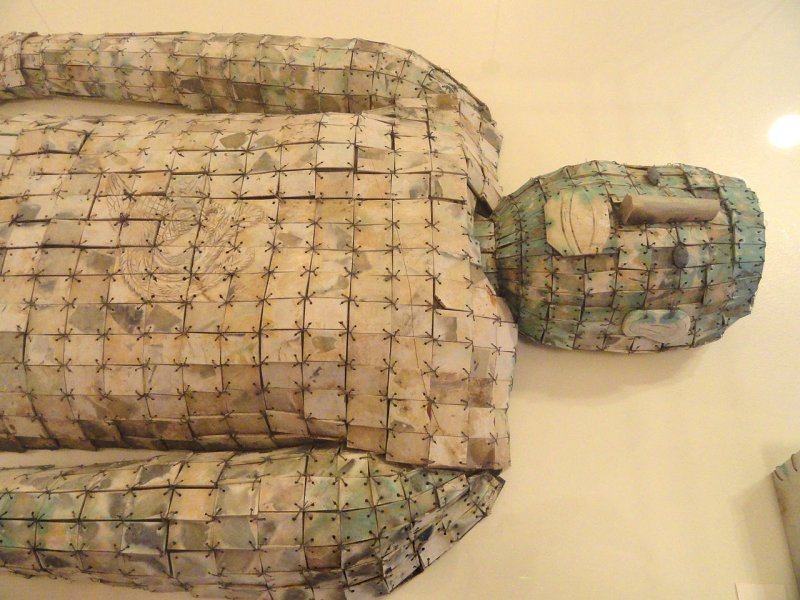
Detail of a jade burial suit with replaced copper wire in the George Walter Vincent Smith Art Museum in Springfield, Massachusetts. Image credit: - CC0
The Chinese people have long considered jade to be foremost among the most valuable treasures that Nature offered humanity.
During the Neolithic Age, stoneworking gradually gave rise to the production of jade articles. At first, jade was used to make ornaments, and later, for making ritual objects used in sacrificial ceremonies.
Ancient texts dated to the Han Dynasty (206 BC - 220 CE) say that members of the imperial family were buried in jade burial suits.
According to the Book of Later Ha, an ancient document, during Han era, jade burial outfits for the Chinesee emperors were sewed by gold threads, while other royal family members had the jade clothes put together with silver or copper threads.
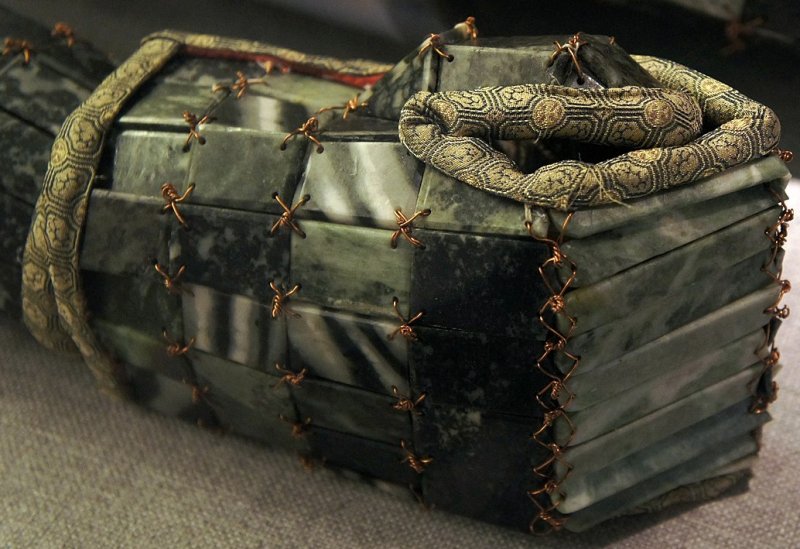
Detail of the hand section of the jade burial suit of Liu Sui, Prince of Liang, of Western Han. Image credit: - CC BY-SA 3.0
The type of threads used for the preparation of the jade burial suit, depended on the social status of the buried person. People believed jade possessed magical properties to protect the body from decay and ward off evil spirits. Attempts to preserve the body reflect the belief that the earthly aspect of the soul continues to dwell in the body after death.
First, jade materials transported from far-away places were processed into thousands of small jade pieces of specific shapes and sizes.
Secondly, each jade piece was polished and drilled, with the shapes and sizes of the holes undergoing particular scrutiny; thirdly, a lot of specially made gold, silver, or copper threads were used to join the jade pieces.
The jade burial suits of emperors used gold thread; princes, princesses, dukes, and marquises, silver thread; sons or daughters of those given silver thread, copper thread; and lesser aristocrats, silk thread. All others were forbidden to be buried in jade burial suits.
Making a jade burial suit was problematic because its hand-making process was complicated and sophisticated.
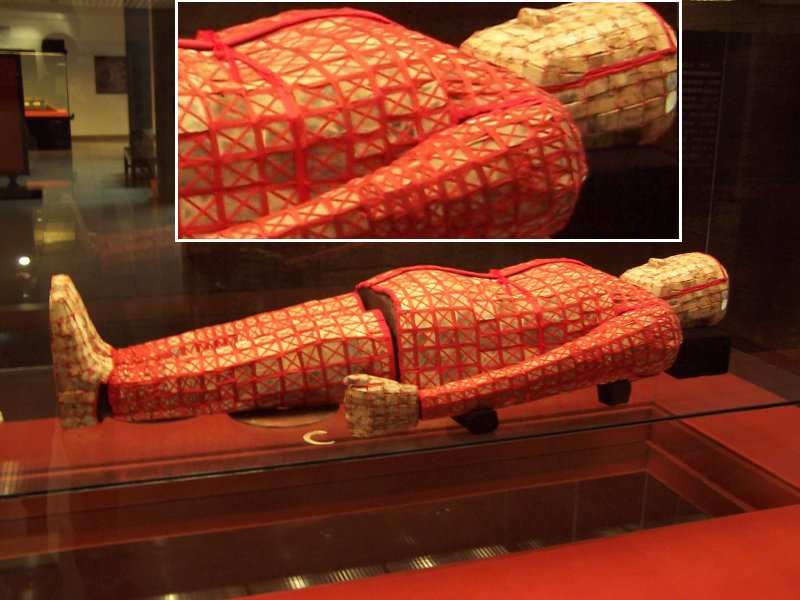
Jade burial suit at the Museum of the Mausoleum of the Nanyue King, in Guangzhou. Image credit: Pubuhan - CC BY-SA 2.5
The most beautiful suits are today preserved in Xuzhou, a city little known in the Western world, but during the early Han Dynasty, Xuzhou was one of the most important regions of China.
Liu Sheng's jade suit was made of 2498 pieces of jade, sewn together with 1.1 kilograms of gold thread (Dou Wan's was smaller). Each jade suit had twelve sections: face, head, front, and back of the tunic, arms, gloves, leggings, and feet.

The golden thread and jade clothes of Liu Sui from the tomb of Xishan No. 1 in the Western HanDynasty. The jade clothes were scattered when they were unearthed. After restoration, the length of the jade clothes was 1.76 meters. Image credit: Zcm11 - CC BY-SA 3.0
Experts estimate that a suit such as Liu Sheng's would have taken ten years to fashion. Along with the jade suits, Liu Sheng and Dou Wan each had a gilt bronze headrest inlaid with jade and held jade crescents in their hands.
After the Han Dynasty, the jade burial suit practice was forbidden in 222 and gradually disappeared.
Written by – A. Sutherland - AncientPages.com Senior Staff Writer
Updated on September 27, 2022
Copyright © AncientPages.com All rights reserved. This material may not be published, broadcast, rewritten or redistributed in whole or part without the express written permission of AncientPages.com
Expand for referencesReferences:
Kaleidoscope Cultural China
S-K. Psarras, Han Material Culture
[/expandMore From Ancient Pages
-
 Mysterious Tiahuanaco Empire Established By The Sons Of The Sun – An Unknown Chapter Of Prehistory
-
 Final Journey Of Ötzi Iceman: More Clues Found In Frozen Moss
-
 8,000-Year-Old Petroglyphs Discovered In Oldest Impact Crater In South Africa
-
 Human Occupation In Lava Tube Cave In Saudi Arabia – First Evidence Discovered
-
 First Discovery Of A 127-Million-Year-Old Side-Necked Turtle Fossil In UK
-
 Rise Of League Of Mayapán And The Last Great Maya Capital
-
 Mysterious Skeleton Of Unusual Lady Anchoress Of York Barbican Discovered By Archaeologists
-
 Tarascan Indians: Intriguing Pre-Columbian Civilization Of Artists, Warriors And Skilled Metallurgists
-
 Are These Puzzling Rings Finger Loops From Ancient Weapon Systems?
-
 Unexpected Discovery Of Roman Baths Under Split City Museum In Croatia
-
 Once Impressive Temple Of Hadrian In City Of Cyzicus Will Be Restored Soon
-
 Unique 4,000-Year-Old Board Game – Unearthed In Oman
-
 Terrace Farming Was Invented In South American Andes Over 1,000 Years Ago
-
 LIDAR Discovers Lost Colonial City Hidden In The Amazon Rainforest
-
 Ancient Shrine Of God Osiris-Ptah Neb And Rare Bust Of Emperor Marcus Aurelius Discovered In Egypt
-
 Telangana And Great Ancient Iron Masterwork Of Skilled Blacksmiths Of India
-
 On This Day In History: National Hero Paul Revere Warns Of The British Coming – On Apr 18, 1775
-
 4 Things Ancient Greeks And Romans Got Right About Mental Health
-
 Mysterious Bones May Re-Write History Of North America – Humans Were Present On The Continent 10 Times Earlier
-
 2000 Ancient Gold Spirals Used By Sun-Worshiping Priest-Kings During The Bronze Age Discovered In Denmark

