
Secrets Of Quipu – One Of The Most Mysterious Phenomena That Existed In Odd Number Of Dimensions
A. Sutherland - AncientPages.com - The Incan Empire, which stretched for over 2000 miles from the north to the south and had an estimated 10 million population - was the largest in pre-Columbian America.

An example of a quipu from the Inca Empire, currently in the Larco Museum Collection. Image credit: Claus Ableiter - CC BY-SA 3.0
To run the empire, the Inca had a sophisticated and organized government. Yet they had no written language but a curious invention, a form of non-verbal communication written in an encoded language similar to the binary code used by modern computers.
A quipu (or 'khipu' - (in Quechua' knot') was a series of strings with knots. The number of knots, the size of the knots, and the distance between knots conveyed meaning.
Each sovereign Inca formed an ayllu or "gens" of his descendants to preserve the memory of his deeds in quipus, traditions, and songs learned by heart. It is fascinating to see what details may be recorded on these cords, for which there are masters like our writing masters.

Quipu in the Museo Machu Picchu, Casa Concha, Cusco. Pi3.124 - CC BY-SA 4.0.
Gary Urton, professor of anthropology at Harvard University, has re-analyzed the complicated knotted and decorative strings of the Inca - decorative objects called 'quipu,' which is not only a way of binding strings but also their length, twisting the cord, and finally the color and type of yarn (to perform kipu Incas used the llama or alpaca hair.)
The system - good and very accurate - was traditionally handed down from fathers to sons, with all recorded past events, repeating the story of them many times, over and over again, until they were all finally memorized for future generations.
Quipus were complex assemblies of knotted ropes used in South America as a data storage device and played an essential role in the Inca administration. Only a few specialists could use and decipher them. Their meaning remains a mystery, but color, the relative position of knots, knot types, and rope length were used to encode categorical and quantitative variables.
The oldest known Quipu is 4600 years old.
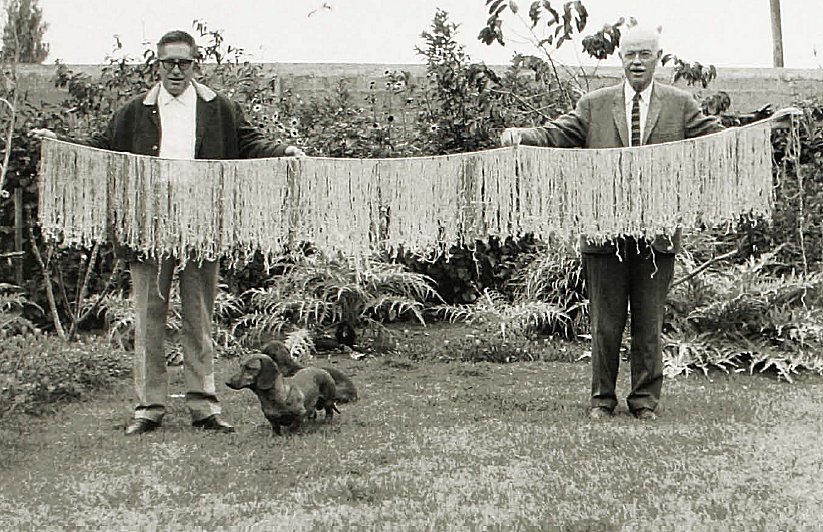 The longest known quipu. Photo credit: P. Dauelsberg
Unfortunately, in the late 16th century, quipus were still being used by Peruvians until the Roman Catholic Church decreed they were "the devil's work" and had most of them destroyed.
Urton discovered they contained a seven-bit binary code capable of conveying more than 1,500 separate information units.
Already, in the 1920s, historians demonstrated that the knots on the strings of some quipu were arranged in such a way that they were a store of calculations, a textile version of an abacus.
"The Incas had never acquired the art of writing, but they had developed an elaborate system of knotted cords called quipus. These were made of the wool of the alpaca or the llama, dyed in various colors, the significance of which was known to the magistrates.
The cords were knotted in such a way to represent the decimal system and were fastened at close intervals along the principal strand of the quipus. Thus, an important message relating to the progress of crops, the amount of taxes collected, or the advance of an enemy could be speedily sent by the trained runners along the post roads..." (Hiram Bingham, the American explorer who found the ruins of Machu Picchu in 1911, wrote in 'Lost City of the Incas.')
Unfortunately, only a few 'quipu' arrangements survived to the present time. The truth is that most of the copies were burned. When the Spaniards conquered the Inca State, the Catholic Church ruled that 'quipu' are the work of Satan and, as such, must, therefore, be destroyed, and so the Spanish conquistadors did in the 16th century.
Approximately 200 of them, dating no earlier than about 650 AD, have been found and still can be analyzed.
Today, the Quipu is considered the world's first three-dimensional language, and deciphering the Inca's encoded writings can be compared to decrypting ancient Egyptian hieroglyphs.
In 2005, the American magazine "Science" published a sensational discovery that the 'quipu' system was not only memorizing numbers but probably non-numeric data - geographical names, names, and more.
With the 'quipu' system, the Inca could also perform complicated calculations, which sufficed to organize the whole empire's economy. However, some believe it was more than a mere calculating device.
In 1996, a manuscript called Historia et Rudimenta Linguae Piruanorum came to light in Italy among the family possessions of a Naples historian.
This fascinating document - supposedly written in the early 17th century by Jesuits - contains a fragment of 'quipu' and explains how Quipu was used to encode spoken language. According to the manuscript, "ideograms" or symbols with well-known meanings from Incan art were used as either phonograms (to represent sounds) or logograms (to denote words).
In 'The Ancient Civilizations of Peru,' J. Alden Mason (among other researchers) suggests another purpose of 'quipu,' namely - a historical record of the whole empire.

The following example demonstrates three segments from a level II cord (UR068) and a segment from a level III cord (UR067), laid out such that the summation of level II numbers match the values in the same relative positions on the level III cord.
Some Chinese chronicles mention certain emperors' wish to replace the ideographic script with one based on knots.
It indicates the existence of links between pre-Columbian America and Asia.
According to Baron Nordenskiold, an expert from Sweden, 'writing need not be the only way expressing thought.' Nordenskiold believed that 'quipu' might represent prophecies and horoscopes as well as mathematical calculations.
Modern mathematicians consider the Inca knots as one of the most mysterious phenomena that can occur in a vast number of dimensions!
Some of the simplest kinds of knots have been already deciphered. It has yet to be found a universal method to decipher all the sacred 'quipu' records of the Inca.
Many discoveries are yet to be made, and time will tell what secrets quipus hold. The use of the "quipu" for accounting purposes has been predominantly attributed to the Inca culture of Peru; however, documented evidence shows that early Hawaiians and ancient Chinese used it much earlier.
Written by A. Sutherland - AncientPages.com Staff Writer
Updated on Nov 1, 2023
Copyright © AncientPages.com. All rights reserved. This material may not be published, broadcast, rewritten or redistributed in whole or part without the express written permission of AncientPages.com
Expand for referencesReferences:
Sze Arthur, Quipu
Urton, Gary. Inka history in knots
The New York Times, Untangling an Accounting Tool and an Ancient Incan Mystery
More From Ancient Pages
-
 DNA Identifies Historical Remains Of George Washington’s Relatives
-
 Ancient Egyptians Invented World’s Oldest Egg Ovens And They Are Still In Use
-
 Amazing New Frescoes With Mythological Individuals Discovered At Pompeii
-
 A King’s Discovery Of A Mysterious Underground World
-
 1,800-Year-Old Slab Engraved With Inscription Unearthed In Ruins Of Ancient City Of Hadrianapolis
-
 On This Day In History: Roman Emperor Trajan Was Born In Spain – On Sep 18, 53 AD
-
 Archaeologists Refute Claims That A Comet Destroyed Hopewell Culture
-
 Revealing 1,200 Years Of Arctic Canadian Cultures And Settlements In Canada
-
 Rare Mammoth Ivory Tool Offers Evidence Of Ropemaking In Central Europe More Than 35,000 Years Ago
-
 10 Remarkable Advanced Ancient Technologies Ahead Of Their Times
-
 The Invisible Plant Technology Of The Prehistoric Philippines
-
 X-Rays Reveal Secret From Da Vinci’s Masterpiece Mona Lisa
-
 Unexplained Phenomenon In East Anglia – Time Portal And Strange Glimpses From The Past – Part 1
-
 13 Ancient Terracotta Figurines Associated With Cybele And Attis Unearthed In Pompeii
-
 Mysterious Stone Age Cemetery Found Near The Arctic – Why Are The Graves Empty?
-
 Meet The First Neanderthal Family And Community
-
 Tile Tomb Dated To The Late Hellenistic Era – Discovered In Surroundings Of Istanbul, Turkey
-
 200,000-Year-Old Grass Bed Discovered In South Africa’s Border Cave
-
 3,800-Year-Old Cuneiform Clay Tablet With Agreement To Purchase A City Discovered In An Ancient Tumulus In Turkey
-
 On This Day In History: Astronomer John Couch Adams And The Discovery Of Planet Neptune – On July 3, 1841

