
Discovery Of Half-Million-Year-Old Wooden Structure Shows We’re Wrong To Underestimate Our Ancient Relatives
AncientPages.com - To most people, complex technologies separate modern humans from their ancestors who lived in the Stone Age, thousands or hundreds of thousands of years ago. In today's fast changing world, older technologies, even those from a few years ago, are often described dismissively as "Stone Age."
Such terms serve to disconnect us from our ancient relatives, who were much more sophisticated than we sometimes think they were.
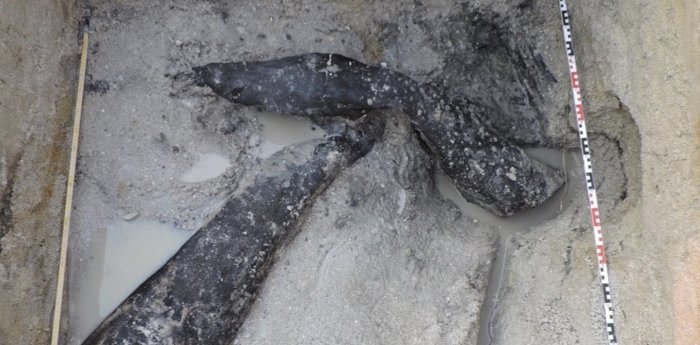
Excavators found part of a structure formed by two overlapping logs. Credit: Barham et al. Nature (2023), Author provided
A team led by archaeologist Larry Barham at the University of Liverpool recently published robust and well dated evidence for the earliest known use of wood technology. The wooden structure, along with artifacts, date to 476,000 years ago and have been excavated from waterlogged deposits at Kalambo Falls, Zambia.
This archaeological site is famous for producing traces of human cultural development dating to hundreds of thousands of years ago.
The remarkably well preserved evidence found by Barham and colleagues include, among other things, a wedge (a type of wooden tool), a digging stick, a log cut with the help of tools and a branch with a notch cut into it.
But why, in the age of AI and robotics, should wood technology from nearly half a million years ago generate so much interest from both scientists and the public?
The evidence from Kalambo Falls demonstrates a remarkable ability by early hominins (ancient human relatives) to source wood and shape it with tools. They were able to produce, not only an assortment of other tools, but also sophisticated wooden structures. We don't know exactly what species made the structure, but Homo heidelbergensis or a species similar to Homo naledi might be candidates, among others.
These results have far reaching implications for our understanding of how sustainable materials were used in the Early Stone Age. It also sheds light on the capabilities of early hominins.
From speculation to fact
Archaeology is the study of deep and recent history using the remains of things left by people who came before us. However, these histories are biased in favor of things that have either survived the passage of time or decayed but left traces.
Humans lived in the era known as the Stone Age for nearly 99% of human history. The Early Stone Age is considered the earliest and perhaps longest "technological age," stretching from nearly four million years ago to 300,000 years ago.

Professor Larry Barham (pictured, right) uncovering the wooden structure on the banks of the river with a fine spray. Credit: Professor Geoff Duller, Aberystwyth University
We know more about stone tools during this early phase of human development, in part because inorganic materials such as rocks are nearly indestructible compared to those made of perishable materials like wood.
Indeed, wood is very scarce in deposits belonging to the Early Stone Age, requiring exceptional conditions of preservation to avoid decaying. It survives only in extremely dry environments such as deserts, or extremely wet conditions—as was the case at Kalambo Falls.
Given the scarcity of evidence, direct proof of the intentional use of wood from more than 400,000 years ago sharply transforms our understanding of the antiquity of wood as a technology—and how long hominins have been interacting with this versatile material. They used it to make tools, to build shelters, to obtain food and perhaps even for fuel as they went about their daily lives.
Although researchers had suspected that wood technology was widely used by early hominins, without hard, direct evidence, we could not accept that as fact. Archaeology is a discovery and evidence-based field of study –- seeing is believing. The Kalambo Falls discovery transformed speculation into fact, changing our understanding of the history of technology.
Benefiting the environment
However, part of the challenge comes from concepts of human history which could be described as progressivist or linear—that envisage history as an inevitable advance towards modernity through scientific and technological achievement.
In the past, some scientists considered the minds of early hominins to have been more limited compared to those of modern humans. They believed technology and culture improved in sophistication as human brain size increased, moving from a "simple" state to the complex, algorithm-dominated world we live in today.
Despite the fact that brain sizes have increased over time, and that technology has changed, it is possible that those who came before us had an impressive understanding of the materials around them and cared for their surroundings.
The intentionally-shaped wood construction from Kalambo Falls is an illustration of design, technology and creativity—using what in today's world we would call a green technology.
Notions of "progress" are quite deeply embedded in culture. This can also be a proxy for the exceptionalism of modern humans (Homo sapiens)—the belief that there is something unique or exemplary about our species compared with earlier hominins. If we put these notions aside, we can recognize that so called "backward technologies" can greatly benefit the environment and the planet.
The fact that wood is perishable makes it a more sustainable material, unlike some modern construction materials that are nearly indestructible, and leave conspicuous ruins. Manufacturing these modern materials also emits greenhouse gases that contribute to climate change.
Of course, there are risks associated with using wood as a construction material, such as fire and decay. But in appropriate situations, we should continue our long tradition of building in wood. Perhaps the ancients were not so backward, but more progressive than us when it came to looking after the planet through sound decision making.
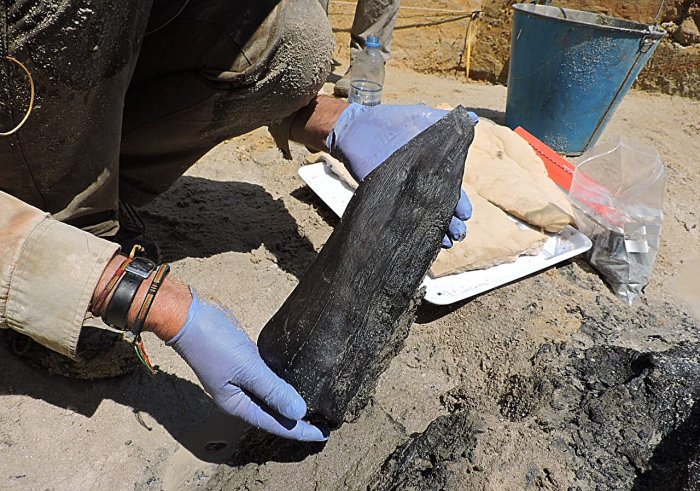
A wedge shaped piece of wood. Credit: Professor Larry Barham, University of Liverpool
In summary, the Kalambo Falls evidence suggests that, at least sometimes, early hominins were able to take advantage of materials other than stone for their everyday needs, including tool-making and shelter. They might also have been able to use the resources in their environment for fuel and medicine.
However, we need more direct evidence, going back to the beginnings of the Stone Age to demonstrate how those who came before us used and worked with wood. More discoveries like this might even lead us to rename the mighty Stone Age as the Wood Age.
This article is republished from The Conversation under a Creative Commons license. Read the original article.
More From Ancient Pages
-
 Translated Ancient Text Offers Evidence Of An Unknown Sophisticated Civilization Present In All Corners Of The World
-
 Spectacular 2,500 Years Old Shwedagon Pagoda In Myanmar – World’s Oldest Pagoda
-
 Ördög – Shapeshifting Demon Who Controls The Evil And Dark Forces In The World
-
 Aristotle’s Influence On Education Of Alexander The Great – Historical Encounter Of Two Famous Men
-
 Ancient Inscription Found In Royal Tomb Reveals Secrets Of Egypt’s First Dynasty
-
 Legendary Epic Of King Gesar Who Descended From Heaven And The Ancient Tarna Monastery
-
 Why Were Ancient And Medieval People Horrified Of The Night?
-
 Beware Of The Shapeshifting Gaelic Bodach Who May Be Difficult To Trick
-
 Perseus – Courageous Adventurer Who Fulfilled A Prophecy
-
 Intriguing Hoard Of Bronze Age Bracelets From Brittany, France Remains An Archaeological Puzzle
-
 Hnefatafl: Ancient Viking Board Game “King’s Table” Popular In Medieval Scandinavia
-
 Why We Celebrate Saint Lucy’s Day – The Bringer Of Light And Patron Of The Blind
-
 Surprising Evidence Of 12,000-Year-Old Unknown Advanced Secret Knowledge Held By Elite Individuals – The Connection – Part 2
-
 Gold Treasures From The Land Of Ancient Colchian Culture In Georgia
-
 Pazzi Conspiracy – Failed Murder Attempt On Lorenzo de’ Medici Made Him Even More Powerful And Threw Renaissance Florence Into Chaos
-
 Unraveling The Mystery Of Ancient ‘False Doorways’
-
 Fascinating Ancient Artifact Discovered In Georgia Confirms Native American Legend Of A Great Catastrophe And Contact With Pre-Columbian Visitors
-
 Unexplained Ancient Wars In America – Knowledge Of Ancient High-Tech Weapons? – Part 1
-
 Viklaumadonna Hides A Thousands-Year-Old Secret
-
 Ancient Secrets Of The Nine Unknown Men: Guardians Of Forbidden Knowledge Hidden From Humanity

