AncientPages.com - If you’ve already spend hours shoveling snow this year, you may be dismayed to realize that technically, it’s not yet winter. According to the astronomical definition, the season will officially begin in the Northern Hemisphere on Dec. 21, the shortest day of the year, known as the winter solstice.

Winter Solstice at Stonehenge in Wiltshire. Credit: Adobe Stock - Declan Hillman
The weeks leading up to the solstice can feel long as days grow shorter and temperatures drop. But it’s also traditionally been a time of renewal and celebration – little wonder that so many cultures mark major holidays just around this time.
Here at The Conversation, we’ve rounded up four of our favorite stories on the solstice: from what it really is to how it’s been commemorated around the world.
1. Journey of the Sun
First things first: What is the winter solstice?
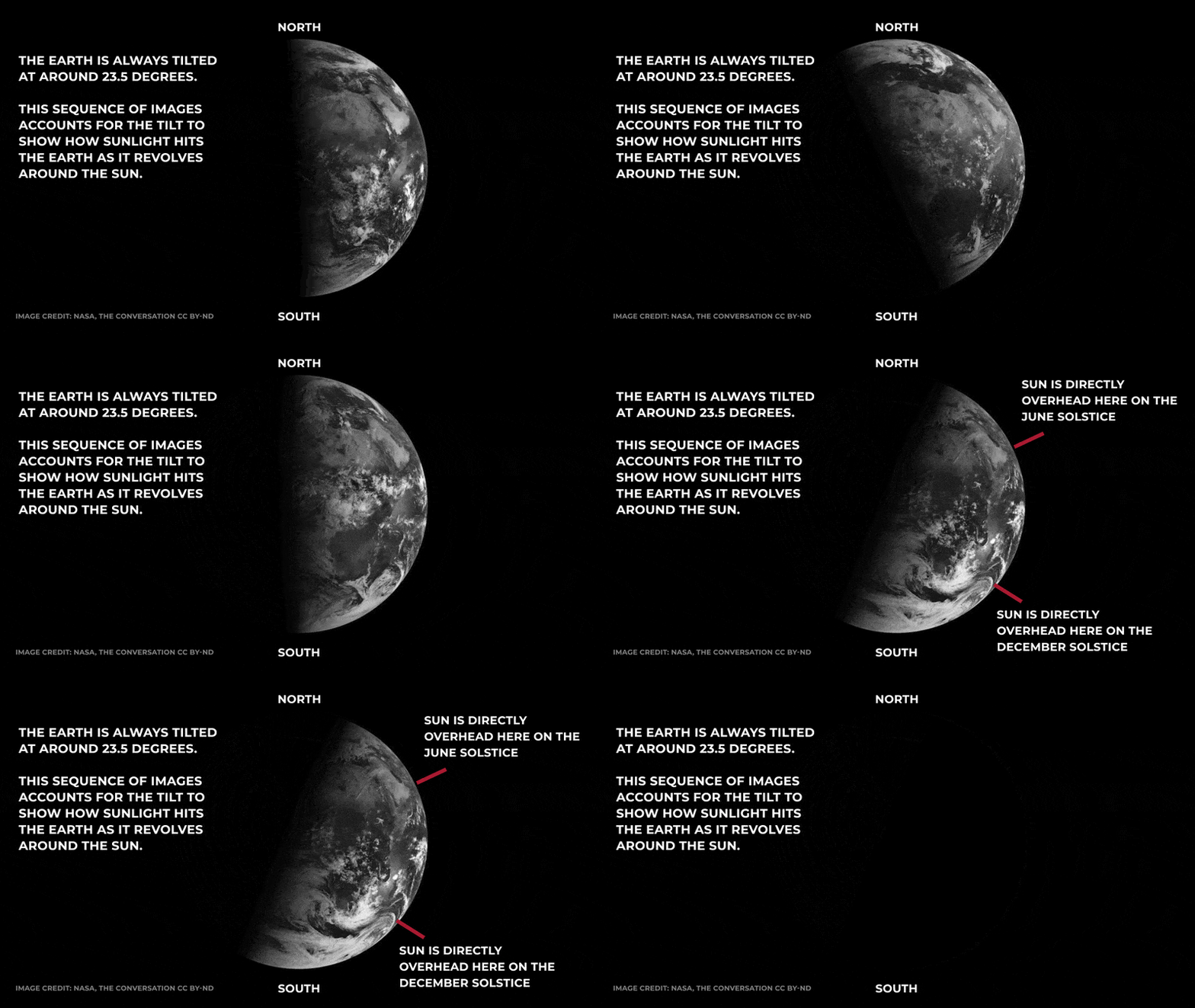
For starters, it’s not the day with the latest sunrise or the earliest sunset. Rather, it’s when “the Sun appears the lowest in the Northern Hemisphere sky and is at its farthest southern point over Earth,” wrote William Teets, an astronomer at Vanderbilt University. “After that, the Sun will start to creep back north again.”
“Believe it or not,” he added, “we are closest to the Sun in January”: a reminder that seasons come from the Earth’s axial tilt at any given time, not from its distance from our solar system’s star.
2. Ancient astronomy
Many Americans picturing winter solstice celebrations may immediately think of Stonehenge, but cultures have honored the solstice much closer to home. Many Native American communities have long held solstice ceremonies, explained University of Illinois Urbana-Champaign scholar Rosalyn LaPier, an Indigenous writer, ethnobotanist and environmental historian.
“For decades, scholars have studied the astronomical observations that ancient indigenous people made and sought to understand their meaning,” LaPier wrote. Some societies in North America expressed this knowledge through constructions at special sites, such as Cahokia in Illinois – temple pyramids and mounds, similar to those the Aztecs built, which align with the Sun on solstice days.
“Although some winter solstice traditions have changed over time, they are still a reminder of indigenous peoples’ understanding of the intricate workings of the solar system,” she wrote, and their “ancient understanding of the interconnectedness of the world.”
3. Dazzling light
Rubén Mendoza, an archaeologist at California State University, Monterey Bay, made an accidental discovery years ago at a mission church. In this worship space and many others that Catholic missionaries built during the Spanish colonial period, the winter solstice “triggers an extraordinary rare and fascinating event,” he explained: “a sunbeam enters each of these churches and bathes an important religious object, altar, crucifix or saint’s statue in brilliant light.”
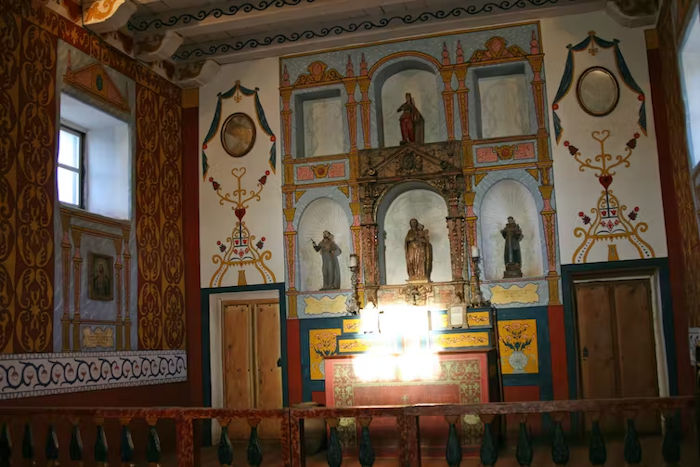
Winter solstice illumination of the main altar tabernacle of the Spanish Royal Presidio Chapel, Santa Barbara, Calif. Rubén G. Mendoza, CC BY-ND
These missions were built to convert Native Americans to Catholicism – people whose cultures had already, for thousands of years, celebrated the solstice Sun’s seeming victory over darkness. Yet the missions incorporated those traditions in a new way, channeling the Sun’s symbolism into a Christian message.
“These events offer us insights into archaeology, cosmology and Spanish colonial history,” Mendoza wrote. “As our own December holidays approach, they demonstrate the power of our instincts to guide us through the darkness toward the light.”
4. Victory over darkness
Our next story goes halfway around the world, describing the Persian solstice festival of Yalda. But it’s also an American story. Growing up in Minneapolis, anthropologist Pardis Mahdavi explained, she felt a bit left out as neighbors celebrated Hanukkah and Christmas. That’s when her grandmother introduced her to their family’s Yalda traditions.
Millions of people around the world celebrate Yalda, which marks the sunrise after the longest night of the year. “Ancient Persians believed that evil forces were strongest on the longest and darkest night of the year,” wrote Mahdavi, who is now provost at the University of Montana. Families stayed up throughout the night, snacking and telling stories, then celebrating “as the light spilled through the sky in the moment of dawn.”
Provided by The Conversation
This article is republished from The Conversation under a Creative Commons license. Read the original article.