
Mysterious ‘Las Labradas’ Petroglyphs With Roots In The Pre-Columbian Times Of Mexico
A. Sutherland - AncientPages.com - Sinaloa's rocks covered with a variety of figures are true history rocks, a legacy of mythological traditions with roots in the Pre-columbian times of North America.
Little is known of the Sinaloa people and their early history. However, ancient carvings and legends represent a legacy of these people. Las Labradas petroglyphs' area is a very ancient and sacred site to the coastal Indians of the area.

A large number of beautiful petroglyphs known as 'las labradas' have been found on a beach in the vicinity of Barras de Piaxtla, a small fishing village, north of Mazatlan in the Mexican state of Sinaloa.
Many of the carvings suffered significant damage due to weather and water over the centuries.
Remarkably, natural erosion hasn't been destructive enough to erase all the testimonies left by the ancients for future generations.
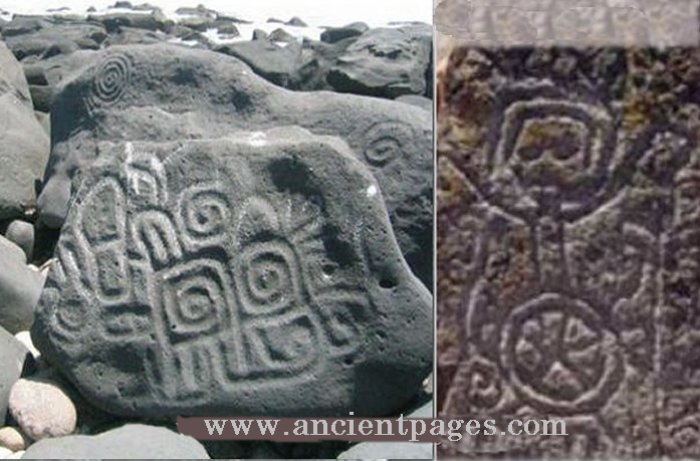
It's still quite easy to recognize many anthropomorphic, zoomorphic or geometric forms that represent solar phenomena expressed with lines, dots, ancient spirals, and figures.
In 1949 engineer Gonzalo Ortiz de Zárate arrived in Culiacán. Of Spanish origin, he came to land in Sinaloa to work in Eureka, a construction company that would be in charge, at that time, to build the irrigation canals of the Sanalona dam.
Accidentally, on one of the beaches of the Sinaloan Pacific, he stumbled upon one of his best finds: "more than 300 meters of rocks of volcanic origin piled at the foot of the beach with a huge number of engravings: evocations of the sun through concentric circles, flowers, animals, human figures... total, almost 650 different prints. The beach, already known then as “las labradas”, was in the set of small inlets near the mouth of the Piaxtla river, known as “Barras de Piaxtla,” as wrote Professor Juan González Morfín, Universidad Panamerican, Mexico.
Many cultures left similar carvings around the world and Sinaloa's prehistoric region is one of them. The ancient carvings were left by the groups that belonged to Aztatlán culture, Sinaloa, México, and living along the rivers of Sinaloa.

Perhaps these people also recorded their prehistoric testimonies on other rocks discovered in several places in Sinaloa.
The Aztatlán culture was one of the major cultures that developed during the late pre-Hispanic northwest Mesoamerica (900 to 1350 AD). Only a few archaeological excavations were carried out over the last fifty years in this region. However, there is some evidence that the Aztatlán culture had a significant influence on social changes in northern Mexico and the American Southwest.
In 1942, Manuel Bonilla (1867 - 1957), a scholar and one of few, who described intriguing petroglyphs of Sinaloa, in his book "De Atlatlán a México" (From Atlatlán to Mexico) said that these relics constitute a very important key to the history of prehistoric peoples of Mexico.
Written by – A. Sutherland - AncientPages.com Senior Staff Writer
Copyright © AncientPages.com All rights reserved. This material may not be published, broadcast, rewritten or redistributed in whole or part without the express written permission of AncientPages.com
Expand for referencesMore From Ancient Pages
-
 Archaeologists Highlight The Tartessos Culture’s Sustainable Construction Skills
-
 Courageous Elizabeth Freeman – First African American Slave Who Filed A Freedom Suit
-
 Ötzi Had Dark Skin, Bald Head And Anatolian Ancestry- DNA Reveals
-
 On This Day In History: American General Benedict Arnold Commits Treason – On Sep 21, 1780
-
 Ancient DNA Shows Neanderthals Used Plant-Based Medicine To Treat Pain And Illness
-
 Climate Change Likely Drove Early Human Species To Extinction – Scientists Say
-
 Ancient Egyptians Invented World’s Oldest Egg Ovens And They Are Still In Use
-
 Symbol of Immortality: Honey Offering In A 2,500-Year-Old Shrine – Identified
-
 Calçoene – Amazon Stonehenge And The Mysterious Amapán Megalithic Culture
-
 Author’s Encounter With A Mysterious Not Of This World Entity Inside Callixtus Catacombs
-
 Fenrir Killed At Ragnarok By Vidar Who Avenged His Father Odin’s Death
-
 Medieval Sword Found In The Sea Off The Carmel Coast Was Probably Used In Combat 800 Years Ago
-
 Unusual Archaeological Finds On Small Pacific Islands May Provide Evidence Of Intriguing Mythical Beings
-
 Matches Were Invented In Ancient China
-
 Mysterious Scottish Stone Circles On Orkney Were Used To Something Very Different Than Previously Thought
-
 Underground Bronze Treasures Unearthed In 2,300-Year-Old Chengdu, China’s Sichuan Province
-
 Asclepius Sanctuary On Acropolis Slope Will Be Restored
-
 Marble Head Of Roman Emperor Augustus Unearthed In Isernia, Italy
-
 Ancient City Of Adab That Flourished In North Sumer
-
 Ancient Knowledge About Horse Taming Is Rewriting Our Picture Of The Past

