
Mystery Of Ancient Metal Clamps – Advanced Lost Technology Modern Science Still Cannot Explain
Ellen Lloyd - AncientPages.com - Ancient metal clamps discovered on megaliths, temples, and other prehistoric monuments worldwide are one of the greatest unsolved ancient mysteries of all time.
Why would the builders use or need a small metal clamp to hold large stone blocks in place?
How did this technology spread to ancient Egypt, Pre-Columbian Peru, and Cambodia thousands of years ago?
These countries are separated by thousands of miles. Who taught our ancestors how to use this technology?
The use of metal clamps in T-Grooves has been discovered in Tiahuanaco, Ollantaytambo, Koricancha, and the site of Yuroc Rumi, Vilcabamba. These clamps were also used on the Parthenon, on buildings in Mesopotamia, Egypt, and Cambodia.

Some scientists have suggested the clamps were for ceremonial use. Other researchers point out that ancient metal clamps served for keeping the blocks together, so they would harden out in the right position.
Several imprints show that metal clamps intended to join huge blocks of stone that our modern machines cannot lift.
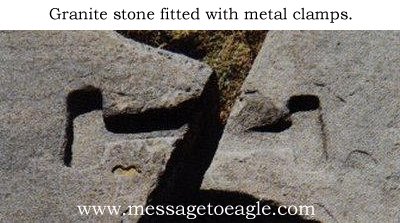
Credit: MessageToEagle.com
Unfortunately, very few of the clamps have survived. The Spanish removed many clamps, thinking they might be gold. Some may indeed have been decorated with silver and gold, because it's well-documented that armies set about demolishing these structures, just for the clamps.
The clamps from Pre-Columbian South America that have been examined show them to be made of a very unusual alloy - 2.05% arsenic, 95.15% copper, 0.26% iron, 0.84% silicon and 1.70% nickel.

This composition is particularly interesting because there is no source nickel anywhere in Bolivia. At first, archaeologists believed that clamps were brought to these grooves to be placed, but recent scans have revealed that metal was poured into these indentations, which means the builders had portable smelters.

The metals used could only be melted at very high temperatures; temperatures the ancients (to our knowledge) were not capable of. The rare alloy of nickel-bronze-arsenic requires extremely high temperatures.
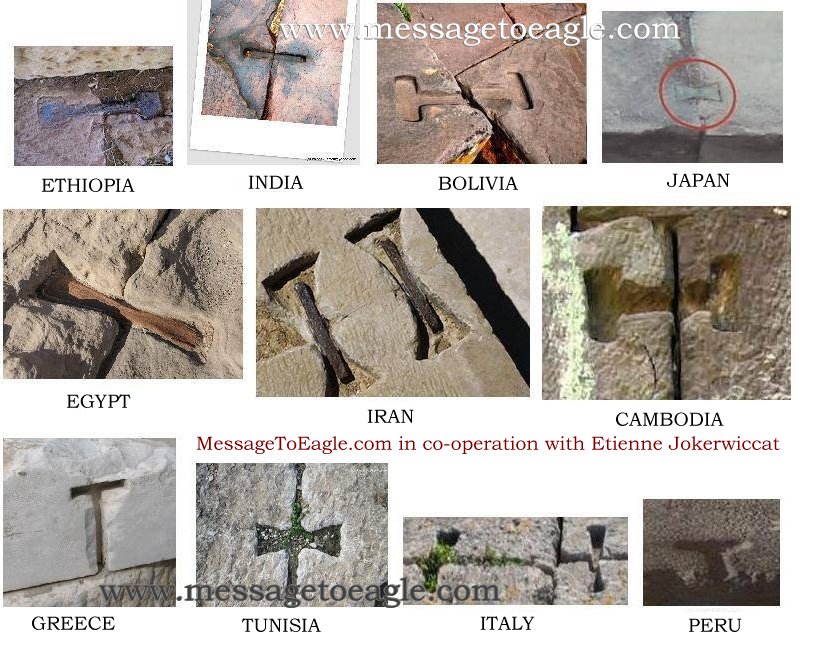
The Puma Punka brackets holes, when analyzed, showed platinum, a metal that only melts at 1753 C and aluminum, which supposedly was not discovered and produced in quantity until the 19th century.

See also:
10 Remarkable Similarities Between Ancient Civilizations
Obviously our ancestors had access to very advanced technology that became lost in the immediate centuries afterward, a technology and means modern science still cannot explain.
NOTE: This article was originally published on MessageToEagle.com would like to express gratitude to Etienne Jokerwiccat for sharing excellent research and photos with us. On behalf of the entire site and all its readers - thank you, Etienne!
Written by Ellen Lloyd - AncientPages.com - MessageToEagle.com
Copyright © AncientPages.com. All rights reserved. This material may not be published, broadcast, rewritten or redistributed in whole or part without the express written permission of AncientPages.com
More From Ancient Pages
-
 Sole Survivor Recalls An Incredible Unexplained Mountain Mystery
-
 Unique 2700-Year-Old Papyrus With Inscription In Paleo-Hebrew Acquired By Israel From U.S
-
 Ancient Secrets Of The Theopetra Cave: World’s Oldest Man-Made Structure And Home To Humans 130,000 Years Ago
-
 Lindholm Høje Burial Site With 700 Graves Dated To The Iron And Viking Ages
-
 Connection Between Viruses And Ancestors Of All Complex Life Has Been Found
-
 The First Australians Ate Giant Eggs Of Huge Flightless Birds That Went Excinct Over 47,000 Years Ago
-
 6,000-Year-Old Bizarre, Mouthless ‘Alien’ Mask Unearthed In “The Salt Pit” Settlement In Northeast Bulgaria
-
 Why Are The 2,000-Year-Old Roman Walls Found In Switzerland An ‘Archaeological Sensation’?
-
 Operation Nightingale – Veterans Uncover Impressive 2,000-Year-Old Celtic Treasure
-
 Anglo-Saxon Warlord’s Grave: Archaeologists And Metal-Detectorists Work Together
-
 Why Were Viking Raids So Successful?
-
 On This Day In History: Treaty Of Worms Signed Between Great Britain, Austria And The Kingdom Of Sardinia – On Sep 13, 1743
-
 Rare Medieval Painting Depicting Judas’ Betrayal Of Christ Saved By Reformation ‘Recycling’
-
 Ceramics Are Telling The Story Of 14th Century Chinese Trade
-
 Machu Picchu Is Older Than Previously Thought – New Study Reveals
-
 Aoife: Beautiful Female Warrior, Lover Of Cuchulainn And Mother Of His Only Son In Irish Beliefs
-
 How The Great Sphinx Gave Thutmose IV Power To Become Pharaoh
-
 Controversial Ancient Tomb Could Prove The Existence Of Biblical Jonah
-
 King Mithradates VI Of Pontus Used Poison To Avoid Death By Poison
-
 Unusual Archaeological Finds On Small Pacific Islands May Provide Evidence Of Intriguing Mythical Beings

