
Why Didn’t Pythagoras And His Followers Eat Beans?
Conny Waters - AncientPages.com - Pythagoras of Samos, an ancient Greek philosopher who made great contributions to mathematics and founded the Pythagorean School of Mathematics in Cortona, a Greek seaport in Southern Italy, was a vegetarian.
But did you know that Pythagoras abstained from meat and beans? Most vegetarians consume beans, but Pythagoras told his followers they mustn’t eat or even touch beans! Was Pythagoras worried about gastric problems, or did he have a deeper reason for omitting beans from the diet?
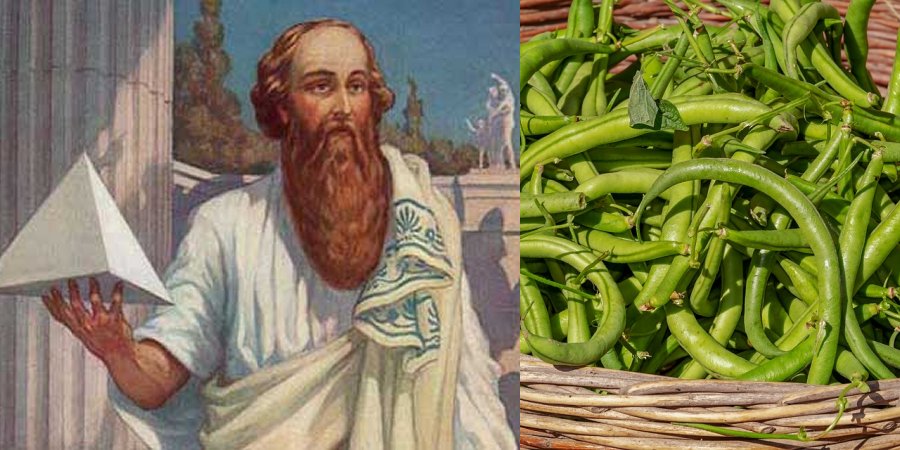
Left: Pythagoras. Credit: Famous Mathematicians. Right: Beans. Credit: Public Domain
The reason behind this is not entirely known, but there are certain theories that can provide some light on the great philosopher’s reluctance to beans.
Pythagoras believed that a person should strive for tranquility and peace. Beans were associated with metempsychosis, a philosophical term in the Greek language referring to the transmigration of the soul, especially its reincarnation after death. Pythagoreans believed that beans had the potential for life because they looked like human genitalia or fetuses.
Pythagoras conducted a scientific experiment demonstrating that humans and beans were spawned from the same source. He took some beans and buried them in the mud. They rested there for a few weeks before being removed and investigated by the great Greek philosopher. He concluded they looked like human fetuses.
Like ancient Egyptians, Greeks knew that fava beans could be deadly. Pliny wrote that followers of Pythagoras believed that fava beans were connected to Hades, the Greek God of the Dead, and the Underworld. The plants’ black-spotted flowers and hollow stems served as ladders for human souls and were associated with reincarnation.
Aristotle suggested that the bulbous shape of beans represented the entire universe, which was why beans shouldn’t be consumed.
Cicero proposed another explanation. In his book On Divination, he just wrote that he believed the Pythagoreans didn’t eat beans because they caused flatulence.
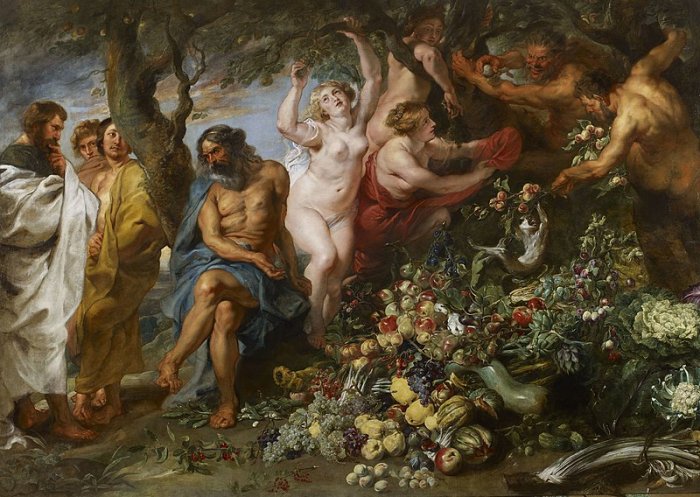
Pythagoras advocating vegetarianism. Painting made between 1618 and 1630. Credit: Public Domain
Another theory is that Pythagoras may not have had anything against beans at all. However, beans were used in ancient Greece as a ballot system. White beans represented a yes vote and black a no.
When Pythagoras said to his disciples, "Abstain from beans," he had no reference to them as an article of diet, for he ate them himself, but he advised his students not to get caught up in politics or government.
As H. L. Sumner points out, “what he did mean, and what his immediate followers already understood, was that they should abstain from the intrigues of politics as being antagonistic to a philosopher's pursuits.”
To put it in plain text – We do know that Pythagoras had disapproved of beans, but we simply don’t know what was behind his negative attitude.
Updated on November 24, 2023
Written by Conny Waters – AncientPages.com Staff Writer
Copyright © AncientPages.com All rights reserved. This material may not be published, broadcast, rewritten or redistributed in whole or part without the express written permission of AncientPages.com
Expand for referencesMore From Ancient Pages
-
 Mythical Shield-Maidens Did Exist – Evidence Of Female Viking Warriors Discovered
-
 Ancient Artifacts With Foreign Inscriptions And Unknown Signs Discovered In The American Southwest Reveal An Epic Story
-
 Great And Never Explained Mysteries Of Nevada’s History
-
 Unsolved Ancient Mystery Of Lost Pre-Olmec Civilization – Evidence Of Advanced Scientific Knowledge That Could Re-Write History
-
 Stone Age Friendship Ornaments Examined By Scientists
-
 Tribe Recalls Ancient Contact With An Extraterrestrial In The Amazon Jungle And A Strange Beam Of Light
-
 Shiva – Hindu God Who Resides In Every Being And In All Things
-
 Incredible Technology In Mysterious Huashan Caves, China
-
 New Reading Of Mesha Stele And Consequences For Biblical History
-
 The Long And Satisfying 28,000-Year History Of The Dildo
-
 Underwater Nabataean Temple With Marble Altars Discovered In Pozzuoli
-
 Amrita: Potion Of Immortality Consumed By Gods To Make Them Strong And Immortal
-
 Maya Storm God Huracán Taught That When We Damage Nature, We Damage Ourselves
-
 Temple Dedicated To Goddess Nemesis Discovered Under Ancient Theater In Greece
-
 The Face Of The Amarakarei – Remarkable Enormous Face Caved Into Stone Cliffs In Peru
-
 Hidden Ancient Underground Tomb Discovered In Petra May Solve The Mystery Of The Nabataean Kingdom
-
 Medieval Manuscript Reveals Surprising Discovery Of Star Wars Master Yoda & Shocking Monsters
-
 Ancient City Of Urkesh – Home Of Kumarbi – The Foremost Son Of Anu
-
 Sword-Kladenets – Hidden Treasure Awaiting A Worthy Hero
-
 Earth’s First Animals Had Particular Taste In Real Estate

