
World’s Largest Complex Of Borobudur – Spectacular Buddhist Masterpiece
A. Sutherland - AncientPages.com - The magnificent Borobudur is the world's largest Buddhist shrine, and one of the finest examples of eighth-century temple architecture. The Borobudur Temple, situated in central Java.
It was constructed in the 8th and 9th centuries AD during the reign of the Syailendra Dynasty, a prominent Indonesian dynasty that flourished in Java after the fall of the Funan kingdom of mainland Southeast Asia.

Aerial view of Borobudur, it took the form of a step pyramid and mandala plan. source
This architectural marvel was constructed when Buddhism and Hinduism were still the dominant religion in the region. Later, the temple was several times buried due to powerful volcanic eruptions. It remained abandoned for several hundred years before its rediscovery by the British in the 19th century.
The whole temple is in the form of a lotus, the sacred flower of Buddha. It was built in three tiers: a pyramidal base with five concentric square terraces, the trunk of a cone with three circular platforms, and at the top, a monumental stupa. The walls and balustrades are decorated with fine low reliefs, and around the circular platforms, seventy-two openwork stupas with Buddhas were constructed.
For each direction, there are 1,460 relief scenes and ninety-two Dhyani Buddha statues. (Dhyani’ is derived from the Sanskrit dhyana, meaning “meditation.” )
The monument is located in the Kedu Valley, in the southern part of Central Java, at the center of Java, Indonesia.
The structure, composed of 55,000 square meters of lava-rock is erected on a hilltop and it has a shape of a stepped pyramid of six rectangular stories, three circular terraces, and a central stupa is located at the summit.

Borobudur Temple Compounds (Indonesia) © UNESCO
Borobudur covers a huge area, measuring 123 x 123 meters. The perfection of this stone monument is clearly seen in its design and its decoration in the form of 2,672 carved relief panels and 504 Buddha statues.
Despite its gigantic size, historical records of its decades-long construction are sparse. The structure, built without using any kind of cement or mortar, and yet, all its parts – hold together, perfectly.

Aerial view of Borobudur. Credit: Adobe Stock - Adel
The vertical division of Borobudur Temple into base, body, and superstructure is in perfect agreement with the concept of the Universe in Buddhist cosmology - Bhumisambara, Borobudur’s original name.
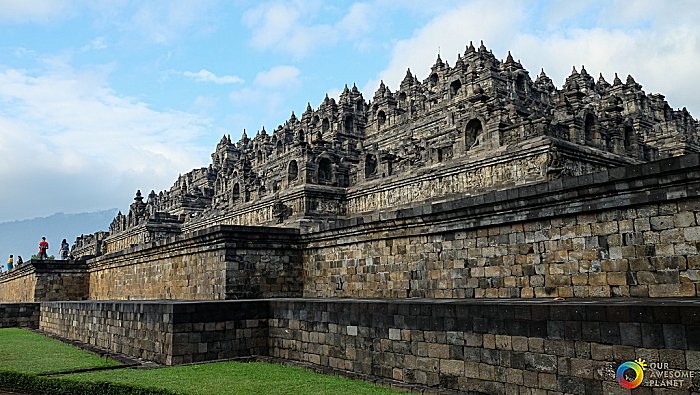
Borobudur. Image credit: Anton Diaz. source
The shrine was built as a stepped pyramid. At the base of the massive temple, there are reliefs of Karmawibhangga' - depiction of human life in the endless cycle of death and rebirth (samsara) and the law of cause and effect, according to the karmic law.
See also:
8 Remarkable Jain Temples – Marvelous Ancient Architecture And Stone Carvings
These reliefs were carved on all sides over andesite stones. Above the base of the shrine, there are multiple layers of structures that symbolize the world of desires (Kamadhatu) at the low levels; the world of forms (Rupadhatu) is at the mid-levels, and the so-called formless world (Arupadhatu) is at the upper levels.
To attain enlightenment - means to walk this long path.
Written by – A. Sutherland - AncientPages.com Senior Staff Writer
Copyright © AncientPages.com All rights reserved. This material may not be published, broadcast, rewritten or redistributed in whole or part without the express written permission of AncientPages.com
Expand for referencesMore From Ancient Pages
-
 Two Rare Full-Sized Viking Burial Ships Uncovered In Sweden
-
 Widespread Literacy In Biblical-Period Kingdom Of Judah – Study Confirms
-
 Mysterious 4,000-Year-Old Table-Like And Unique Dolmen Discovered In Galilee Hills, Israel
-
 Impressive Complex Of 4,000-Year-Old Walled Oases Discovered In The Arabian Desert
-
 Apalala: Harsh Dragon Controlling Swat River Who Became Benevolent Naga King Helping People In Buddhist Tradition
-
 5 Myths About The Amazons – Ancient Female Warriors
-
 10,000-Year-Old Adorned Female Infant Burial Discovered In European Cave
-
 Everyday Life Of A Samurai: Armor, Appearance And Belongingness
-
 God Ptah ‘Lord Of Memphis’ Was Among The Most Revered Creator Gods Of Ancient Egypt
-
 Unique Pig-Shaped Figurine Found In East China Was Probably A Child’s Toy 6,000-Years Ago
-
 168 Unknown Geoglyphs Discovered In The Nazca Desert By Drones
-
 Lunar Society: Great Scientists Of The 18th Century Who Changed The World
-
 Unique Ancient Aryan Bow Reconstructed By Archaeologists
-
 Surprise! ‘Viking Ship’ Found On The Seabed Is Not What We Previously Thought And Rewrites Scandinavian Maritime History, Scientists Say
-
 Warming Of North Pacific Helped First Human Migration From Asia To North America
-
 Strange Tale Of Mysterious Thousand-Year-Old Underground Network Of Caves And Encounters With Subterranean Dwellers
-
 Cappadocia And Huge Unique Selime Cathedral
-
 Rare Pictish Symbol Stone Found Near The Battle Of Nechtansmere Site
-
 Germany’s Stonehenge Pömmelte Reveals More Secrets – 140 Wooden Houses And 78 Silos Found
-
 Gold Treasures From The Land Of Ancient Colchian Culture In Georgia

