
Mystery Of The Lydenburg Heads
A. Sutherland - AncientPages.com - In 1957 a young boy, Karl-Ludvig "Ludi" von Bezing (now famous Austrian-South African mineral collector), saw pieces of some mysterious heads while playing in the field on his father's farm, near Lydenburg, Mpumalanga, South Africa.
He returned to the area a few years later and, over a period of several years, collected the pieces of seven heads. This internationally important discovery is known as the Lydenburg Heads.
The artifacts are one of the earliest known forms of African sculpture in Southern Africa. There are seven hollow terracotta sculptures that are named after the site at which they were discovered in the late 1950s.
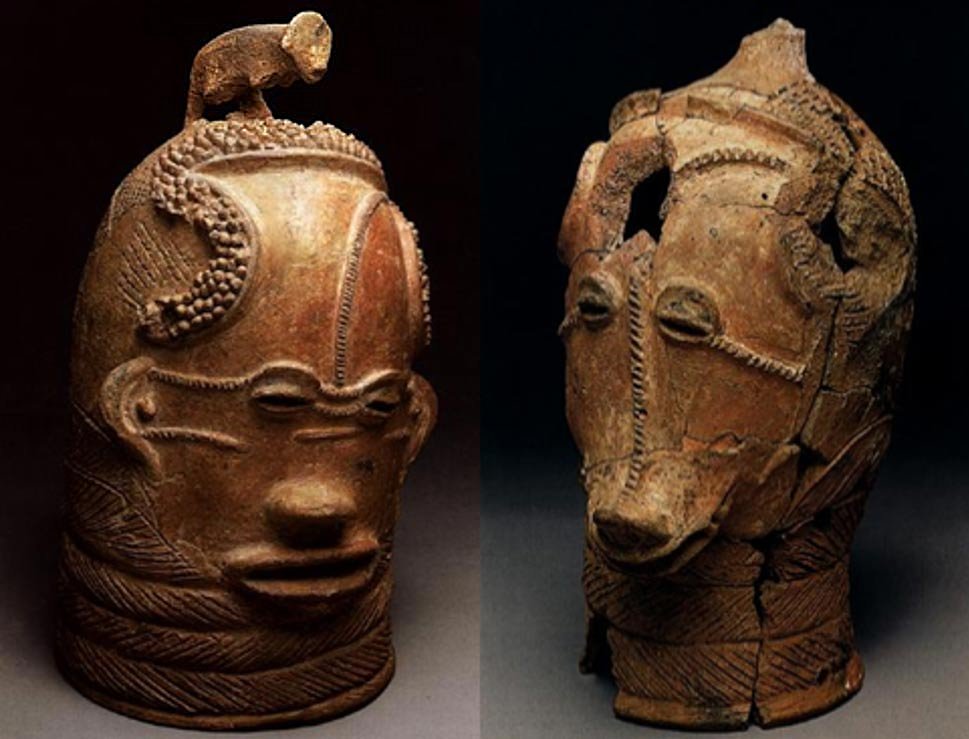
The heads have scarification marks (scars intentionally created to form patterns on the flesh) on the forehead, temples, and between the eyes. Six of the heads are human and the seventh is some kind of an animal replica.
Nearly life-size terracotta heads are ancient masks officially dated back to 500 AD and represent the earliest and unique sculpture found in southern Africa.
Excavations suggest that the heads may have been burned and deliberately buried, rather than just discarded or abandoned.
The reconstructed heads are not identical but do share a number of characteristics. Modeled strips of clay form the thinly opened oval eyes, slightly projecting mouths, noses, and ears, and raised bands decorating the faces, while the backs of the heads are adorned with incised linear patterns.
The columnar necks are defined by large furrowed rings, Necks ringed with fat have been and continue to be viewed as a sign of prosperity by many African peoples.
However, it is currently impossible to know whether the rings on the Lydenburg heads were intended to be read in this way due to the barely sufficient information available on the ancient culture that produced them.
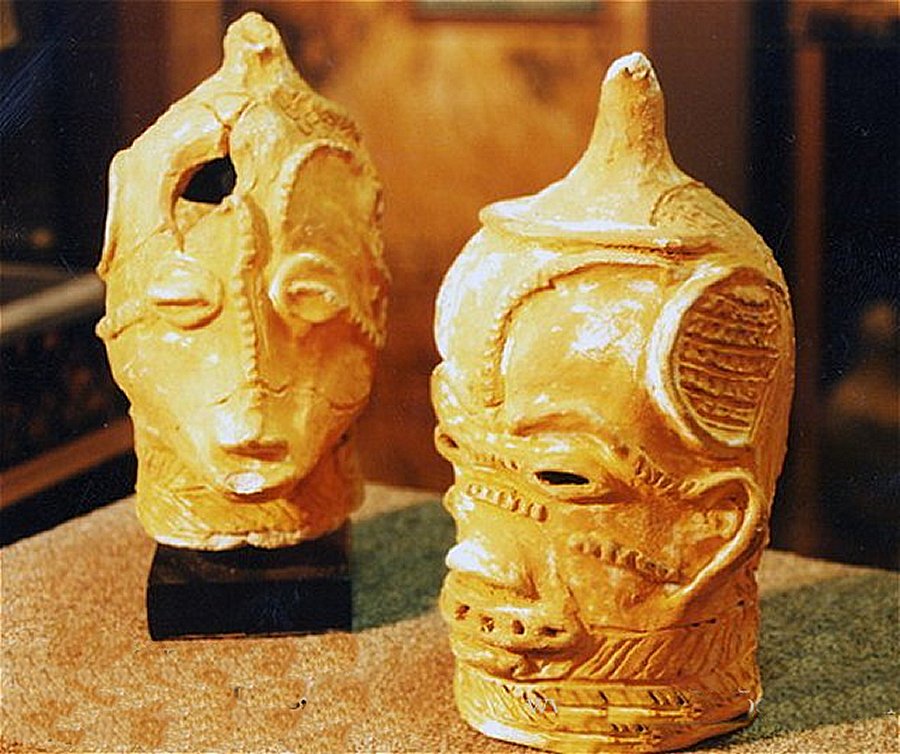
Nearly life-size terracotta heads are ancient masks officially dated back to 500 AD and represent the earliest and unique sculpture found in southern Africa.
The purpose of the heads is obscure.
Little is known of people who created them but the careful manner, in which they were buried suggests that the masks were of significant value for the people who laid them under the ground.
The heads have scarification marks (scars intentionally created to form patterns on the flesh) on the forehead, temples, and between the eyes. Six of the heads are human and the seventh is some kind of an animal replica.
Of the seven heads, two of them are large enough to be worn as helmets and are surmounted by animal figurines. The other five are decorated with a hole on either side of the neck which was likely used to attach them to a costume or structure.
Animals are a common motif in African mask making. They represent the spirit of an animal and one that bears the mask, becomes that animal himself which allows for communication with that animal, for instance, to ask the animal to keep away from the village. In other cases, the animal is a symbol of virtue.
The most common animals that are represented with masks are buffalo, hyena, hawk, crocodile, and antelope. Antelope is one of the most widely used animal masks, additionally, a small unidentifiable animal sits atop one of the Lydenburg heads.
What kind of role did this unrecognizable animal play for the creators of the Lydenburg Heads? While their actual use continues to be a mystery, archeologists have suggested that they were likely used during initiation rituals as in during the rites of enactment that signified the transition to a new social status or perhaps membership into an exclusive group.
In absence of contemporaneous written documents, the only possibility is to guess at the use and meaning of a head such as this one.
The animals appear only on those Lydenburg heads large enough to have served as helmet masks. The original heads are now housed in the Iziko National Musem in Cape Town and their replicas are displayed in the Lydenburg Museum, Lydenburg, Mpumalanga.
Written by – A. Sutherland AncientPages.com Staff Writer
Copyright © AncientPages.com All rights reserved. This material may not be published, broadcast, rewritten or redistributed in whole or part without the express written permission of AncientPages.com
More From Ancient Pages
-
 Lunar Society: Great Scientists Of The 18th Century Who Changed The World
-
 Ancient Mystery Of Acra Citadel – Solved
-
 America’s Oldest Tombstone: Jamestown’s Black “Marble” Knight’s Tombstone Was Imported From Belgium
-
 Unique 8,400-Year-Old Burial Of A Dog Different From Modern Dogs Discovered In Sweden
-
 On This Day In History: George Plantagenet Privately Executed At The Tower Of London – On Feb 18, 1478
-
 Unearthing South Australia’s Oldest Known Shipwreck: The Bark South Australian (1837)
-
 Human Skeleton Dated To Parthian Era Unearthed At Tepe Ashraf In Iran’s City Of Isfahan
-
 Unexplained Accounts Of Mysterious Fires – ‘Burning’ Questions Remain Unanswered – Part 1
-
 Stone Age Friendship Ornaments Examined By Scientists
-
 Vast Paleogenetic Study Reveals Insights On Migration, Farming And Language Development Across The Southern Arc
-
 Secret Ancient Knowledge Of Portals Leading To Unknown Realms -The Arrival And Departure – Part 1
-
 On This Day In History: Krakatoa – Most Dangerous Volcano Erupted- On August 26, 1883
-
 Ancient Jaintia Kingdom And The Garden Of Monoliths And Dolmens
-
 Why Did Sages And Shamans Repeatedly Visit The Mysterious Finnish Pirunkirkko Cave (Devil’s Church)?
-
 Mystery Of Gigantic Lion Sculptures Dated To The Hittite Era
-
 First Pay Toilets Were Invented In Ancient Rome In 74 A.D.
-
 Gefjon: Norse Fertility Goddess Who Knew Humans’ Fates, And Plowed Away Part Of Sweden To Give It To Denmark
-
 Brian Boru – Famous And Brave Irish Hero Who Dared To Chase Off The Vikings
-
 Cruithne: Legendary King, His Seven Sons And The First Celtic Tribe That Inhabited British Isles
-
 Mystery Of The Ancient Giant Wish Stone At Hattusa

