
Canopic Jars: Funerary Tradition Of Ancient Egyptians And Their Beliefs In Afterlife
A. Sutherland - AncientPages.com - Ancient Egyptians sincerely believed in the afterlife, and a complex ritual set of burial customs was necessary to ensure an afterlife.
Mummification was an essential part of this ritual. All vital internal organs had to accompany the deceased to the underworld to be reborn. However, the dead's heart was never among the organs chosen for preservation in canopic jars.
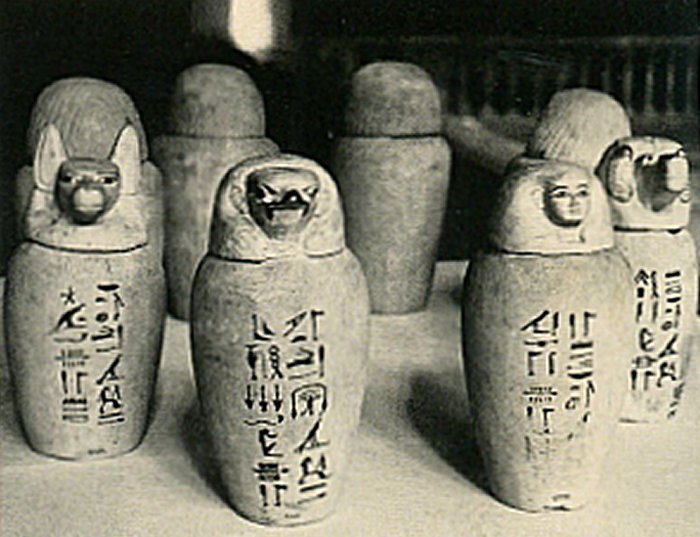 Limestone canopic jars with the heads of Qebesenuef, Duamutef, Hapy, Imsety. Originally these jars were decorated with human heads. Image credit: Egyptian Museum, Cairo
According to Egyptian beliefs, this precious organ was the source of wisdom and the seat of memory and emotions of the human being.
Therefore the heart was always left inside the mummified corpse for use in the afterlife. Canopic jars were ritual vessels containing internal organs removed from the deceased's body during mummification.
Their name, "canopies," comes from Canopus, an ancient Egyptian city in the Nile Delta, where they were first discovered. According to Strabo, Canopus was the pilot of a ship that belonged to King Menelaus of Sparta during the Trojan War.
Ancient legend says Canopus received a fatal snake bite during his stay on the Egyptian coast. In the vicinity of this tragic place, king Menelaus had erected a temple dedicated to Canopus, and a city of Canopus developed around this place.

Canopic jars of Tutankhamun; 1333–1323 BC; alabaster; total height: 85.5 cm; Egyptian Museum (Cairo). - http://www.egyptarchive.co.uk/html/cairo_museum_49.html - Copyrighted free use
The canopies were usually made of calcite (alabaster), wood, limestone, and sometimes ceramic and earthenware. Four canopies were always placed in the burial chamber near the coffin.
Each canopy protected a different organ.
Clay canopies with flat covers and only sometimes covered with texts were already known during the Old Kingdom.
Later, in the Middle Kingdom, they were adorned with human heads.
In 1320-1085 BC (the Ramesside Period) and during the 19th and 20th dynasties, the canopies were adorned with the heads of four Horus sons. They were the guardians of the intestines of the deceased.

Canopic jars of Ruiu; 1504–1447 BC; painted pottery; Metropolitan Museum of Art (New York City). Image credit: English: Rogers Fund, 1935 - CC0 1.0
These four gods were the baboon-headed Hapy, who guarded the lungs (protected by Nephthys). The human-headed Imsety guarded the liver (and who was himself guarded by Isis); the jackal-headed Duamutef guarded the stomach (often protected by Neith); and the falcon-headed Qebesenuef, guardian of the intestines (who was often protected by Serket).
The earliest reference to these four gods can be found in the "Pyramid Texts." They were the children and, simultaneously, the "souls" of Horus and the "friends of the king." They assisted the deceased monarch in his journey to the sky ("Pyramid Texts").
Jean-François Champollion, a French scholar, philologist, and orientalist, deciphered Egyptian hieroglyphs. He contributed much to our knowledge about ancient Egypt and the jars linked to the funerary cult of ancient Egypt.
Written by – A. Sutherland AncientPages.com Staff Writer
Updated on January 21, 2023
Copyright © AncientPages.com All rights reserved. This material may not be published, broadcast, rewritten or redistributed in whole or part without the express written permission of AncientPages.com
Expand for referencesReferences:
Erman A. A Handbook of Egyptian Religion
Colin Macfarquhar C. Gleig G. Encyclopædia Britannica: Or, A Dictionary of Arts ..., Volym 4
More From Ancient Pages
-
 Saptarishi – Seven Sages Who Guided Humanity During Four Great Ages
-
 Madagascar Hippos Were Forest Dwellers – New Study
-
 What Really Happened To Library Of Alexandria Remains A Mystery
-
 Curious Ancient Prairie Mystery In Washington Scientists Cannot Solve – Maybe You Have An Idea What Happened?
-
 Why Did Modern Humans Replace The Neanderthals? The Key Might Lie In Our Social Structures
-
 More Than 3,000-Year-Old Multicolored Pre-Inca Mural Discovered At Huaca Yolanda, Peru
-
 America’s Oldest Tombstone: Jamestown’s Black “Marble” Knight’s Tombstone Was Imported From Belgium
-
 Eriu: Powerful Irish Goddess And Sacred Uisneach Hill Where She And God Lugh Are Buried
-
 19 Cannons Shot From British Ships During The American Revolution Discovered In Savannah River
-
 Towering Sacred Mt. Fuji: Abode Of The Immortals In Ancient Japanese Beliefs
-
 Mystery Of Doppelgangers And Spirit Doubles – From Ancient To Modern Times
-
 A Scientist’s Powerful Dream Revealed An Extraordinary Archaeological Discovery
-
 Large Pre-Columbian Pyramid Discovered Under Highway In Mexico But It Will Not Be Excavated
-
 Mysterious Lost Civilization Of Chu And Its Powerful Kingdom
-
 Valentine’s Day’s Connection With Love Was Probably Invented By Chaucer And Other 14th-Century Poets
-
 Teotihuacan’s Puzzling Red Glyphs Could Be Unknown Ancient Writing
-
 Mysterious Toaleans – Remains Of Unknown Humans Who Lived 8,000 Years Ago Discovered In The Leang Panninge Cave
-
 Unique Native American Artifacts Found At The River Bend Site, Wyoming
-
 Ancient Town Pontefract, England Reveals Some Of Its Secrets
-
 Roman Fort Of Apsaros Reveal Some Of Its Archaeological Secrets

