AncientPages.com - We have no written evidence about how people lived in Europe during the Bronze Age (2300–800 BCE), so archaeologists piece together their world from the artefacts and materials they left behind. Unlike perishable materials such as wool or wood, it’s the metal that has been well preserved.
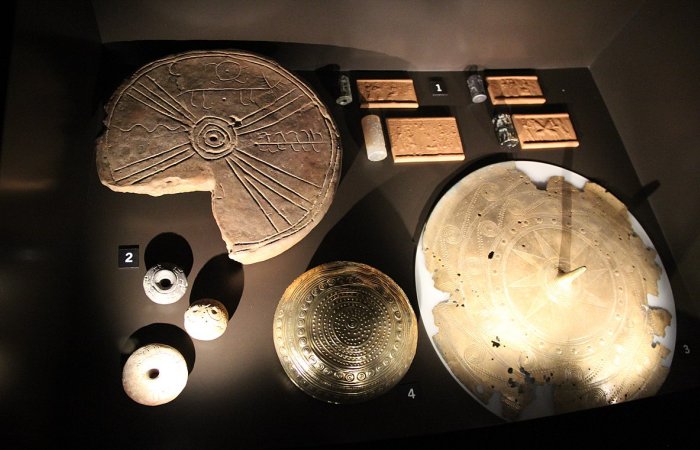
Bronze Age artifacts. Credit: Gary Todd - CC0 1.0
Considerable archaeological attention focuses on elite members of society, largely because common people left fewer traces. A new study suggests we can learn something about these everyday people from buried hoards of metal – and that their economic lives were much like our own.
Why did people bury hoards of metal?
During the Bronze Age, it was a common practice across Europe to deposit hoards of metalwork in the ground. People would gather metal objects and then bury them together or place them at a special location, such as a bog or a boundary.
Sometimes these hoards included many objects, sometimes just a few. Sometimes they were composed of a single type of object – hoards of tens of axes of the same form are a well-known example. Sometimes they included a variety of objects, and even fragments of broken objects.
Despite their variety, the hoards show the Bronze Age world was interconnected across Europe, and that bronze objects had a special value throughout most of it.
Why did people deposit these hoards? Archaeologists have spent decades trying to answer this question.
Was it a religious act? An intentional destruction of valued goods designed to lessen wealth inequalities? Scrap hidden during times of strife or put aside for future use in metalworking?
Only a small number of Bronze Age people have ever been found. Often these were people buried in huge mounds of earth, who are presumed to have been important figures – ritual leaders, chiefs or other elites. Archaeologists have tended to assume that these people and their alliances shaped the movements of metal in the Bronze Age.
Bronze as money for common folk?
In a new paper in Nature Human Behaviour, archaeologists Nicola Ialongo and Giancarlo Lago propose a different way of understanding hoards. Instead of focusing on elites as the movers and shakers, they suggest hoards show how common people contributed to the interconnected Bronze Age world and the spread of metal objects within it.
Ialongo and Lago analysed nearly 25,000 objects from hoards in Italy, Switzerland, Austria, Slovenia and Germany dating from the full 1,500-year span of the Bronze Age. They found that, over the centuries, a standardised weight system emerged that was widely shared across the Bronze Age world.
The paper goes on to argue this standardisation indicates that small pieces of bronze of standard weights could have been used as currency for everyday transactions by ordinary people.
The spread of European standards
Well before 2300 BCE, there seems to have been growing standardisation in artefact forms, at least on a surface level. Distinct types of objects emerged, such as daggers or certain pottery vessels, which appear similar across large areas but had different local uses in different places.
Archaeologists believe this sort of standardisation arose from a mix of shared religious rites and a growing interest in long-distance travel. When encountering new people whose language you don’t speak, having a shared way of dressing or acting can be a sort of social lubrication, easing communication and the exchange of stories and goods.
During the Bronze Age, this manifested in widely recognised social personae, or roles in society. The best known of these is “the warrior” with his characteristic bronze equipment and armour, which was common to much of the continent.
But does it follow that this interest in standardised forms – and later weights – means we see the development of a nascent currency system? And if so, does this mean we should assume that Bronze Age peoples’ economic behaviour was the same as our own?
What is money, anyway?
There are many views about what money is and what it does for different societies, both today and in the deep past.
Many modern economists focus on money’s usefulness in transactions as a medium of exchange. This emphasises market-based buying and selling.
Other economists apply “chartist” theory (taken from the Latin word for “token”) to emphasise money as a unit of account. In this view, money can be used for “social accounting” to keep track of socially important activities such as gifts, debts, tributes, and offerings. This is not just a historical idea, as even some modern debts function through social collateral.
The distinction between these two views of money may seem like splitting hairs, but it points to a profound disagreement.
Beyond the market
How would we know which view of money is more correct? To understand the function of money in a society, archaeologists and anthropologists would suggest starting with the social and technological meaning of the material tokens themselves. That is, the bits of bronze buried in those ancient hordes.
Ialongo and Lago argue that discovering standardised counting units reveals a system of exchange, and therefore markets. But that raises a bigger question: does standardisation do anything other than indicate an exchange value for those bits of metal?
We know things other than metal were circulating long distances, and exchange systems were likely complex. Archaeologists believe wool, fleeces and textiles were key Bronze Age valuables and drivers of long-distance communication, though they are harder to find archaeologically.
Standardisation also has many uses beyond social cohesion and economics. For example, Bronze Age smiths needed careful control of proportions of different metals (copper, tin, antimony, lead and others) to make different kinds of bronze for use in their sophisticated metalworking. We don’t know exactly how they achieved this control, but Sumerian texts from the same time period tell us Sumerian smiths did it by weight.
Ialongo and Lago show how metal hoards may teach us about the everyday livelihoods of Bronze Age communities, not just the elites. But if we overemphasise the role of exchange in their economic worlds, we risk turning them from puppets of elites to thralls of the invisible hand.
Understanding money as a form of social accounting, and standardisation as a technology, can reveal much more about their lives.
Provided by The Conversation
This article is republished from The Conversation under a Creative Commons license. Read the original article.