
3D Reconstruction Of The Serpent Column At Chichen Itza’s El Castillo
Conny Waters - AncientPages.com - Chichen Itza’s El Castillo, or the Pyramid of Kukulcán, stands as a compelling testament to the ingenuity and spiritual depth of the pre-Columbian Maya civilization.
Built between the 8th and 12th centuries CE in Yucatán, Mexico, this remarkable monument served as a temple honoring Kukulcán, the revered Feathered Serpent deity. The significance of Kukulcán extends beyond the Maya; he is closely linked to Quetzalcoatl, an influential god venerated by the Aztecs and other ancient Central Mexican cultures.
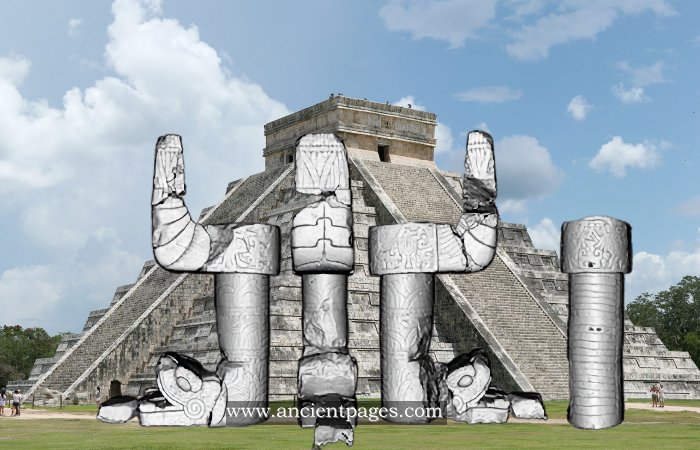
Credit: Daniel Schwen - CC BY-SA 4.0, McAvoy S, García-Solís C, Coltman JD, et al - CC BY 4.0 . Image compilation by AncientPages.com
El Castillo stands approximately 30 meters tall and measures nearly 55.5 meters on each side, making it Chichen Itza’s largest structure by volume. Over time, much of its original exterior stonework was lost, including sections of monumental limestone feathered-serpent columns that once supported the upper temple’s portico.
In 1905, restoration efforts led by Mexico’s Instituto Nacional de Antropología e Historia (INAH) and the Carnegie Institute of Washington significantly altered parts of El Castillo’s exterior. Interpretations of Kukulcán vary among scholars; some view this feathered serpent deity as central to Maya religion and regard it as a manifestation of the wind that moves the sun across the sky each day.

The fragments where they were found. Credit: McAvoy S, García-Solís C, Coltman JD, et al
The site features numerous carved serpent heads; however, those found at El Castillo’s upper temple portico are considered especially significant due to their prominent placement within this iconic structure.
In 2023, scientists launched the Chichen Itza 3D Archaeological Atlas by combining extensive 3D scanning with a new geospatial visualization framework. The project includes over 750 assets, such as aerial lidar data revealing hidden buildings and features beneath the forest canopy, mobile and terrestrial lidar scans, photogrammetric data of architectural details, and sub-millimeter artifact scans. This digital system enabled a site-wide search for missing serpent column pieces at Chichen Itza and led to the identification of four original fragments forming the head and tail of the western column.

3D reconstruction of the serpent column. Credit: McAvoy S, García-Solís C, Coltman JD, et al
Serpent columns at Chichen Itza are notable architectural features found in several locations and made from the same limestone as La Gran Nivelación. Their design includes a serpent head base, cylindrical shaft segments, and an L-shaped capital resembling a tail with overlapping scales (“rattle”) and a plumed tip. These capitals once supported wooden lintels, but as the wood decays, the columns become more vulnerable to damage.
At El Castillo’s north entrance, two serpent columns (each about 0.7 meters wide and 2.5 meters tall) support a portico to the inner chamber. Both have lost their heads and parts of their tails due to deterioration or possible intentional destruction—evidenced by historical accounts like Désiré Charnay's visit in the 1880s—and deliberate displacement of fragments.
Identified fragments around Chichen Itza include:
- The western column’s head (fragment 2), now about 110 meters northeast of its original spot.
- Additional pieces nearby—part of a tongue (fragment 3) and tail tip (fragment 4), likely from the eastern column.
- Three-dimensional scans confirm the fragment fit for these components.
- A rattle segment (fragment 5) found east of Venus Platform matches the characteristics of the western column.
- Another tail tip piece (fragment 6) remains atop El Castillo among debris; its features indicate it belonged there.
These findings reveal Maya construction techniques at Chichen Itza and document how natural decay or human actions led to damage or displacement of these distinctive serpent columns.

A photograph of El Castillo prior to reconstruction efforts (left) and a 2023 photogrammetric 3D reconstruction (right). Credit: McAvoy S, García-Solís C, Coltman JD, et al
The temple portico, the remaining columns, and individual fragments were digitized using an Artec Leo SLAM-based structured-light scanner. According to the researchers, the resulting model allows them to confidently determine the original locations of five fragments from the pair of serpent columns on the upper temple façade.
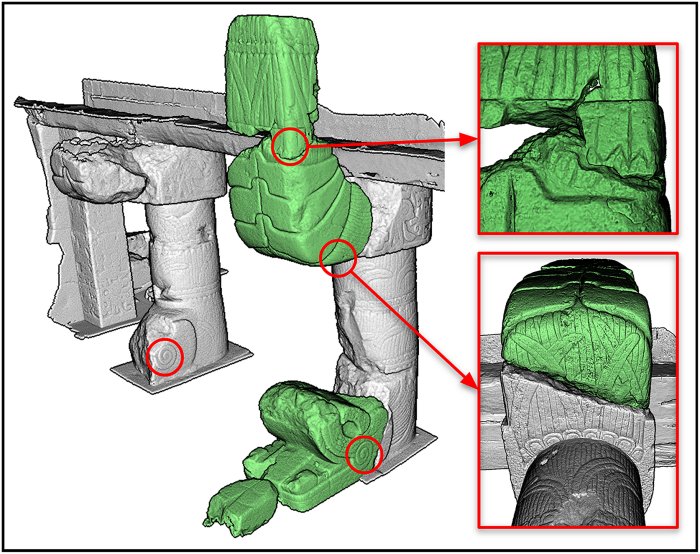
Scattered fragments (green) digitally reconstructed on unmodified columns (white). Credit: McAvoy S, García-Solís C, Coltman JD, et al
This process has enabled nearly complete completion of the western column. The reconstruction is supported by matching overall dimensions, shared decorative features, and complementary break patterns between paired fragments.
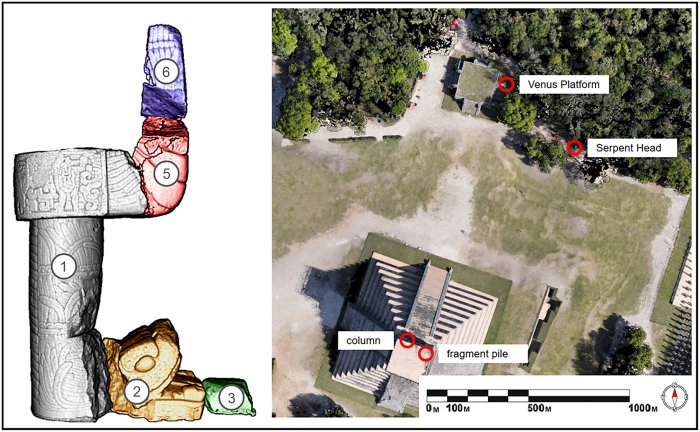
The column fragments and their find locations. Credit: McAvoy S, García-Solís C, Coltman JD, et al
These digital investigations are integral to a conservation plan that involves physically relocating and installing the fragments in their identified positions.
See also: More Archaeology News
This case study demonstrates one of many potential applications of the Chichen Itza 3D Archaeological Atlas project. The researchers hope this example will illustrate their vision for an open and accessible digital replica environment that enables broad reuse of complex survey data.
Source: McAvoy S, García-Solís C, Coltman JD, et al. Digital reconstruction of a serpent column at Chichen Itza’s El Castillo. Antiquity. Published online 2025:1-8. doi:10.15184/aqy.2025.10223
Written by Conny Waters - AncientPages.com Staff Writer
More From Ancient Pages
-
 Three Grave Steles Unearthed At Istanbul’s 1,500-Year-Old St. Polyeuktos Church
-
 Khopesh Sword – Symbolic Weapon Of The Pharaohs And Emblem OF Egyptian Deities
-
 Chilean Mummies Clad In Red Poison Dresses – Evidence Of A Unique Inca Ritual
-
 Anglo-Saxon Harpole Treasure Reveals More Secrets – Unique Medieval Silver Cross Found
-
 How The Horseshoe Became A Symbol Of Good Luck
-
 Ancient Mystery Of The Before – Time People – Traces Of An Unknown Lost Race – Part 1
-
 The Opening Of Pandora’s Box May Have Been A Real Event
-
 On This Day In History: Peter The Great Defeats Charles XII Of Sweden At The Battle Of Poltava – On June 28, 1709
-
 Lofn ‘Matchmaker’ – Norse Goddess Of Forbidden Marriages Of People Who Wish To Be Loved And Search For Partners
-
 Mystery Of The Neanderthals – Search For Traces Of Neanderthals’ Lives And Hints Of Their Demise
-
 Surprising Inscription Discovered On Birka Ring – Ancient Viking Artifact
-
 Remains at Crenshaw Site Are Local, Ancestors Of Caddo – New Study
-
 Massive trophy skull rack discovered in the Aztec ruins
-
 What Was The Sphinx And What Is Wrong With Its Body And Head?
-
 Mysterious Gigantic Jars Of Unknown Origin Discovered Worldwide
-
 Perseus – Courageous Adventurer Who Fulfilled A Prophecy
-
 Were Other Humans The First Victims Of The Sixth Mass Extinction?
-
 World’s Largest DNA Study Of Viking Skeletons Re-Writes Ancient History – Norse Warriors Were Not Those Who We Thought
-
 Sacred Ancient Texts Reveal Who Really Aligned The Oldest Monuments To The Stars
-
 Puzzling Ancient Artifacts Of Unknown Origin And Purpose

