Conny Waters - AncientPages.com - A significant discovery in the form of the complete text of the previously unknown "Hymn to Babylon," was made by Dr. Enrique Jiménez, Professor of Ancient Near Eastern Literatures at the Ludwig Maximilian University of Munich (LMU) in partnership with the University of Baghdad.
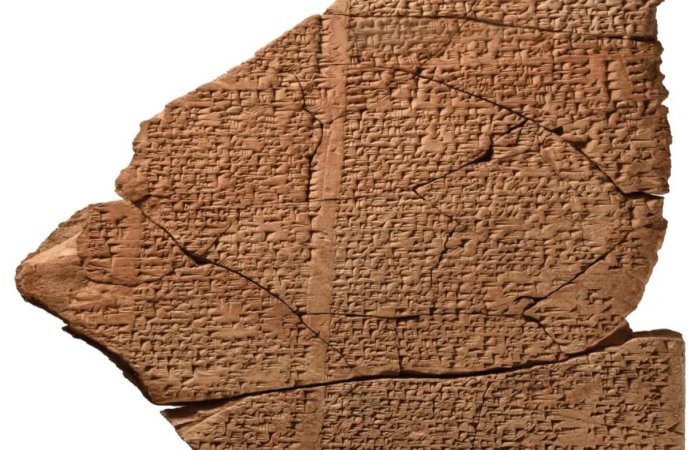
The cuneiform tablet with the newly discovered hymn to Babylon. Credit: Anmar A. Fadhil, Department of Archaeology, University of Baghdad. Courtesy of the Iraqi Museum and the State Board of Antiquities and Heritage.
The text tells its story and changes our view of Mesopotamian literature. The previously unknown hymn of praise comes from the period around 1000 BCE.
The lost hymn is preserved solely on clay tablets inscribed in cuneiform. These tablets were partially destroyed and dispersed across numerous collections. In this state, they remained indecipherable for many centuries. It was only through the efforts conducted on the electronic platform of the Library of Babylon and the application of artificial intelligence that researchers successfully connected 30 manuscripts belonging to this particular work.
“Using our AI-supported platform, we managed to identify 30 other manuscripts that belong to the rediscovered hymn – a process that would formerly have taken decades,” says Jiménez. Thanks to these additional texts, the scholars were able to completely decipher the hymn of praise on the clay tablet, parts of which were missing.
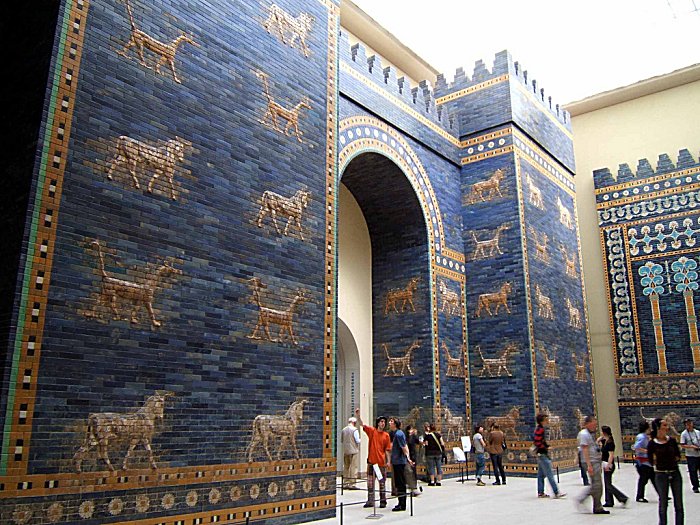
A reconstruction of the blue-tiled Ishtar Gate, Pergamon Museum, Berlin, once the northern entrance to Babylon. It was named for the goddess of love and war. Bulls and dragons, symbols of the god Marduk, decorated the gate. Image credit: https://www.flickr.com/photos/24065742@N00/151247206/ - CC BY 2.0
The presence of numerous additional copies indicates that the text was widely circulated during its time. The hymn was even copied by children at school, and this underlines its popularity. It is interesting,however, tje hymn remained undiscovered by modern researchers until today.
The text, which is believed to originate from the beginning of the first millennium BCE, consists of 250 lines (about two-thirds of the original text.
Written by a Babylonian who wanted to praise his city, describing its architecture, society, and natural environment, especially, how the waters of the Euphrates bring the spring and green the fields. Of particular significance is the insight it provides into the roles of women and priestesses, as well as the inhabitants' tolerance towards foreigners.
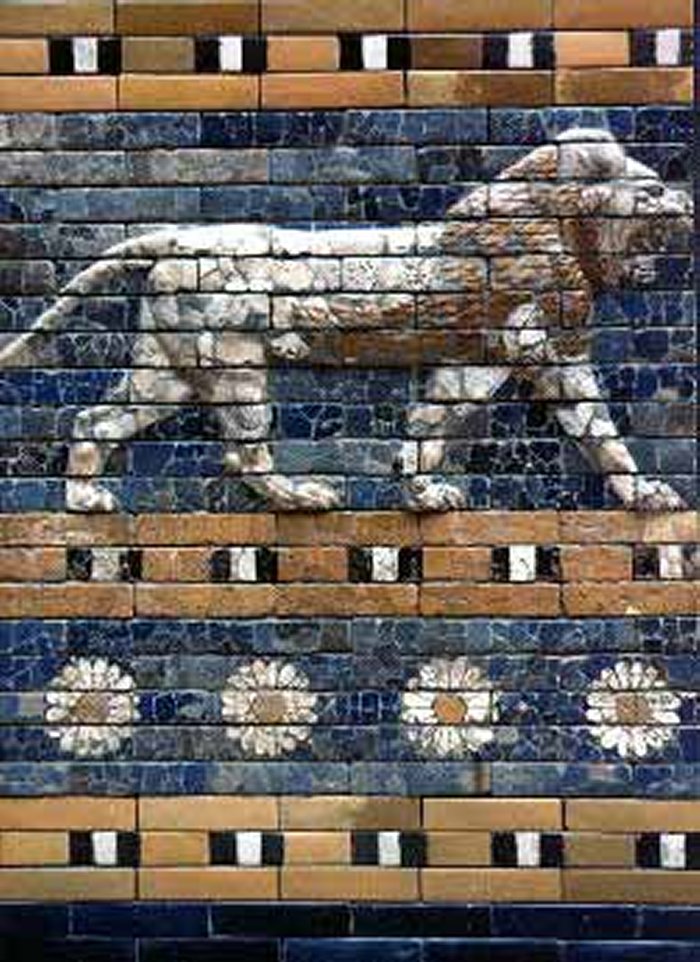
Lion, a symbol of the goddess Ishtar. Detail of a relief from the reconstruction of the Ishtar Gate in the Pergamon Museum, Berlin. (photoghraphed by Zunkir) -Public Domain
These important topics have not been previously addressed in Mesopotamian literature.
The following lines are from a recently discovered hymn that describes the river Euphrates. During the period when this hymn was composed, the city was situated along its riverbanks:
The Euphrates is her river—established by wise lord Nudimmud—
It quenches the lea, saturates the canebrake,
Disgorges its waters into lagoon and sea,
Its fields burgeon with herbs and flowers,
Its meadows, in brilliant bloom, sprout barley,
From which, gathered, sheaves are stacked,
Herds and flocks lie on verdant pastures,
Wealth and splendor—what befit mankind—
Are bestowed, multiplied, and regally granted.
Babylon, established in Mesopotamia around 2000 BCE, was once the largest city in the world and served as a cultural hub. It played a significant role in producing literary works that are now integral to our global heritage. The texts from Babylon were composed using cuneiform script on clay tablets, many of which have only partially survived to this day.
One of the primary objectives of the collaboration with the University of Baghdad is to meticulously decipher and preserve for posterity hundreds of cuneiform tablets originating from the renowned Sippar Library. According to legend, these tablets were concealed by Noah in this location to protect them from floodwaters before he embarked on the ark.
“Using our AI-supported platform, we managed to identify 30 other manuscripts that belong to the rediscovered hymn – a process that would formerly have taken decades,” says Jiménez, who is digitizing all cuneiform text fragments that have been discovered worldwide to date and using artificial intelligence to decipher fragments that belong together.
Thanks to these additional texts, the scholars were able to completely decipher the hymn of praise on the clay tablet, parts of which were missing.
The ruins of the ancient city of Babylon are located approximately 85 kilometers south of the Iraqi capital of Baghdad. They are a UNESCO World Heritage Site.
Written by Conny Waters - AncientPages.com Staff Writer