
Etruscan Beautiful Bronze Lamp of Cortona – Studied
Conny Waters - AncientPages.com - Archaeologists have recently focused their study on a beautiful artifact dated to the ancient Etruscan civilization that inhabited Etruria in ancient Italy.
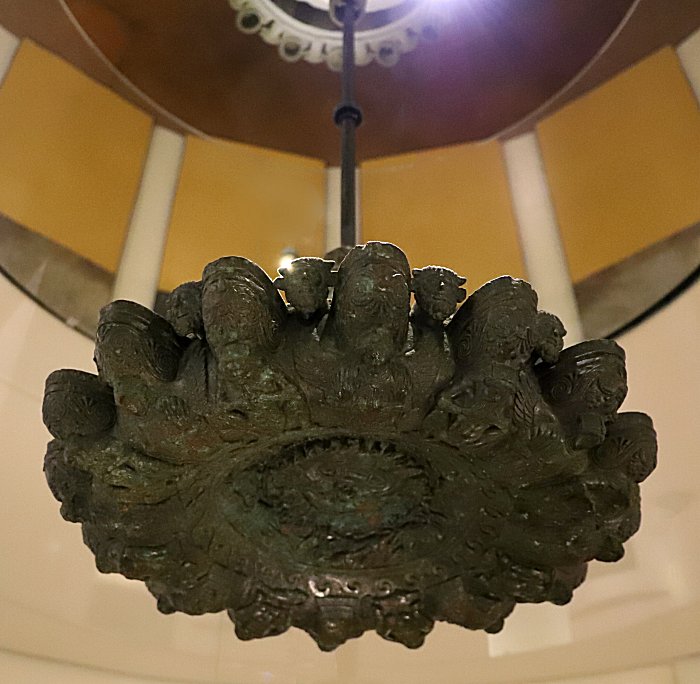
Underside of the bronze lamp of Cortona. Museo dell’Accademia Etrusca e della Città di Cortona (MAEC henceforth), Cortona. Published with the permission of MAEC. (Photo: MAEC webpage, edited by R. Alburz)
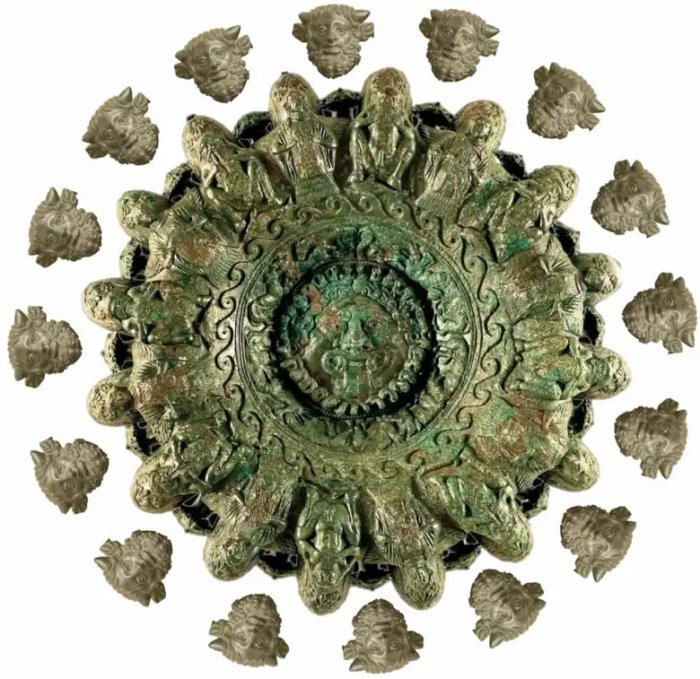
This artifact is a large, intricately designed bronze hanging lamp that might have been part of rituals paying homage to the Greek god Dionysus, but it took long time to come up with this conclusion.
The researchers wrote in their paper that the Cortona lamp has a “diameter of 60 cm and weighs 57.72 kg. It was found on 14 September 1840 in an isolated ditch, approximately 2.8 km to the west of Cortona at località La Fratta in central Etruria on land owned by the Cortonese noblewoman Luisa Bartolozzi Tommasi.
The lamp was recovered together with a damaged and inscribed bronze plaque.
For nearly two centuries, many researchers have worked tirelessly to unravel the intricate symbolism of this Etruscan artifact.
For many years it was believed that these figures symbolized the Greek river god Acheloos, usually considered the father of the famous sirens.
The Etruscan lamp of Cortona. Credit: Museo dell'Accademia Etrusca e della città di Cortona
After a comprehensive analysis of literary materials and visual proofs, the researchers concluded that the lamp's decorations probably represent the "thiasos" – a group of devotees associated with Dionysus, the god of wine and festivity.
After thoroughly analyzing literary materials and visual proofs, the team - Ronak Alburz, Ph.D. student and Associate Professor Gijs Willem Tol of the University of Melbourne, Australia, concluded that the lamp's adornments probably represent the "thiasos" – a group of devotees (often dancers, singers) and other followers associated with Dionysus.
The Cortona lamp also contains cosmic symbolism, which has been observed but not fully understood by earlier researchers.
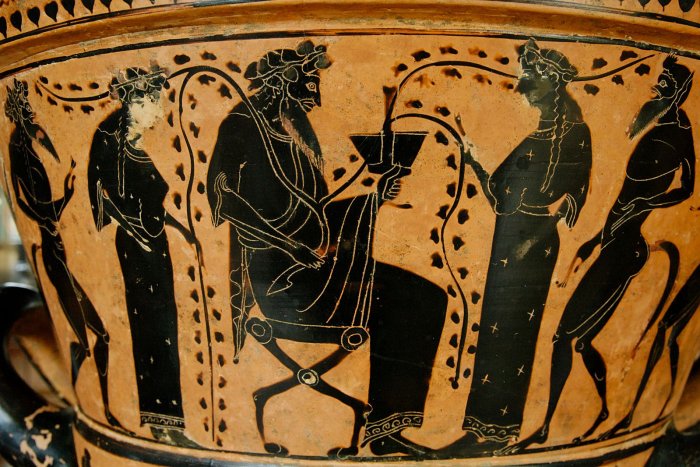
Dionysos and his thiasus. Upper tier of an Attic black-figure krater-psykter. Credit line: 1998 purchaded. Musée du Louvre - Public Domain
Therefore, the recent analysis of the artifact represents a visible depiction of the mysteries' cosmos. The lamp dated to the Late Archaic period (ca. 480 BCE) is a representation of the mysterious cosmos, featuring Dionysus, the sun god, in each of the sixteen segments of the Etruscan sky. It symbolizes the god’s journey through the alternate universe's outermost region.
The Cortona lamp was likely linked to the secretive Dionysus cult. The lamp's design portrays a Dionysian thiasus, possibly participating in a ritualistic act within the mystical universe in honor of Dionysus, according Alburz, the lead author of the study.
Paper: “A Re-Evaluation of the Iconography of the Etruscan Bronze Lamp of Cortona” Etruscan and Italic Studies, 2024. doi.org/10.1515/etst-2023-0019
Written by Conny Waters - AncientPages.com Staff Writer
More From Ancient Pages
-
 Ancient Necropolis With Lead Coffins Sheds Light On Early Christian Funeral Practices
-
 Ostrich Eggshell Beads Reveal 50,000-Year-Old Social Network Across Africa
-
 Incredibly Well-Preserved 2,000-Year-Old Statue Of Greek God Hermes Found In Heraclea Sintica, Bulgaria
-
 Cryptic Ice Age Markings In European Caves Deciphered – Proto-Writing Discovered By Amateur Archaeologist
-
 First Animals On Earth Could Have Evolved Much Earlier Than The Oldest Fossils Suggest
-
 On This Day In History: James Cook – Navigator And Explorer – Killed On Feb 14, 1779
-
 Ancient Tools Used In Religious Rituals In Honor Of Goddess Hathor Discovered In Egypt
-
 Archaeologists Excavate Two Roman Bath Hidden In A Dark Passage Below The Streets Of Bath
-
 Rare Medieval Bronze Wheel Cross Found In Brandenburg Shows Christian Symbols Were Widespread Before The Slavic Uprising Of 983
-
 Headless remains related to Huns or Sarmatians puzzle archaeologists in Kazakhstan
-
 7,800-Year-Old Clay Female Figurine Unearthed In Ulucak Mound, Turkey’s Izmir
-
 More Than 1, 300 Prehistoric Burial Mounds In Western Azerbaijan Have Been Systematically Surveyed For The First Time
-
 Tombstone With Ancient Greek Inscription Unearthed Near Nitzana In The Negev, Israel
-
 Neolithic People Ate Focaccia As Far Back As 9,000 Years Ago
-
 Man Finds A Viking Sword In His Garden – A Viking Grave Could Also Be Nearby – Scientists Say
-
 ‘Skeleton Mosaic’ – 2,400-Year-Old Scenes Depicted On Glass Artwork Found In Turkey
-
 Almost Unknown Ancient Greek Text Rewrites History Of Poetry And Song
-
 Mysterious Massive 3,800-Year-Old Structure And Passageway Found In The Jezreel Valley, Israel
-
 The Invisible Plant Technology Of The Prehistoric Philippines
-
 Cosmic Rays Reveal Mysterious Void Inside Great Pyramid – What’s Hiding Inside?

