Conny Waters - AncientPages.com - Two tiny Ice Age artifacts, hidden for 40,000 years, may help explain why our species survived. Archaeologists recently excavated these nearly 40,000-year-old figures from a German cave, offering important clues about the success of early modern humans in Europe.

The Hohle Fels cave. Credit: A. Janas, Universität Tübingen
Scientists have announced another significant discovery from the Hohle Fels cave, a UNESCO World Heritage Site in the Swabian Alps: two bird figurines carved from mammoth ivory. Each is intricately detailed and barely larger than a thumbnail. An archaeological team from the University of Tübingen recovered them from the lower Aurignacian layers, which date back 40,000 years and are rich in the oldest known figurative art.
At the time these figures were made, modern humans shared Europe with other human groups. As Neanderthals and others vanished, Homo sapiens spread throughout the continent.
Researchers believe that our ability to think symbolically, tell stories, and create art helped build stronger communities and made it easier to pass down knowledge. These skills may have been key to survival.
The small bird figures give us a rare glimpse into this special human skill.
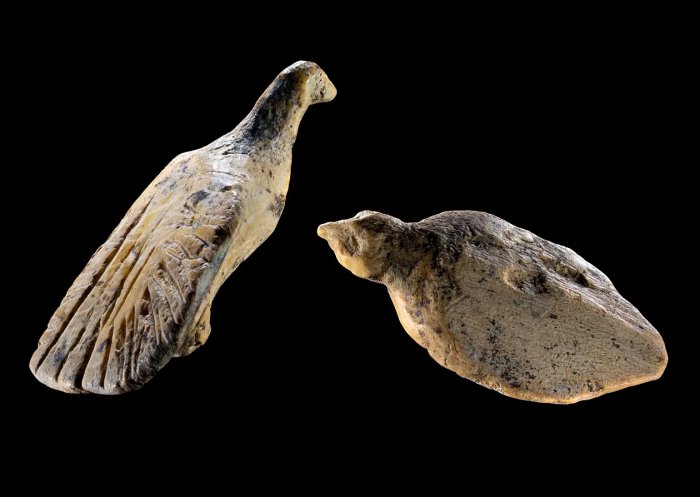
These two bird figurines were found in the Hohle Fels cave, a World Heritage site, and are about 40,000 years old. Credit: Ralf Ehmann, Universität Tübingen
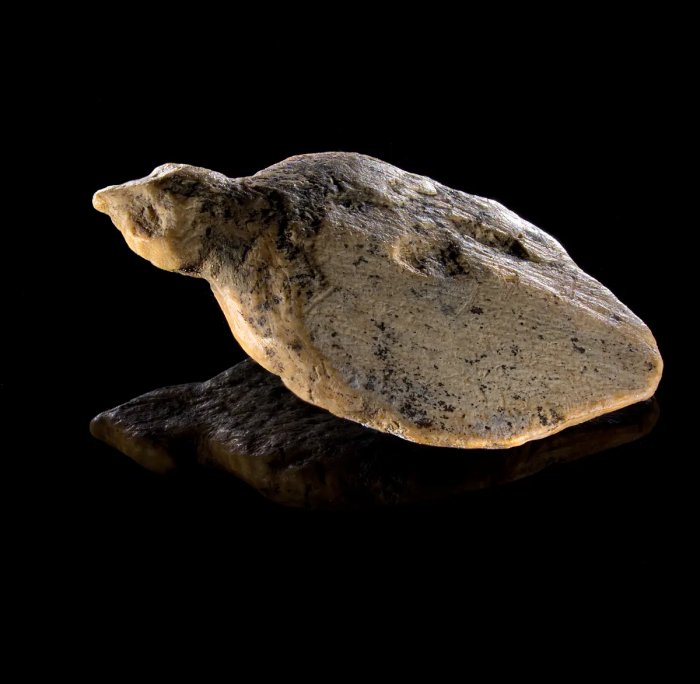
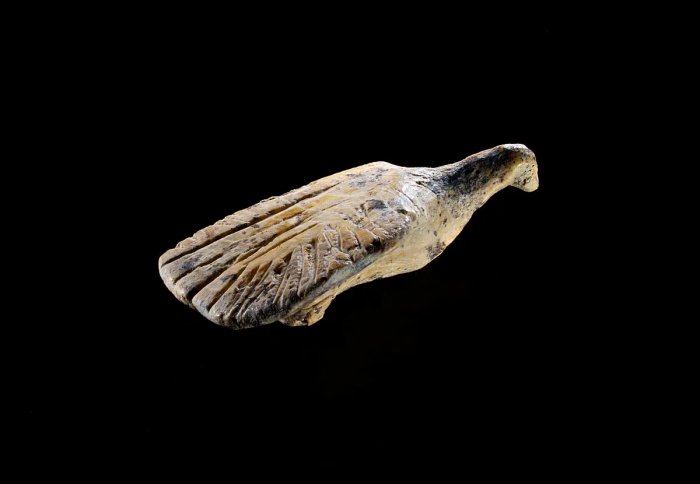
The new finds include an almost complete depiction of a resting, possibly brooding, bird and a bird with outstretched wings, though its left wing is missing and cannot be reattached.
It is unclear whether the figures were created by the same individual or by different generations, as they were found in the same layer but about 1.5 meters apart.
"However, the figurines demonstrate that the carvers of the world's oldest art were able to depict birds in diverse and extremely intricate ways, and that certain motifs appear to be specific to particular archaeological sites," said research director Professor Nicholas Conard from the Department of Prehistory and Early History at the University of Tübingen during the presentation of the bird figures as "Find of the Year" in Blaubeuren.
The newly discovered bird figurines are exceptionally small. Measuring two centimeters long, one centimeter wide, and half a centimeter high, the outstretched bird is the smallest known Ice Age artwork in the World Heritage region. Most other Ice Age figures range from three to nine centimeters.
Despite their size, the birds are intricately crafted: the resting bird features round eyes, while the other displays a distinctive beak and parallel wing markings representing plumage. "Here, the mammoth tusk wasn't simply used to create some simplified form of a bird's body," says Professor Conard.
Credit: Ralf Ehmann, Universität Tübingen
"Here, precise observations of nature were translated into figures whose wealth of detail even allows for an examination of which bird species is depicted and what it is doing."
Most Ice Age animal figurines are shown in static poses, but these bird figurines display specific behaviors. Professor Conard's team suggests the resting bird, with its outstretched, flattened posture, head close to its body, and legs tucked in, may be brooding.
The bird with spread wings and an elongated neck could be flying, landing on water, threatening, or displaying courtship. The exact body language and species remain uncertain. They may represent ptarmigan, whose bones are common in the region's archaeological record, but researchers are also considering other pheasant-like birds such as the capercaillie or certain birds of prey.
“Weighing just under 1.3 and 0.7 grams respectively, the two newly discovered ivory birds are real lightweights,” says Professor Conard, “but they pose many exciting scientific questions for us.” One question is what these birds represented to Ice Age hunter-gatherers, possibly as personal talismans or group symbols that fostered a sense of identity.
The reason for the apparent focus on birds by the people at Hohle Fels near Schelklingen in the Achtal valley 40,000 years ago also remains unclear. The cave, which yielded a water-bird sculpture twenty-five years ago, now contains three depictions of birds.
Credit: Ralf Ehmann, Universität Tübingen
In contrast, the other three Ice Age art sites in the UNESCO World Heritage area feature many animal figures, such as mammoths, cave lions, and wild horses, but not a single bird. Conard reports, “We are therefore increasingly recognizing that people produced individual works, for which they resorted to different motifs depending on the ivory workshop – each site thus bears its own unique signature.”
See also: More Archaeology News
The figurines will be on display until April 4, 2027, at the Blaubeuren Museum of Prehistory and Ice Age Art (urmu) in the exhibition "Featherlight and Research-Heavy – Discover the Miniature Birds of Ice Age Art," near their discovery site. Dr. Stefanie Kölbl, Managing Director, notes, "Our landscape here has always provided a habitat for a wide variety of bird species; today, with Lake Schmiechen, it even boasts a European bird sanctuary."
She adds, "Even 40,000 years ago, birds were ever-present: they greeted the day with their chirping, their migration south heralded the changing of the seasons, and their alarmed flocks warned of danger. People could imitate their songs on bone flutes… how wonderful that they also so vividly sculpted these enchanting creatures in ivory." Free guided tours of the "Find of the Year" will be offered on Saturday, August 1, and Sunday, August 2, at 2:30 p.m.
Source: Universität Tübingen
Written by Conny Waters - AncientPages.com Staff Writer