AncientPages.com - Ireland and Wales share more than just geographical proximity; they have deep cultural and linguistic connections. And this year marks the centenary of a groundbreaking work which explored the relationship between the two countries.
Ireland and Wales: Their Historical and Literary Relations was written by the Irish scholar Cecile O’Rahilly in 1924. Her legacy in the field of Celtic studies continues to resonate, 100 years after her book was first published.
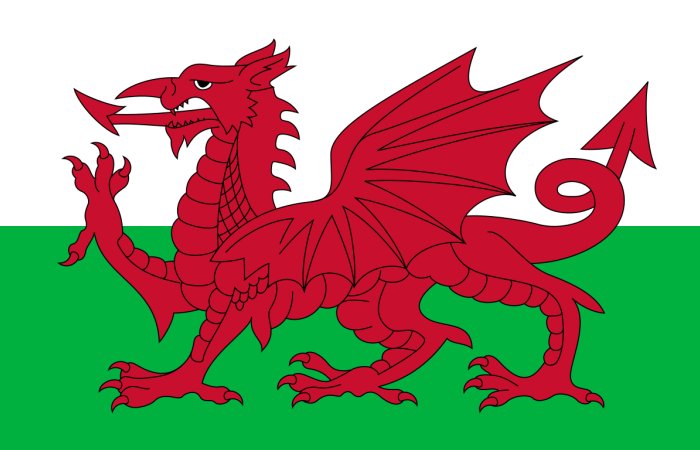
Flag of Wales. Credit: Public Domain
The Welsh and Irish languages are close relatives, descended from a common Celtic ancestor. It seems plausible, if much less open to proof, that the Irish and Welsh also inherited cultural and literary features from their Celtic-speaking ancestors.
One striking example is the role of the professional praise poet, a revered figure in both Irish and Welsh societies. Classical authors note that poets in ancient Celtic Gaul (present-day France, Belgium and Luxembourg, as well as parts of the Netherlands, Germany, Switzerland and northern Italy), held a similarly esteemed position. The word for “poet” in Gaulish, bardos, shares its roots with the Middle Irish word bard and the Welsh bardd. It’s a linguistic link that underscores their shared cultural heritage.
Irish literature offers vivid examples that closely mirror classical descriptions of ancient Gaulish society. Notably, warriors were said to keep severed heads as trophies and fierce competitions to the death at feasts determined who would claim the choicest cut of meat. These examples led to the theory that a relatively uniform Celtic culture once spanned the Celtic-speaking regions of antiquity, with Ireland preserving these traditions the longest, partly due to the fact it never became part of the Roman Empire.
Wales, on the other hand, was profoundly altered by its absorption into the Roman province of Britannia. The medieval Welsh adopted the Trojan Brutus as their ancestor, and idolised the Roman general Magnus Maximus.
The Welsh word Gwyddel (Irishman) derives from gŵydd (wild), and so literally means “savage”. The gulf between Irish and Welsh was facilitated by the fact that major phonological (the sounds in a particular language) changes to both languages obscured their historical relationship. No doubt the 7th-century Irish who borrowed the Welsh word Gwyddel as a term of self-definition (it gives us Gael today) were blissfully unaware of its original meaning.
Despite the fact that the medieval Welsh saw the Irish as being just as alien as the English, they were in frequent contact with them. There were Irish-speaking communities in parts of Wales, until the 7th century, as can be seen principally from bilingual inscriptions carved into stones in Irish and Latin.
Welsh churchmen such as the family of Sulien of Llanbadarn Fawr, 11th-century bishop of St Davids, were educated in Ireland. And Gruffudd ap Cynan, king of Gwynedd from 1081 until his death in 1137, spent his youth exiled in Ireland. He returned to north Wales with Irish soldiers to reclaim his throne. Day-to-day commerce across the Irish sea is also reflected in both Welsh and Irish literature.
Cecile O’Rahilly
Born in 1894 in County Kerry, O’Rahilly’s academic journey began in Ireland but her work soon took her to Wales, where she won a scholarship to pursue a master’s degree at Bangor University. She submitted an essay to the National Eisteddfod Welsh cultural festival in 1920 and ended up winning. The essay was the seed that grew into her seminal book, which explored the complex relationship between Ireland and Wales during the middle ages.
She remained in Wales, teaching French at a number of different schools, until 1946 when she took up a post at the Dublin Institute for Advanced Studies. She later became a professor there, the first woman to hold the post. O’Rahilly lived in the Irish capital with her Welsh companion Myfanwy Williams until her death in 1980. She is best known today as the editor of the epic Irish saga Táin Bó Cúailnge (the Cattle-Raid of Cúailnge), released in 1967.
O’Rahilly did not return to the question of the relationship between medieval Ireland and Wales in print. Nonetheless, her work was pioneering, but it also opened up debates that continue to this day.
Debates
Among the discussions arising from her work, scholar Proinsias Mac Cana and others, posited plenty of Irish influence on Middle Welsh tales such as Branwen, one of the earliest surviving Welsh prose stories.
But given their shared heritage, some similarities might date back to prehistoric times rather than the medieval period. They could also have arisen by independent generation, or have been independently borrowed into the two traditions from a third source, such as Latin literature, for example. A colleague of mine, Patrick Sims-Williams, has shown that it is difficult, if not impossible, to choose definitively between these possibilities.
The rise of “Celtoscepticism” in the late 20th century has challenged traditional views of Celtic identity, namely that there was no uniform shared culture among Celtic speakers over time and place. It has led to the retreat of individual scholars within Celtic studies departments into their own areas of expertise, rather than broader comparative work.
Scholars like Cecile O’Rahilly, who expertly navigated both Irish and Welsh sources and was fluent in both languages, are increasingly rare. But as new generations of experts explore these connections, the shared heritage of these two nations continues to offer fresh insights.
Provided by The Conversation
This article is republished from The Conversation under a Creative Commons license. Read the original article.