
Triumvirates In Ancient Rome: Power Struggle, Intrigue And Ambush
Conny Waters - AncientPages.com - A triumvirate (in Latin' tre viri' - three-man - or 'triumviri') was a board of three officials who shared a position of authority or power in ancient Rome.
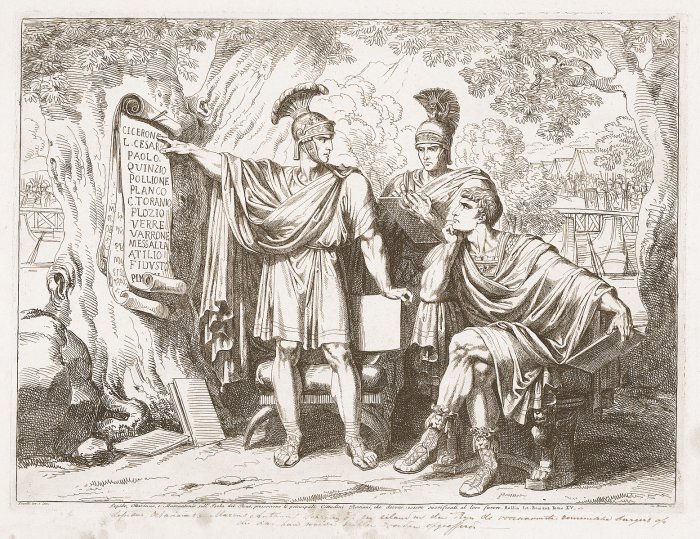
Lepidus, Octavian and Mark Antony make a list of names of the most important Romans, whom they can execute with impunity and expropriate their property (the second triumvirate). Image credit: Rijksmuseum -Credit line: Schenking van J.J. de Man, Ede - CC0 1.0 DEED
A political agreement between these statesmen enabled them to govern together so that "nothing in the republic could happen without their consent."
The "First Triumvirate," also known as - the alliance of 'three' - was an unofficial arrangement made in 60 BC by Gnaeus Pompeius Magnus (Pompey' the Great'), Gaius Julius Caesar, and Marcus Licinius Crassus.
These three strong political leaders could control the Roman political system and support each other to achieve their goals.
This "first alliance of three" lasted until the death of Crassus, who started an unwarranted invasion of Parthia and was killed in 53 BC during the Battle of Carrhae (now Harran Southeastern Anatolia, Turkey.
Caesar's triumphant military campaigns in Gaul and Pompey's persistent pursuit of more alliances to weaken Caesar unintentionally paved the way for a conflict. Pompey was defeated at the Battle of Pharsalus in 48 BC and sought refuge in Ptolemaic Egypt, where the courtiers of Ptolemy XIII assassinated him. The triumvirate fell apart because of a battle and ambush. Caesar ruled alone until his assassination in the Senate in 44.
The Second triumvirate was created in 43 BC by a Roman law, 'lex Titia.'

It granted Mark Antony, the young Caesar (the future Augustus), and Lepidus unlimited power for five years.
The triumvirate was later renewed in 38 BC. Unlike the so-called First Triumvirate, a private arrangement among three men, the Second Triumvirate was a legal instrument that created a formal legal framework to empower the three triumvirs with practically absolute power.
They had the authority to enact or abolish laws and issue judicial penalties without following due process or allowing for appeals, and they were responsible for appointing all other officials.
Additionally, they divided the Roman world into three distinct provinces.
This agreement concluded in 43 BC between Octavian, Marek Antony, and Marek Lepidus, was established to sort out the situation in Rome after the death of Gaius Julius Caesar and punish his assassins.

The Augustus of Prima Porta, 1st century AD, depicting Augustus, the first Roman emperor. Image credit: Joel Bellviure - CC BY-SA 4.0
The Second triumvirate differed from the first in that it was a legal entity expressly approved by the Senate rather than a private contract between strongmen. However, the second suffered the same fate as the first.
Many internal quarrels and jealousy led to its weakening and downfall.
Lepidus was the first to fall. After a power struggle against Octavian, he was stripped of all his offices except Pontifex Maximus in the year 36 and later banished to a remote island. Antony, on the other hand, spent four decades in Egypt living with Cleopatra and progressively distancing himself from Rome's political power plays. He met a crushing defeat at the 31st Battle of Actium.
It was a devastating loss, and Antony took his own life.
Octavian changed his title to Augustus in 27 AD and became the first emperor of Rome. The situation in ancient Rome began to change; the power of the Senate and its consuls was broken. The Roman Empire began its almost half-millennium influence on the Mediterranean world.
Among several different triumvirates, there was, for example, 'tresviri monetales 'in charge of the mint for Rome and Italy during the republic and the empire.
Another one, 'Tresviri epulones,' was initially a board of three priests created in 196 BC to manage the banquet of Jupiter, the critical event in the Ludi Romani and Ludi Plebeii festivals.
Written by Conny Waters - AncientPages.com Staff Writer
Copyright © AncientPages.com All rights reserved. This material may not be published, broadcast, rewritten or redistributed in whole or part without the express written permission of AncientPages.com
Expand for referencesReferences:
Clifford A. The First Triumvirate Of Rome
Zoch Paul. A. Ancient Rome: An Introductory History
Balsamo W. The First Triumvirate Of Rome
More From Ancient Pages
-
 Pre-Incan Tombs Of The Chancay Culture Discovered In Lima, Peru
-
 Ancient Village Of Monsanto, Miraculously Balanced Giant Boulders And Knights Templar Connection
-
 Unexplained Ancient Wars In America – Strange Physical Evidence – Part 2
-
 Humans Lived In The Qal-e Kord Caves 400,000 Years Ago – Oldest Settlement In Iran Found?
-
 Ancient Greco-Roman Amphora Workshop Discovered In Alexandria, Egypt
-
 Anne Askew: Woman Of Great Courage, Strong Beliefs And Principles Who Was Arrested For Heresy, Imprisoned, Tortured And Burnt At The Stake
-
 Can This Ancient Coin Solve The Mysterious Disappearance Of Pirate Henry Every?
-
 Gashadokuro: A Terrifying Nocturnal Ghost Yokai With Voracious Appetite For Human Blood
-
 Gryla: Cannibalistic, Evil Troll And Her Sons ‘Yule Lads’ – In Icelandic Folklore
-
 What Was On The Menu For Stonehenge’s Builders, 2500 BC? Milk, Yoghurt And Cheese Only Eaten In Exclusive Ceremonies
-
 Similarities And Differences Between Living Spaces Of Neanderthals And Homo Sapiens
-
 Ice Age Cycles Played A Key Role In Early Human Interbreeding
-
 Why Are The 2,000-Year-Old Roman Walls Found In Switzerland An ‘Archaeological Sensation’?
-
 Abu Erteila’s Lost Temple And The Meroitic Empire: New Discoveries Shed Light On Nubian Civilization
-
 Jamestown: Unearthed graves with four bodies and a small sealed silver box
-
 We Need To Look Underwater To Understand Our Past – New Study
-
 Mysterious Voynich Manuscript Was Written In Two Languages – Scientists Say
-
 Fall Equinox Explains Unusual Alignment Of Egypt’s Great Pyramids – Engineer Says
-
 Neolithic Monuments, Prehistoric Pits And Anglo-Saxon Cemetery Unearthed In England
-
 Ancient Roman Coins Thought To Be Fakes Are Authentic – Experts Say

