
Flexible Glass – Lost Ancient Roman Invention Because Glassmaker Was Beheaded By Emperor Tiberius
Ellen Lloyd - AncientPages.com - Did ancient Romans invent unbreakable glass? If they did, their secrets would be long lost because the Roman Emperor Tiberius beheaded the inventor of flexible glass.
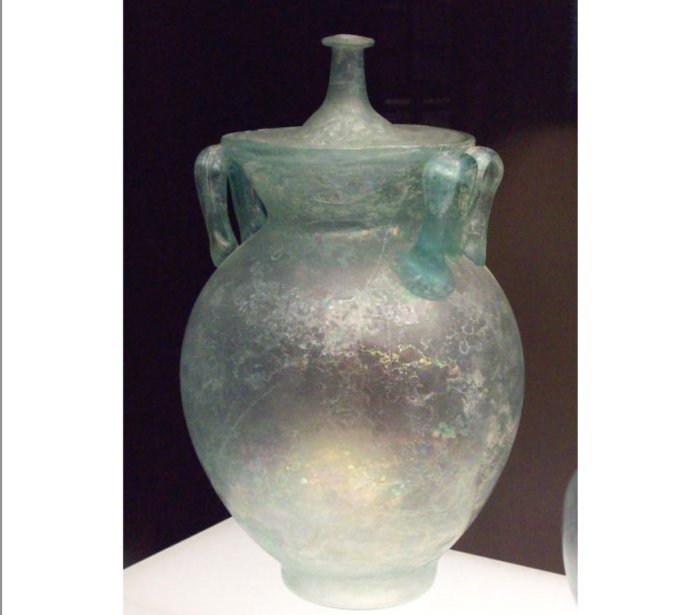
A Roman blown-glass cinerary urn, dated between 1st and 3rd centuries AD. Image credit: Luis García - CC BY-SA 3.0
According to Roman authors Petronius (c. 27–66 AD) and Pliny the Elder (23–79 AD), a glassmaker was granted an audience with Emperor Tiberius. The glassmaker presented an incredible invention called a phiale (a shallow drinking vessel). The drinking bowl must have been made out of extraordinary material because he failed when the Roman Emperor Tiberius Caesar attempted to break the bowl.
Instead of breaking, the bowl dented like a bronze vessel. The glassmaker took out a hammer and removed the dent.
When Emperor Tiberius asked if anyone else knew how to make this kind of glass, the proud inventor replied that he knew the manufacturing technique. Unfortunately, the Emperor was by no means impressed.
Emperor Tiberius feared that such remarkable material could undermine the value of gold and silver and gave the order to behead the inventor.
In his Naturalis Historia, Pliny the Elder relates the story, but he also clarifies that he doesn’t believe anyone invented flexible glass (vitrum flexile). According to Pliny, the Elder, it’s just a story.
Another version of the story is told by Dio Cassius (AD 150–235), a Roman statesman and historian of Greek origin. Dio Cassius wrote in his Historia Romana that ‘an architect whose name no one knows’ aroused the jealousy of Emperor Tiberius, who exiled him. Emperor Tiberius was jealous of the architect’s skills.

Portrait of Roman Emperor Tiberius in Ny Carlsberg Glyptotek, Copenhagen. Original. Cast in Rome. Image credit: Cnyborg - Public Domain
“About this time, one of the largest porticos in Rome began to lean to one side and was set upright in a remarkable way by an architect whose name no one knows because Tiberius, jealous of his wonderful achievement, would not permit it to be entered in the records. This architect, then, whatever his name may have been, first strengthened the foundations roundabout so that they should not collapse, and wrapped all the rest of the structure in fleeces and thick garments, binding it firmly together on all sides by means of ropes; then with the aid of many men and windlasses, he raised it back to its original position.
At the time, Tiberius both admired and envied him; for the former reason, he honored him with a present of money, and for the latter, he expelled him from the city. Later the exile approached him to crave pardon, and while doing so, he purposely let a crystal goblet fall; and though it was bruised in some way or shattered, he promptly exhibited it whole once more by passing his hands over it. He hoped to obtain pardon for this, but instead, the Emperor put him to death.” (Historia Romana 57.21.7).
Whether the story is just a myth or there is some truth behind it, it is impossible to say. No example of Roman vitreum flexible is known to exist.
Could a Roman inventor have invented a form of break-resistant, denting glass? Modern scientists are attempting to develop flexible glass that will be used in smartphones.
It is important to remember that Roman glassmaking peaked during the early Imperial period, around the 1st century AD.
 The map depicts the Roman Empire in 117 C.E., at the height of the Pax Romana. (background) Image credit: ushistory.org
The Pax Romana (‘Roman Peace’) was a period of relative peace and stability across the Roman Empire that lasted for over 200 years, beginning with the reign of Augustus (27 BC – 14 CE), the first emperor of Rome to the rule of Marcus Aurelius (161 -180 CE).
During this period, there were constant improvements in glassmaking techniques. It was also a time when glassblowing was invented. It was quicker and required fewer resources per vessel than earlier methods. Ancient Romans started to produce colorless glass, window panes, and glass mosaics. Historians say Roman glassmaking was so advanced that some achievements could only be replicated in the 18th century.
An inventor could have successfully produced flexible glass, but he made a mistake in showing the Emperor his achievement.
There are several examples of ancient Roman inventions that changed the world. Ancient Romans were skilled inventors who were not afraid of experimenting with technology. As a result of their efforts, we can today benefit from various surgical tools, bound books, aqueducts, and many other things we take for granted.
Written by Ellen Lloyd – AncientPages.com
Updated on July 26, 2023
Copyright © AncientPages.com All rights reserved. This material may not be published, broadcast, rewritten or redistributed in whole or part without the express written permission of AncientPages.com
Expand for referencesRoman Mold-blown Glass: The First Through Sixth Centuries
By E. M. Stern, Toledo Museum of Art
Isidore of Seville (2006). The Etymologies
More From Ancient Pages
-
 Top 10 Discoveries About Our Ancient Ancestors In 2023
-
 Drought Was Not The Reason Cahokia, North America’s First City Was Suddenly Abandoned – New Study
-
 Is North America’s Oldest House In Ohio A 12,250-Year-Old Clovis Dwelling? Archaeologists Re-Investigate The Paleo Crossing Site
-
 Archaeologists Focus On Greek Poet Aratus’ Memorial Tomb And Ruins Of Soli Pompeiopolis
-
 Humans May Be The Result Of An Evolution ‘Accident’- Scientists Say
-
 Expressive Beautiful And Celebrated Bowls Created By Mimbres Artisans From Distant Past
-
 Evidence Vikings Had Windows With Glass Panes Already Between 800 And 1100
-
 4,000-Year-Old ‘Woodhenge’ Discovered In Denmark Is An Extraordinary Find!
-
 Unusual Rock With Ancient Paintings Discovered By Hiker In Norway
-
 Rare Magic Mirror In Cincinnati Museum Has A Secret Hiding In Plain Sight
-
 Ancient DNA Reveals The Earliest Evidence Of The Last Massive Human Migration To Western Europe
-
 ‘Saimaluu-Tash’ Time Capsule: Largest Millennia-Old Collection Of Petroglyphs In Central Asia
-
 Cooking Gear Found In Graves Of Viking Men And Women
-
 More Beautiful Mosaics In The Ancient City Of Hadrianopolis In Northern Turkey
-
 On This Day In History: Albertus Magnus – Medieval Person Of Great Historical Importance Died – On Nov 15, 1280
-
 5th-Century Tomb With Finds Of Historical And Artistic Value Discovered In Eastern Bohemia
-
 1,700-Year-Old Underground Temple Of Mithras Unearthed In East Anatolia, Turkey
-
 Vindelev Treasure – Surprising Evidence Of Nordic Connection With The European Iron Age Elite
-
 One Of The Biggest Gold Treasures Ever Discovered In Denmark Is 1,500-Year-Old
-
 Denisovan DNA Found In The Genome Of Oldest Human Fossil Discovered In Mongolia

