
Archaeologists Discover Ancient Mayan Board Game – Here’s What It Can Teach Modern Educators
AncientPages.com - Games have been played for thousands of years in cultures across the world.
There's the chequerboard game Senet, played in Egypt around BCE 3100. The African cup board game Mancala has been played since BCE 1400. Chess originated in India over 1,500 years ago. And the strategic game Go began in China 2,500 years ago.
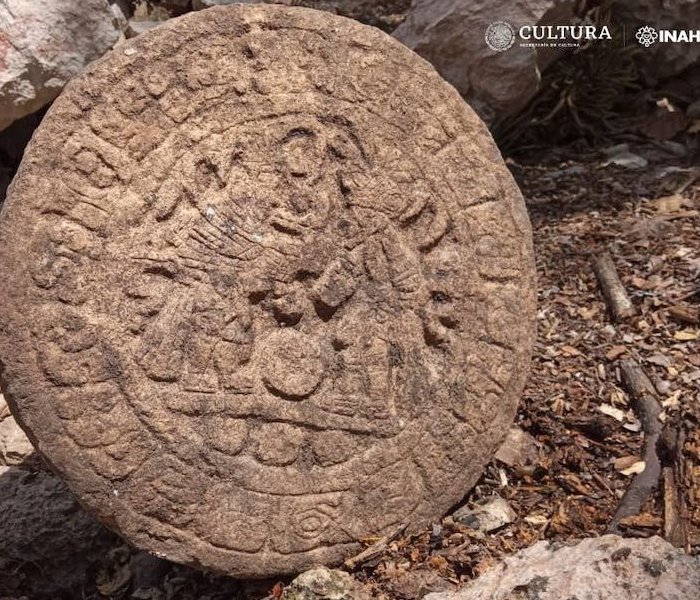
The ball game marker discovered in Chichén Itzá. Credit: INAH
The Mayan civilization—which flourished in central America from BCE 2000 to 1500 AD—had several popular games. These games were thought to have the supernatural power to predict war. They include a cross-shaped board game called Patolli and a ball game called Pok-a-Tok.
Recently, a stone scoreboard was found by archaeologists in Chichén Itzá, Mexico's Yucatán peninsula. The Mayan people appeared to have used it to play a ritualistic game with a heavy ball.
This game held significant cultural and religious importance for the Mayan civilization. More than a simple recreational activity, it reflected the deep-rooted beliefs and values of the Mayan people. For Mayans, games provided a platform for the expression of physical abilities, the establishment of social order and the connection between the mortal and the divine.
The game discovered in Chichén Itzá symbolizes the delicate balance between light and darkness, embodying a cosmic struggle. Like other Mayan games, it was believed to influence the fate of harvests, the climate, communities and individuals.
In Mayan culture, winning a game like this was seen as a sign of divine favor. They believed that victorious people or teams had been chosen by the gods. Those who consistently lost were sometimes offered as sacrifices to the deities. Mayan games were not solely intended for entertainment, but served as ways to connect with the divine.
By participating in these games, Mayan people experienced a sense of communal identity and belonging. The rituals and beliefs associated with the games fostered a collective understanding and reinforced the connections between the physical, spiritual and social realms.
What educators can learn from ancient games
The concept of the "magic circle", introduced by Dutch historian Johan Huizinga, suggests that during games, players enter a temporary world with its own rules and boundaries.
This is exemplified in this Mayan find, which involves rules, suspension of normalcy and shared experiences.
The magic circle represents a ritual space that both transforms and builds a sense of community. Understanding of this concept can be used to promote inclusion and collaboration in modern day education. Playful experiences within game spaces can facilitate learning and create a sense of belonging, enabling students to grow and learn collectively.
Ancient rituals and games possess characteristics like repetition, structure and the use of symbolic objects that aid students in understanding the world. They also offer psychological and social benefits, fostering social bonds, reducing anxiety and improving cognitive flexibility and problem-solving skills.
Incorporating ancient and modern games in education promotes soft skills, critical thinking and inclusivity. In fostering communication, giving students agency, and crossing cultural divides, analogue games help students to understand one another better in the classroom.
Applying the lessons
The TEGA project, which we led, created a toolkit to support the development and customization of inclusive analogue games for learning, with an emphasis on accessibility.
Analogue games, like tabletop or board games, offer a tangible experience that helps teach abstract concepts which typically lack clear physical representations. Through interaction with game elements such as cards, dice and pieces, student players can grasp abstract ideas like probability and strategy more effectively than through digital games or other media.
By considering accessibility needs through their motor, sensory and cognitive dimensions, games can be designed to accommodate a wider range of students. So by incorporating board games into higher education, teachers can create a learning environments that works for all students.
Written by Associate Professor, University of Bradford; Assistant professor, Lusófona University.
Provided by The Conversation
This article is republished from The Conversation under a Creative Commons license. Read the original article.
More From Ancient Pages
-
 Trung Sisters Of Vietnam: National Heroines That Stood Against Cruel Chinese Occupation Of Their Country
-
 Biblical Prophet Jeremiah Whose Prophecies Disappointed People
-
 Mary Boleyn – King Henry VIII’s Other Woman And Sister Of Anne Boleyn
-
 Why Didn’t Pythagoras And His Followers Eat Beans?
-
 10 Surprising Facts About The Neanderthals Who Were Not As Primitive As Previously Thought
-
 Jure Grando – First ‘Real’ Historical Vampire Case Documented
-
 Unorthodox Ancient ‘Out-Of-This World’ Carvings Were Found And Destroyed – Mysterious Labyrinth And Unknown Ruins – Part 2
-
 Bonobos And Chimps: What Our Closest Relatives Tell Us About Humans
-
 When Giants Ruled North America – Giant Skeletons ‘Erased’ From History – Part 2
-
 Thor And Tyr Journey To Hymir’s Hall To Steal Huge Cauldron – In Norse Mythology
-
 Shepherd’s Graffiti Sheds New Light On Acropolis Lost Temple Mystery – New Research
-
 Strange Tale Of Mysterious Thousand-Year-Old Underground Network Of Caves And Encounters With Subterranean Dwellers
-
 Was Alulim, First King Of Sumer And Eridu Biblical Adam?
-
 Why Was Grette The Strong, Icelandic Poet And Warrior Afraid Of Darkness?
-
 Lost Kingdom Of Idu And Its Seven Unknown Kings
-
 Magnificent Meteora And ‘Suspended In The Air’ Greek Monasteries
-
 Burials Of An Unknown Race Of Unusually Small Humanoids Found In Ohio May Confirm Native American Legend
-
 Great Sumerian God Enki: Protector Of Humanity, Brilliant Scientist And Patron Of Craftsmen And Artisans
-
 Fomorians: Supernatural Race Of Giants Who Came From Atlantis
-
 Mystery Of Ancient Beehive Tombs Around The World

