
Natural Wonders: ‘Fingal’s Cave’ – An Enigmatic Place Shrouded In Mystery And Legend
A.Sutherland - AncientPages.com - The cathedral-like structure - the least-visited and unique place in the world - is located on the barren and uninhabited island of Staffa, six miles off the western coast of Mull, which is part of the chain of islands known as the Inner Hebrides, Scotland.
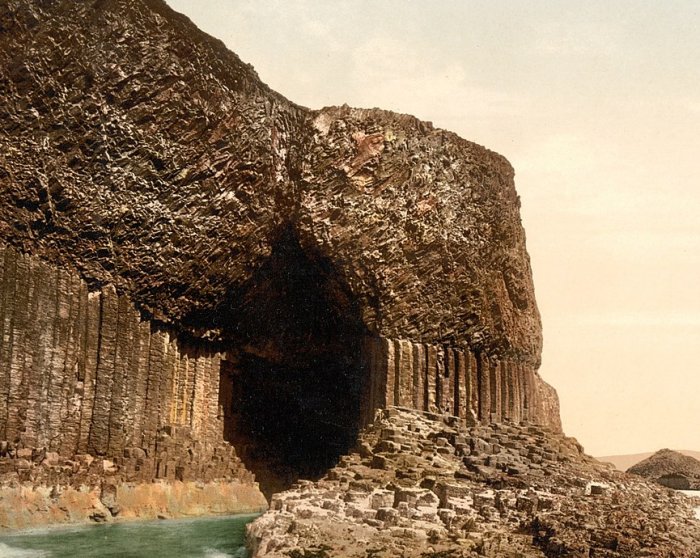
Fingal's Cave, Island of Staffa, Scotland. Image credit: - Public Domain
Bizarre basalt pillars, unusual symmetry, and eerie sounds produced by the echoes of waves can be admired in a vast sea cave formed from hexagonal basalt and known as Fingal's Cave.
A unique 69m (227 feet) tall structure results from intense volcanic activity approximately 60 million years ago.
The cave was formed from the most spectacular, hexagonally jointed black basalt columns.
Its height is 20m (66 feet), and its mouth, surrounded by these columns, has an opening of 13m (42 feet). The pillars are from 6 to 12 m high.
The cave was discovered in 1772 by Sir Joseph Banks (1743-1820), a British explorer and naturalist. He visited the island of Staffa and Fingal's Cave during his expedition to Iceland. Ancient records say that the island shakes so much during violent storms that one family occupying a small hamlet near the island's center in the late 1790s was forced to leave.
The hexagonal columns of basalt on Staffa seem to have unusual qualities.
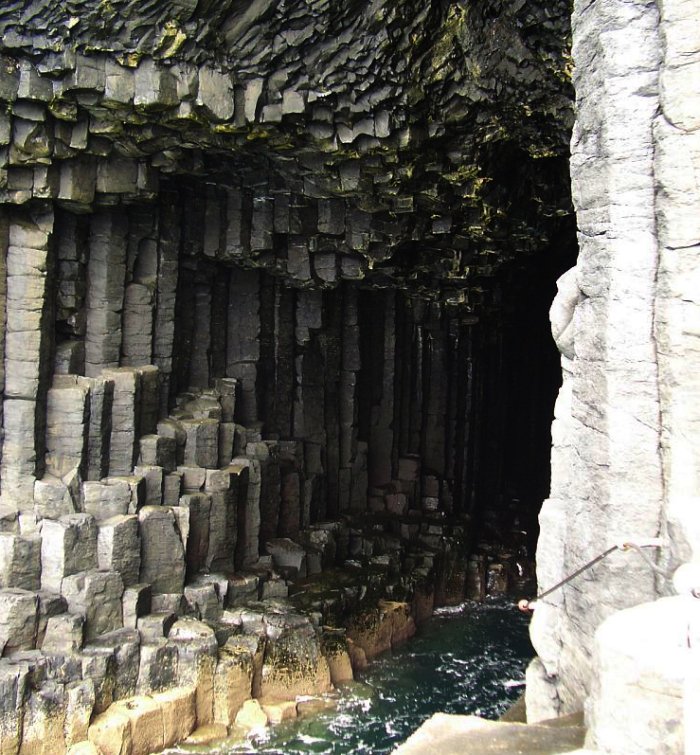
Basalt columns inside Fingal's Cave. Image credit: Karl Gruber - CC BY-SA 3.0
According to Salvatore M. Trento's "Field Guide to Mysterious Places of the Pacific Coast," a magnetic anomaly exists in the area. Very high magnetic readings have been recorded approximately twenty feet from the cliff face. Still, near ancient paintings that cover columns, the milligauss (one-thousandth of a gauss) readings dropped.
Historical sources confirm that prehistoric inhabitants lived in the region 8,000 years ago. Were they aware of locations with low magnetic readings that could cause special effects?
The Scottish historical novelist and poet Sir Walter Scott saw the famous Fingal's Cave. They listened to the unearthly music emitted by the dark-colored basaltic columns and water, affected by the ebb and flow of tides.
According to legend, an Irish giant and hero, Fingal (Finn mac Cumhail), built Staffa to avoid getting his feet wet when he walked across the sea from the Giant's Causeway in Ireland to Scotland to "lift" cattle.
His impression was that the place is "a naturally adorned cathedral where one touches the spirit of God." The Gaelic name means "the Cave of Music."
Also, Giant's Causeway's unique structure is ascribed to Fingal, who built it in Antrim, Northern Ireland, to walk to Scotland to fight his rival giant, Benandonner.
Fingal and his giant warriors are common in ancient Celtic mythology.
Finn, whose name means: white, a fair-haired person, also possessed a magic horn, which bore a mysterious curse, and Knud Mariboe in 'The Encyclopedia Of The Celts' writes that 'Finn's mother was the granddaughter of Nuada, king of Erin (Ireland) and leader of the Tuatha De Danann, and Ethlinn, the mother of Lugh of the Long Hand, a sun god, worshipped in the Celtic world...'
Today no one believes that Fingal built the Staffa's magnificent cave and the Giant's Causeway, but rather Mother Nature did millions of years ago.
Nevertheless, places like these have always been seen as something special, possibly sacred or mythical.
Written by – A. Sutherland - AncientPages.com Senior Staff Writer
Updated on March 13, 2023
Copyright © AncientPages.com All rights reserved. This material may not be published, broadcast, rewritten or redistributed in whole or part without the express written permission of AncientPages.com
More From Ancient Pages
-
 Vikings Visited America 1,000 Years Ago – Solar Storm And Archaeology Confirm Icelandic Sagas
-
 Durendal – Magical Sword Of Knight Roland That Cut Stone Boulders With A Single Strike
-
 Gothic Warrior With Rare Sword Unearthed In Thessaloniki, Greece
-
 Mystery Of Ancient New York Giants – Who Was Really Buried In The Druid Barrow?
-
 Zyndram’s Hill: Oldest-Known Stone Wall – A Masterpiece Of Architecture Found In Poland
-
 Magnetic Field From 9,000 Years Ago Teach Us About The Magnetic Field Today
-
 Dresden Codex – Probably The Oldest And Best Preserved Book Of The Maya
-
 On This Day In History: Battle Of Naulochus Was Fought Off The Coast Of Sicily – On Sep 3, 36 BC
-
 Earliest Evidence Of Flip Flops In The Middle Stone Age
-
 Lost William Turner Painting “The Rising Squall” Re-Discovered After 150 Years
-
 6,000-Year-Old Village Unearthed In Kurdestan
-
 A Researcher’s Life’s Work Uncovers First Ancient DNA From Swahili Civilization
-
 A Pioneering Study Provides New Insights Into Pregnancy During The Viking Age
-
 Ancient Stone Cylinders Shed New Light On The Invention Of Writing In Mesopotamia
-
 Looking Into The Secrets Of Parthenon’s Illumination That Enhanced The Sense of Awe And Religious Experience
-
 Strange Tale Of Demonic Possession And Exorcism In 17th-Century New France – What Happened?
-
 Evidence Of Frightening Rituals Practiced By Ancient Steppe Nomads In Siberia – Discovered
-
 Ancient DNA Confirms Picuris Pueblo Tribe’s Ancestral Ties To Chaco Canyon
-
 Genghis Khan Has 16 Million Relatives – You Could Be One Of Them
-
 8th Century Sculpture Of Lord Vishnu Belonging To Pandya Dynasty – Unearthed

