
Why Do Old Norse Myths Endure In Popular Culture?
AncientPages.com - From Wagner to William Morris in the late 19th century, via Tolkien’s dwarves and CS Lewis’s The Last Battle, through to last year’s controversial film The Northman, Scandinavian gods and heroes have been central to the stories we tell ourselves.
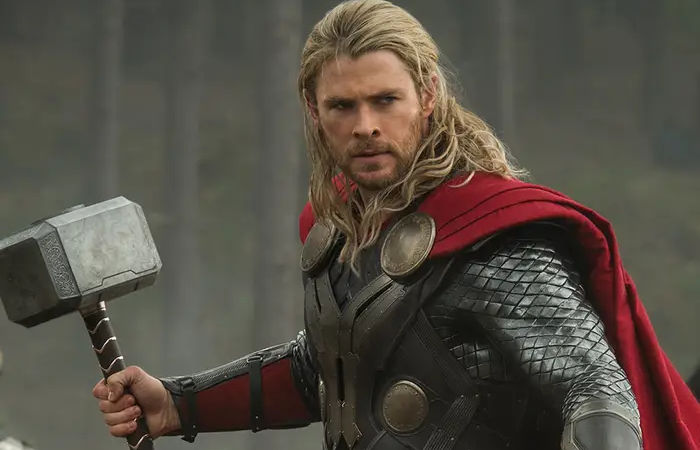
Chris Hemsworth in "Thor: The Dark World." Disney / Marvel
As professor of medieval European literature, I have been exploring Old Norse mythology since my undergraduate days. I have always been fascinated by the ways in which the old myths remain vital and relevant in the present, particularly now in various pop-cultural forms. In my new book, The Norse Myths That Shape The Way We Think, I explore how 10 key Norse myths and legends have been reworked over the last 200 years.
Although these stories have been influential since their discovery in 17th-century Europe, in recent years Norse narratives have exploded across fiction, Hollywood blockbusters, rock albums, opera, video games and TV shows – these are just a few of the cultural spheres in which Norse myths have been put to work. Here I introduce three of the most important gods, the feminine divine in the form of valkyriesand shield-maidens, and finally, the looming threat of ragnarök – the end of the world.
Gods and monsters
The main gods – not so much the goddesses unfortunately – offer ways to think about different stages of masculinity. Odin, the all-father, is the leader of the Norse pantheon, creator of humankind and god of wisdom. He will die at ragna rök, devoured by the great wolf Fenrir.
Starting with the main character Wotan in Das Rheingold, the first part of Wagner’s Ring Cycle – and also in Neil Gaiman’s 2001 epic American Gods, and Douglas Adams’ 1988 comic novel The Long, Dark Teatime of the Soul – Odin is a figure who senses that power is draining away from him. Yet he ingeniously seeks out ways of clinging to his waning authority, cutting dodgy deals and manipulating his own flesh and blood through cunning and deceit.
The Marvel Comic Universe has already killed off the aged god, for he embodies an older patriarchal principle, one that refuses to step aside for the next generation.
In Norse myth, Thor’s main role is smiting giants with his great hammer Mjöllnir, patrolling the borders of the gods’ and human territory to keep out enemies. An indomitable performer of mighty feats, he is not always taken seriously in the myths: a favourite story involves him being forced to cross-dress as a reluctant and implausible bride.
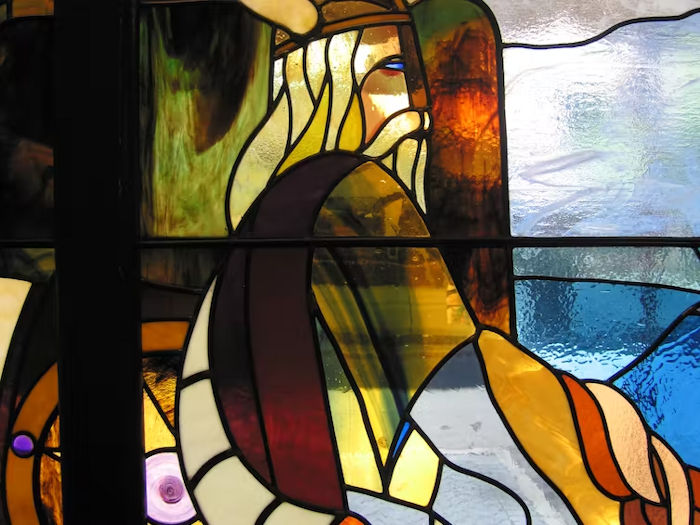
Viking warrior detail from stained-glass window at Miss Maud Swedish Hotel, Perth, Australia. John Davis, Author provided
So too, the modern Thor is often depicted as a bumbling loutish thug, reaching for his hammer instead of thinking things through. Contemporary writers, such as Joanne Harris and Francesca Simon, make him the butt of their tales for younger readers – the cross-dressing story makes for great comedy.
The god’s image has been rescued through his incarnation as the Mighty Thor. In Marvel comics and movies, he has learned maturity, how to wield and to restrain his power, and has come to care for others, both humans and his own people, the semi-divine Asgardians. Marvel’s Thor is constructing a new kind of masculinity, one that understands that violence is not always the answer and which has learned the value of forethought and compromise.
Half-god, half-giant, Loki is a strangely ambiguous being; in the Marvel Universe he is Thor’s adoptive brother, though not in the original myth. He gets the gods out of tight situations – often ones that he himself has caused – but he will march against them with their enemies at ragna rök. For novelist AS Byatt, he is the intellectual’s god, questioning and nonconformist, while Marvel and Disney have made Loki into a shape-changing, gender-bending cult hero, always ready with a quip as he double-crosses Thor once again.
A female perspective
Loki is also the father of monsters: his daughter Hel, goddess of death, is the heroine of Gavin Higgins and Francesca Simon’s chamber opera from 2019, The Monstrous Child. Hel is a sparky teenager living with disability and consigned to a grim underworld, a girl whose story takes in love, vengeance and learning the true extent of her powers.
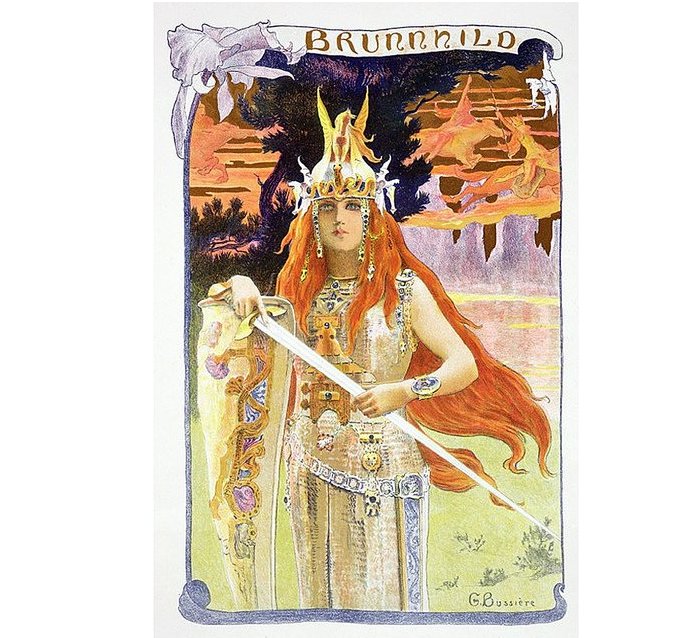
"Brynhild" (1897) by Gaston Bussière
Warrior-maidens and fate-goddesses rolled in one, the valkyries range high above the battlefield, determining who shall live and who shall die. Wagner’s Brünnhilde is the most remarkable of the valkyries, the true heroine of his Ring Cycle, fulfilling her father Wotan’s will and finally bringing down the gods.
Valkyries were also imagined as the battle-trained women warriors who now throng such TV shows as Vikings and The Last Kingdom, skilled fighters who battle on an equal footing with men. These women vividly dramatise aspects of contemporary femininity: effective in traditional masculine domains, wielding power and choosing their own lovers, yet still working out how to manage sexual relationships and motherhood alongside their professional identities.
Literally “the doom of the gods”, ragna rök lies in the mythic future for gods and humans: the powers of ice and fire will destroy the earth. Tolkien suggests that this inevitable ending shapes the northern spirit, kindling courage and resignation in the face of certain doom.
Wagner saw his Götterdämmerung (the twilight of the gods) as sweeping away the corrupt divine order, leaving a purified, empty world where free human beings could build anew. In HBO’s Game of Thrones, humanity’s apocalyptic clash with the icy power of the Night King is resolved by one young woman’s courage and determination.
The Norse myths envisage a cleansed green world that rises again from the ocean, but the climate cataclysm towards which we are heading admits no such renewal. Perhaps we can learn from the gods’ bad faith and carelessness in time to avert the downfall that ragna rök foreshadows for us all.
Written by Professor and Tutorial Fellow in English, University of Oxford
Provided by The Conversation
This article is republished from The Conversation under a Creative Commons license. Read the original article.
More From Ancient Pages
-
 Forbidden Knowledge: Secret Ancient Gates Of The Shining Ones – The Beginning – Part 1
-
 Persephone: Greek Goddess Of The Coming Spring And Lady Of The Land Of The Dead
-
 Never-Before-Seen Object Found In The Skull Of Powerful Ancient Ruler Raises Many Questions
-
 Unique Viking Age Hearths Discovered In Tallinn, Estonia
-
 Fascinating Discovery Of An Inhabited Underground World In Medieval Wales
-
 Beautiful Legend Of Giant Olentzero Who Brings Christmas Presents To Basque Children
-
 Pre-Columbian Americans Mastered Electricity – Ancient Inscription And Document Reveal Proof Of Advanced Ancient Technology
-
 Ullr – Famous Norse Archer, God Of Asgard And Fastest Skier Ever Known Who Taught People The Art
-
 Ancient Bizarre Experiments Conducted In Mysterious Underground Temple
-
 Trentren And Caicai: The Battling Serpents Of Chilote Mythology
-
 Baffling Structures Unearthed In A Place Where Prehistoric Human Remains Are Missing Is An Ancient Mystery
-
 Enigma Of Étienne Le Ray – Unusual Vagabond Prophet Nicknamed Nostradamus Of Brittany
-
 Archaeologists Investigate The Mysterious Disappearance Of Human Skeletons In England And Wales During The 5th Century
-
 How King Arthur Became One Of The Most Pervasive Legends Of All Time
-
 Why Was The Urnes Brooch So Popular At The End Of The Viking Age?
-
 Kingdom Of Mitanni: Forgotten For Millennia But Once Great Power Of Ancient West Asia In 2000 BC
-
 Tangaroa: The Firstborn, God Of The Seas, Oceans And Fish Of Every Kind In Polynesian Beliefs
-
 Famous Runestone Is Not What We Thought And Re-Writes History Of The Vikings – Scholar Argues
-
 Radar Discovers Huge Oval-Shaped Anomaly Beneath Ancient Egyptian City – An Archaeological Mystery In Lower Egypt
-
 Do Neanderthal Genes Determine Our Skin Color And Sleep Patterns?

