
Recently Found ‘Neanderthal Footprints’ In the South Of Spain Could Be 275,000 Years Old
AncientPages.com - A little over a year ago we reported on a large area at the foot of the Asperillo cliff, on the coast of the Doñana Natural Area in Huelva, Spain. There, along with numerous animal footprints, other footprints had been found—those of hominids.

General view of the site at Matalascañas beach, Huelva, and various hominid footprints discovered there. E. Mayoral, Author provided.
Until then, the only time reference that allowed the age of the site to be established was the dating of one of the dunes that covered the surface to around 106,000 years ago (Upper Pleistocene). As with most of the hominid footprints found worldwide, we dated them in line with the environment in which they were found. For this reason, our first hypothesis when trying to attribute the new found footprints was that they belonged to Neanderthals, who lived in the Upper Pleistocene.
However, in the course of the investigation, we sampled the surface where the footprints were found, which had never been dated before, and the dunes above. It turned out to be about 295,800 years old (Middle Pleistocene): this is to say, much earlier than previously thought.
Drastic climate change
The new dating placed the footprints in a new geographical and environmental context. The European continent was about to undergo drastic climate change 300,000 years ago. Relatively warm conditions were changing to much colder conditions, a precursor to a an ice age. At that time, the sea level on the European continent was on average about 60 meters below its present level, which implies that the Huelva coastline would be 20 to 25 kilometers offshore from its present position.
In other words, the coastal plain was very extensive and probably created by the delta of the river. It was probably covered by water during the wet seasons and totally or partially exposed during the dry seasons.
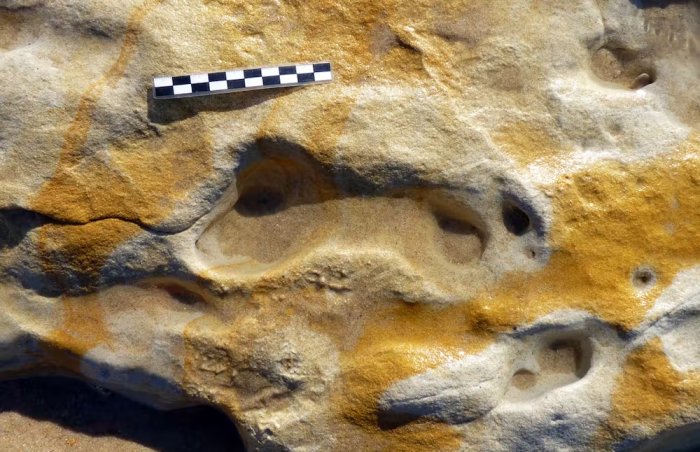
One of the hominid footprints analysed. E. Mayoral, Author provided.
Over this shallow and saline lake environment, made of polygonal ground and microbial covers, that hominids and other fauna trampled. Today, the same kind of polygonal covers are found in extensive areas of marshland in both hot desert and tropical climates.
More or less extensive vegetated areas would be found in the non-flooded areas of this wide coastal plain.
Around them, there would be a significant development of dune systems that would move landward from the coast.
New suspects?
The environmental context and the landscape have changed in relation to the initial interpretation. The question, therefore, became whether our understanding of who produced these footprints should also change. The answer is to be found in the paleontological record.
Hominid fossils belonging to the Middle Pleistocene are thought to be from the Neanderthal lineage: Homo neanderthalensis and Homo heidelbergensis. However, their remains are still very scarce, fragmentary and geographically dispersed. Worse still, footprints are even scarcer than skeletal remains. In the entire European Middle Pleistocene, only four sites have provided traces from this period: Terra Amata, in France (380,000 years old), Roccamonfina, in Italy (345,000 years old, attributed to Homo heidelbergensis), Biache-Vaast, in France (236,000 years old, Homo neanderthalensis) and Theopetra, in Greece (130,000 years old, Homo neanderthalensis).

E. Mayoral, Author provided.
On the other hand, it must be considered that the formal characteristics of the footprint are not only the result of the anatomy of the foot, but also of other factors such as biomechanical characteristics, the type of substrate and the processes that gave rise to the fossil. Therefore, the footprints studied must be well preserved and reflect several anatomical features (arch impression of the toes), which is rarely the case in places like this site in Huelva.
To confirm which hominid group the footprints belong to, we would need to compare their anatomical characteristics with the known skeletal record for the Middle Pleistocene.
Almost all the foot fossils known for this period come from the Sima de Los Huesos site (Atapuerca, Spain) and are associated with individuals related to Neanderthals. Making a more precise attribution would be difficult, as there are many debates about the evolution of this lineage, but also about the taxonomic definition of Homo heidelbergensis.
Different models for the evolution of the Neanderthal lineage have been proposed, but this question is still far from being resolved, given the paucity of the fossil record and the new and more complicated evolutionary picture provided by the latest ancient DNA studies. Moreover, not all anatomical traits evolved at the same rate and polymorphisms probably occurred in different traits at different rates of occurrence.
Despite these uncertainties, the Doñana site proves to be a crucial record for understanding human occupations in Europe during the Pleistocene. Our recent dating opens up a broader horizon of possibilities. For example, we may be looking at the remains of very early Neanderthal hominids or their more directly related ancestors, Homo heidelbergensis.
Provided by The Conversation
This article is republished from The Conversation under a Creative Commons license. Read the original article.
More From Ancient Pages
-
 Anchor Church Caves – Has The Home Of Anglo-Saxon King Eardwulf And Saint Hardulph Been Found?
-
 Unique Bones Decorated With Black Markings Discovered In 4,500-Year-Old Tomb In Ukraine
-
 Has The Mythical Long-Lost Underwater Ancient Land Of The King With Three Crowns Been Found?
-
 Researchers Confirm Museum Shrunken Head As Human Remains
-
 Is A Viking Settlement And An Even Older Church Hidden Under St. Clement’s Church In Norway?
-
 DNA Of 10,000-Year-Old Luzio Solves The Mysterious Disappearance Of The Sambaqui Builders
-
 Ancient Magical Bowls Inscribed With Spells And Other Rare Artifacts Seized In Jerusalem Raid
-
 Has AI Found An Unknown Human Ancestor?
-
 On This Day In History: Ferdinand Magellan Reached Pacific And South American Strait – On Nov 28, 1520
-
 Cisterns Unearthed In Metropolis, Turkey Give Insight Into Daily Life Of Its Inhabitants 1,500 Years Ago
-
 Controversial Study Of Ancient DNA Could Re-Write History Of South Florida And Prove Humans And Huge Prehistoric Animals Co-Existed
-
 New Study Questions ‘Incestuous Royalty’ In Neolithic Ireland
-
 3,500-Year-Old Stone Inscribed With A Curse Against The City’s Governor Discovered In Jerusalem
-
 Stunning Ancient Khanqah With Large Underground Crypt, Ritual Halls And Burials Discovered In Turkestan
-
 Story About Cahokia’s Lost Civilization Is Wrong – Archaeologist Says
-
 Mystery Of The Ancient Talayot Sword
-
 Fossil Study: Coelacanths Thrived In Switzerland After A Mass Extinction
-
 Sanctuary Of Amarysia Artemis, Amarynthos – New Valuable Finds By Greek-Swiss Team
-
 Naglfar Nail-Ship Carries Demonic Forces To Ragnarok In Norse Beliefs
-
 Heliopolis ‘Sun City’ Was One Of The Most Ancient Cities Of Egypt

