
Unusual Bronze Age Neck Rings Discovered In Norrköping, Sweden
Conny Waters - AncientPages.com - Two unusual Bronze Age neck rings have been found in a grave during an archaeological survey in Marby, east of Norrköping, Sweden. The rings, which are over 2,500 years old, were probably deposited as offerings.
Credit: Arkeologerna, SHM
“Finding them in a context like this is unusual, perhaps unique,” says Alf Ericsson of the State Historical Museums. Although the site appears to be an ordinary forest slope, it contains significant traces of past human activity dating back thousands of years.
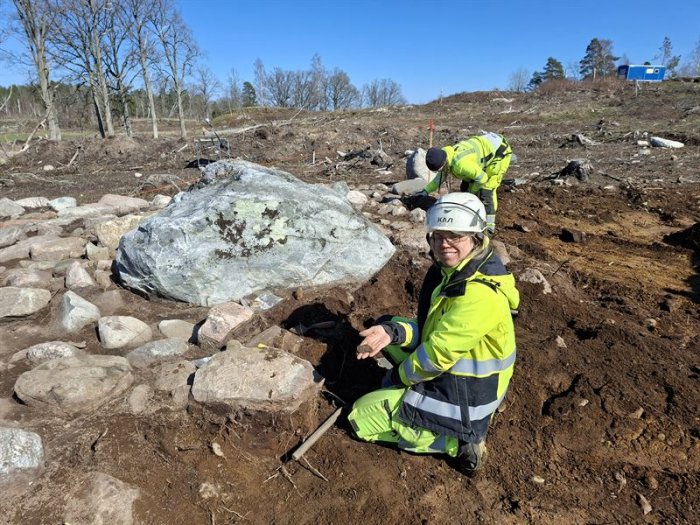
In recent weeks, archaeologists have examined a large site east of Norrköping, which includes graves, rock carvings, and settlement remains from the Late Bronze Age (around 1100 BC to 500 BC). At that time, the site was located by a bay near the sea. The excavation is taking place in preparation for new housing construction. During this work, archaeologists made an unexpected discovery.
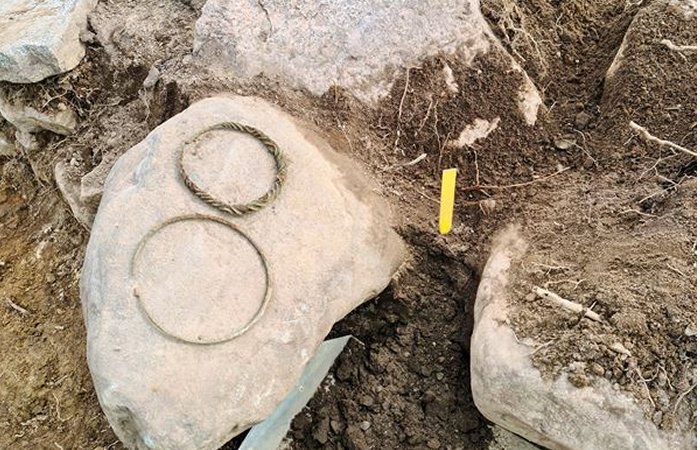
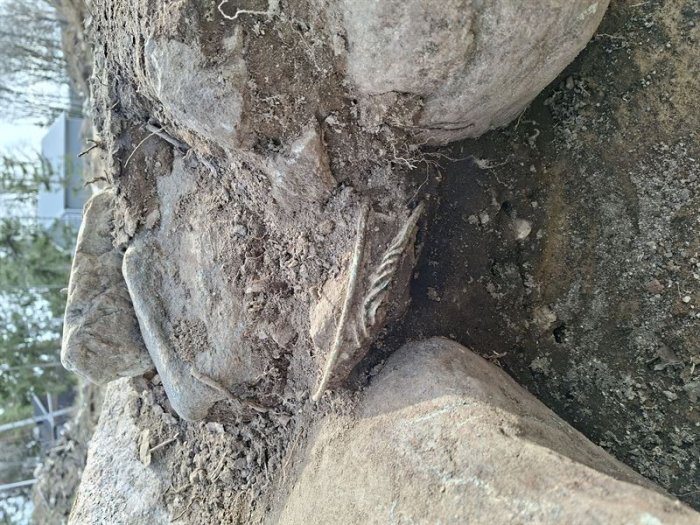
In one grave, a stone setting with a central block contained cremated human bones, some placed in an urn and others in small pits. Additional bones were scattered throughout the earth and stone fill. At the eastern edge, separate from the burials, two bronze neck rings were found between stones.
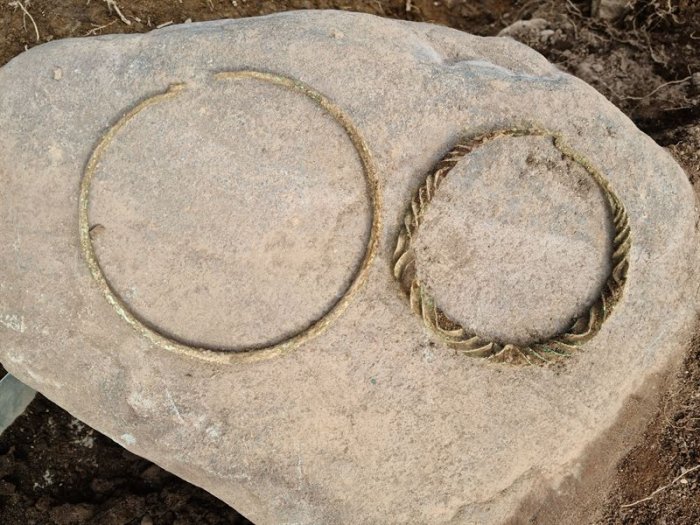
These neck rings, known as wendel rings, date to the final stage of the Bronze Age. They are made of cast bronze, twisted in either direction. According to Alf Ericsson, the larger ring is thinner, while the smaller is thicker and more strongly profiled.
Credit: Arkeologerna, SHM
The Vendel Period, called Vendeltiden in Swedish, lasted from about 550 to 800 AD. It followed the Migration Period and the volcanic winter of 536 AD.
The period takes its name from the boat-burial cemetery at Vendel in Uppland, Sweden, where archaeologists found elaborate graves of high-status individuals.
“Vendel rings are rare discoveries. They are usually found with other objects in bogs and marshes. For example, a bog deposit in Häradshammar, Östergötland, near our site, contained two Vendel rings. However, finding two neck rings placed together in a stone setting with burials is very rare, and may even be unique.
Almost ten rings have been found in Östergötland before. These neck rings were usually worn by women and showed their status.
We never expected to find something like this and have not fully processed the discovery yet,” says Alf Ericsson.
Credit: Arkeologerna, SHM
Researchers hope that the bone analysis will show how many people were buried in the stone setting.
People living here during the Bronze Age had a complex culture with strong symbolic traditions. Archaeologists also found the remains of houses and examined two piles of burned stones. Cairns were once thought to be mere waste heaps from daily life, but the discovery of human bones and bronze objects suggests they had a more important role.
Credit: Arkeologerna, SHM
During the excavation at Marby, archaeologists found that one cairn had been converted into a Bronze Age funerary monument, a rare occurrence.
See also: More Archaeology News
The other cairn contained many fire-affected stones, along with pottery shards and pieces of clay that once sealed a wall in a house damaged by fire. At the bottom of the mound, they found two stone circles, a feature typical of funerary monuments from this period.
Source: Arkeologerna
Written by Conny Waters - AncientPages.com Staff Writer
More From Ancient Pages
-
 3rd Century AD Marble Child Head, Chamber Pot Unearthed In Roman City Novae
-
 Ancient Society In The Sahara Desert Rose And Fell With Groundwater – Study
-
 Red Paint On 1,000-Year-Old Gold Mask From Peru Contains Human Blood Proteins
-
 DNA Reveals Early Maya Trace Their Roots To Unknown Ancient Immigrants Carrying Maize From The South
-
 Long-Lost Sun Temple Of King Nyuserre Discovered At Abu Ghurab, Egypt
-
 Ancient DNA Reveals Some Northern Europeans Came From Siberia
-
 Ancient Tools Found In Maryland Re-Write The History Of First Humans In America
-
 Pre-Incan Tombs Of The Chancay Culture Discovered In Lima, Peru
-
 Vijayanagara King Bukkaraya’s Earliest Inscription Discovered
-
 Easter Island’s Moai Statues Did ‘Walk,’ Researchers Demonstrate Using Physics And 3D Modeling
-
 3,000-Year-Old Fortress Built By The Mysterious Votadini Tribe Discovered On Top Of Arthur’s Seat
-
 Ice Age Engraved Stones, Tools Unearthed At Jersey Hunter-Gatherer Site Dated To Magdalenian Culture
-
 Bone Fragments Found Inside Mysterious Medieval Pendant
-
 Englishmen Jailed For Stealing Rare Viking Hoard Worth Millions
-
 Historic Event – Exeter Museum Returns Ceremonial Dress Of Famous Chief Crowfoot To Canada’s Siksika People
-
 Bacho Kiro Cave: Early Homo Sapiens Groups In Europe Faced Subarctic Climates
-
 First 5th Century Mosaic Found Near Cirencester Once The Second-Largest Roman-British Town In England
-
 New Details On Neanderthals – Revealed By Museum Exhibition In Norway
-
 Two Scribes Penned 8th Century ‘Samaria Ostraca’ Inscriptions Unearthed In Samaria
-
 Startling Discovery Of Nubian Levallois Technology In Shukbah Cave Re-Writes Ancient History Of Neanderthals And Homo Sapiens

