
Manuscripts And Art Support Evidence That Syphilis Was In Europe Long Before Explorers Could Have Brought It Home
AncientPages.com - That the arrival of Europeans in the New World in 1492 led to a massive shift in the ecological landscape has been widely accepted for the past 50 years.
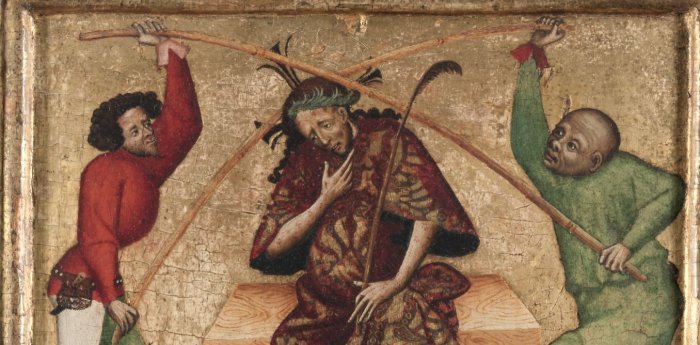
Does a painting from 1400 depict one of Jesus’ torturers as suffering from ‘saddle nose,’ a common effect of syphilis? Detail of an Austrian painting c. 1400 of the Passion of Christ. Credit: The Cleveland Museum of Art
Suddenly a trans-Atlantic exchange—maize for wheat, tomatoes for apples, tobacco for horses—meant that plants and animals were moving between continents for the first time.
It was the same for pathogens, according to historian Alfred W. Crosby and his influential book "The Columbian Exchange." Diseases like smallpox and measles, brought to the Western Hemisphere by the invaders, soon killed almost the entire Indigenous population. In return, Europeans fell prey to syphilis, a venereal disease they picked up from the native people. Crosby's idea about the exchange of diseases was an interesting one and it made for a good story, suggesting that with the arrival of syphilis in Europe justice of a sort had been done.
The only problem is that this syphilis scenario is wrong, according to ongoing research by paleopathologists, scientists who study skeletal remains for evidence of disease. After decades of painstaking work, they have concluded that the syphilis-causing spirochete bacterium Treponema pallidum already existed in the Old World long before Columbus boarded his ship and sailed to Hispaniola.
As a women's historian who has studied documents and artworks for evidence of syphilis in the medieval period, I believe the paleopathologists are right. Like skeletal remains, paintings show life as it was. Even manuscripts, although more open to interpretation, can reveal the truth once readers open their minds to new possibilities. Here's a sample of the evidence that Europeans suffered from syphilis long before they reached the Americas.

View of a human skull damaged by late-stage syphilis, the kind of evidence paleopathologists can look for. Credit: Canley/Wikimedia Commons, CC BY-SA
Evidence from bones and teeth in the Old World
In a cemetery in West Sussex, U.K., archaeologists uncovered the skeleton of a young man with extensive damage to his skull, clavicles, arms and legs—a combination typical of syphilis. He died in the sixth century.
In St. Polten, Austria, a medieval cemetery holds the remains of a child age 6 with deformed teeth consistent with a diagnosis of treponematosis, perhaps a case of congenital syphilis, when the Treponema pallidum bacteria are passed from mother to child during pregnancy or birth.
In Anatolia in western Turkey, the skeleton of a teenager revealed not only the same deformed incisors as in St. Polten, but also damage to the entire skeleton below the head. Involvement of both teeth and bones in the same specimen, and especially the large number of bones affected in this case, points to syphilis. The victim died in the 13th century—a couple hundred years before Columbus set sail.
And so it goes. While the absolute number of cases is not large, they keep turning up. Some of the evidence appears in the remains of people who lived more than 2,000 years ago.

In an early 15th-century painting, a discerning historian’s eye sees two soldiers (one in yellow, one behind red plume) with facial features indicative of advanced syphilis leading Christ to his crucifixion. Credit: The Disrobing of Christ from the Karlsruhe Passion (detail), c.1440. Staatliche Kunsthalle Karlsruhe, Strasbourg
There is an outstanding issue, however. Damaged bones and teeth seem to hold proof of pre-Columbian syphilis, but there is a possibility that they point to another form of the disease instead. Treponema pallidum appears in several strains. The subspecies that causes syphilis is the deadliest. But two other subspecies of the bacteria cause less serious, if still painful and unsightly, diseases called bejel (also known as endemic syphilis) and yaws that are not usually transmitted sexually. Nowadays all three can be treated with antibiotics.
How then, to distinguish between the three subspecies and prove that the venereal form had existed in Europe all along?
Writers and artists recorded other evidence
Documentary and artistic evidence can help settle the issue. Of all the pathogens known to humanity, only treponemes produce such widely divergent outcomes based on climate and culture, an important clue for finding evidence in manuscripts.
This fact explains my theory that medieval elites suffered more severely from treponematosis than peasants. Their wealthy lifestyle would have protected them from childhood infections their social inferiors picked up in their crowded and unsanitary households. But those childhood sicknesses would have had the benefit of triggering some future immunity in the peasantry.
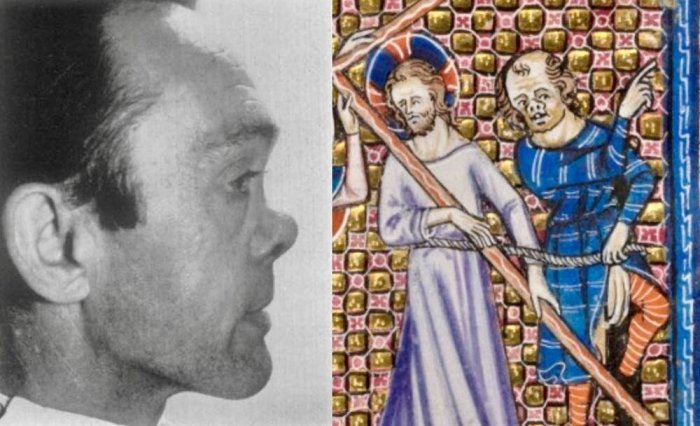
In a medieval painting, one of Christ’s tormentors has facial features reminiscent of a syphilis patient’s saddle nose. Credit: L: British Journal of Plastic Surgery, Vol. 10, McLaren + Penney, The reconstruction of the syphilitic saddle nose: A review of seven cases, Pages 236-252, Copyright 1957–1958. R: The Taymouth Hours, England, mid-14th century. British Library, MS Yates Thompson 13, fol. 120v.
If members of the elite reached sexual maturity without having had milder infections while growing up, they would be highly susceptible to contracting the disease for the first time during intercourse. A sore on the genitalia contains a massive dose of infectious bacteria compared with the small doses found on the shared clothing or bedding of the peasantry. Peasants who suffered a recurrence of the disease as adults could likely fend it off successfully because of their prior immunity. I contend this was not true for elites who then suffered more devastating illnesses.
In addition to dying young themselves, infected elites risked giving their children congenital syphilis, which often proved fatal to the next generation. Elites and their children died in such high numbers that some noble families had trouble maintaining their bloodlines, a point noted long ago without making a potential connection to syphilis.
One royal who I believe almost certainly died of syphilis was king Edward IV of England (1442-83). One of his councilors wrote that he died of an illness difficult to cure even in a person of lesser status, a cryptic comment not previously understood by historians. But his statement perfectly fits the difference between venereal and endemic syphilis, evidence that suggests both diseases existed in 15th-century England. The king's symptoms and reputation for sexual promiscuity help confirm my diagnosis.
Evidence for the presence of syphilis in the Old World also comes from art.
Doctors know that syphilis can result in "saddle nose," in which spirochetes invade a patient's nose and cause it to collapse in a distinctive way. Medieval artists from as early as the 12th century depicted this deformity in their work.
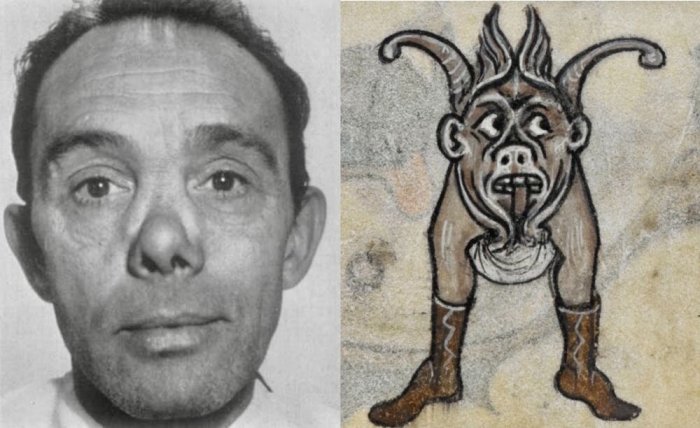
A gryllus displaying the saddle nose deformity in a drawing from the early 1300s. Credit: L: British Journal of Plastic Surgery, Vol. 10, McLaren + Penney, The reconstruction of the syphilitic saddle nose: A review of seven cases, Pages 236-252, Copyright 1957–1958. R: The Maastricht Hours, Liège, early 14th century. British Library, MS Stowe 17, fol. 151r.
I believe they intended to show venereal and not endemic disease because they use saddle nose in depictions of sinful figures, including the men who tortured Christ or killed babies on the orders of King Herod.
Even the silly gryllus, a medieval monster with a face and legs but no body, was a symbol of human depravity.
Examples abound. Historians have ignored good evidence—as plain as the nose on your face, so to speak—because they believed in the Columbian exchange. Regarding syphilis, however, that intellectual framework now appears outdated.
Written by Marylynn Salmon, Research Associate in History, Smith College
This article is republished from The Conversation under a Creative Commons license.
The original article - here.
More From Ancient Pages
-
 On This Day In History: Treaty of Calais Ratified Between France And England – On Oct 24, 1360
-
 Why We Celebrate Saint Lucy’s Day – The Bringer Of Light And Patron Of The Blind
-
 Swiss Farmer Discovered Roman Coins Among Cherry Trees
-
 3,000-Year-Old Egyptian Artificial Wooden Toe In New Light
-
 On This Day In History: Agatha Christie Known As ‘Queen Of Crime’ Died – On Jan 12, 1976
-
 Ancient Temple Complex Dated To Nanzhao Kingdom Unearthed In Southwest China
-
 Rome’s Most Wanted Enemy – Poison King Mithradates Murdered 80,000 Roman Civilians
-
 On This Day In History: Joan Of Arc Was Captured By The Burgundians – On May 23, 1430
-
 New Cosmic Ray Bombardment Of The Great Pyramid – Search For The Hidden Chamber Continues
-
 Is This The Face of Queen Elizabeth I?
-
 Ancient City Empuries (Emporiae) With Best Greek Ruins Located Outside Of Greece
-
 Mount’s Bay, Lyonesse, Langarroc: Legendary Submerged Lands And Buried Towns Of Cornwall
-
 Unusual Stone Carvings And Medieval ‘Witching’ Marks To Ward Off Evil Spirits Discovered In England
-
 Homo Sapiens Survived In The Kalahari Desert More Than 20,000 Years Ago – Stone Age Discovery Shows
-
 Old Bone Links Lost American Parrot To Ancient Indigenous Bird Trade
-
 Mysterious 4,000-Year-Old Table-Like And Unique Dolmen Discovered In Galilee Hills, Israel
-
 10 Great Ancient Mysteries Of North America
-
 Lost Biblical City, Ancient Treasure And Atlantis – Biblical And Archaeological Perspective
-
 Tomb Of Christopher Columbus Finally Found But There Is One Problem With His Body
-
 Central European Prehistory Was Highly Dynamic – New Study Shows

