
Was Tintagel Castle A Fortress Used By Iconic Hero King Arthur?
A. Sutherland - AncientPages.com - Ancient Tintagel Castle has quite spectacular natural topography, particularly the eroded neck of land dividing the island from the mainland.

Located on both sides of the chasm, the Castle experienced centuries-long erosion.
It practically 'consumed' many parts of it along with earlier buildings. Split in two by the force of the sea and ruined, the Tintagel Castle was once the fortress used by King Arthur.
Iconic hero King Arthur was first linked to Tintagel in the 12th century when Geoffrey of Monmouth named it the place where Arthur was conceived.
One legend is that the infant Arthur, probably of mixed Roman and British parentage, was thrown by the waves on the beach by Merlin's cave. He is identified with the known history of a Celtic chieftain of the 5th century, a great warrior who led his fellow citizens in the West in their resistance against Saxon invaders.

The marriage of Arthur and Guinevere. Image credit: Speed Lancelot (1860-1931) - Scan of illustration at title page in a book of The Legends of King Arthur and His Knights (Facing p. 78), 1912., 9th edition. Ed. Sir James Knowles, K. C. V. O. London; New York: Frederick Warne and Co., 1912 - Public Domain
The original fortress is long gone, but archaeologists have found proof in their diggings on the Tintagel Castle that fifth-century citizens lived on the site.
The replacement castle was built between 1230 and 1236 and is now nearly 800 years old. The Castle was in ruins within two hundred years and remains so.
There is something special about Tintagel. Its associations with the legendary King Arthur date back to the twelfth century.
This iconic hero was for the first time linked to Tintagel by Geoffrey of Monmouth, the medieval author of "History of the Kings of Britain," who, in the story "Once and Future King," confirms it as the place where Arthur was conceived with the help of Merlin.
Geoffrey places the event at Tintagel Castle, which was said to be the home of the Duke of Cornwall, Gorlois, and his enchanting wife, Ygerna. Some 700 years later, the great Victorian poet laureate, Alfred Lord Tennyson, in "Idylls of the King," begins his story of Arthur at Tintagel.
Was it just a coincidence? Why did the authors choose this particular place for their stories? Were they inspired by an ancient oral or written tradition that associated Arthur with Tintagel?
Geoffrey of Monmouth's History of the Kings of Britain contains the earliest written mention of Tintagel. The tale tells how Arthur was conceived there by Uther Pendragon, King of Britain, because of his magically assisted seduction of Queen Igerna (Igraine), wife of Duke Gorlois of Cornwall.
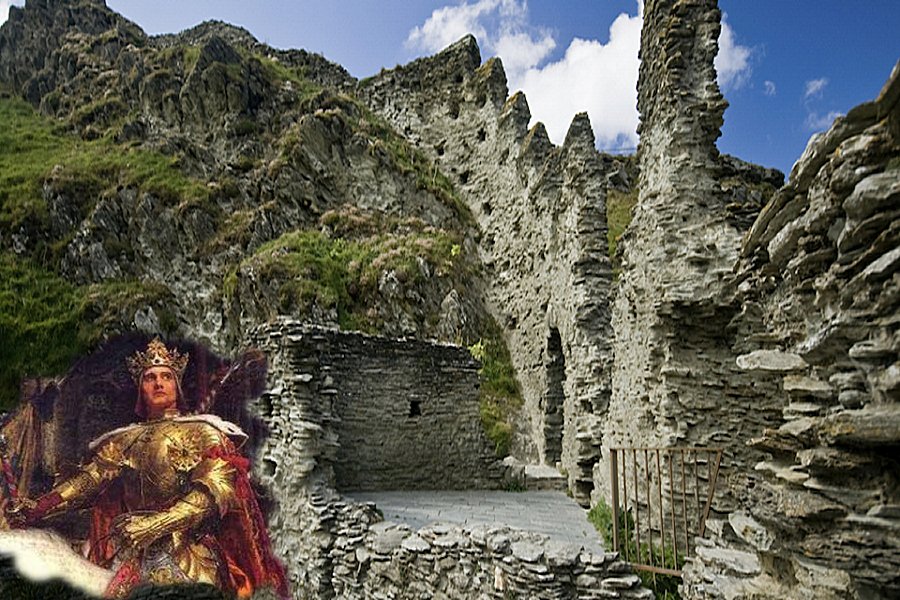
Enigmatic Tintagel Castle is a very ancient place; its visible ruins date back to the 13th century, but according to archaeological excavations, there were other older ruins on this site.
Dr. C.A. Ralegh Radford (1900- 1999) excavated the site in the 1930s. He believed that the earlier Tintagel was a Celtic monastery dating back to around the fifth century, the supposed time of Arthur.
Further excavations in the 1990s have shown that it was not a monastic site but the stronghold of a powerful, dark-age chieftain.
Who was the mysterious man?
Written by – A. Sutherland AncientPages.com Staff Writer
Copyright © AncientPages.com All rights reserved. This material may not be published, broadcast, rewritten or redistributed in whole or part without the express written permission of AncientPages.com
Expand for referencesMore From Ancient Pages
-
 Denisovan DNA Found In The Genome Of Oldest Human Fossil Discovered In Mongolia
-
 On This Day In History: Battle Of The Rhyndacus – Oct 15, 1211
-
 The Lost Prophecy Reveals Chilling Future Events – The Last Words To Mankind?
-
 Hayk – Legendary Patriarch And Founder Of Armenia Who Defeated King Bel Of Babylon
-
 Is There An Ancient Secret Connection Between The Statue Of Liberty And The Anunnaki Goddess Inanna?
-
 MaizeCODE Sheds Light On How Corn Was Domesticated 9,000 Years Ago
-
 Long Mysterious Tunnel Discovered Inside The Khufu Pyramid
-
 Mysterious Toaleans – Remains Of Unknown Humans Who Lived 8,000 Years Ago Discovered In The Leang Panninge Cave
-
 Surprising And Fascinating Finds On The Wreck Of The Lootsi Cog
-
 ‘Face Of First European’ – Oldest Fossil Of European Human Ancestor Found At Spain’s Atapuerca Archaeological Site
-
 Cerberus – Giant Multi-Headed Dog Guards The Underworld Of God Hades In Greek Mythology
-
 Ancient City Of Sogmatar And Recent Discovery Of 5,000-Year-Old Children’s Toy
-
 Telangana And Great Ancient Iron Masterwork Of Skilled Blacksmiths Of India
-
 DNA Of 10,000-Year-Old Luzio Solves The Mysterious Disappearance Of The Sambaqui Builders
-
 Immigrants In Prehispanic Cancun Were Treated Just Like Maya Locals
-
 Soyal: Hopi Indians’ Winter Solstice Celebration And Arrival Of Katchinas
-
 ChatGPT Is Confronting, But Humans Have Always Adapted To New Technology – Ask The Mesopotamians, Who Invented Writing
-
 Trung Sisters Of Vietnam: National Heroines That Stood Against Cruel Chinese Occupation Of Their Country
-
 Unique Well-Preserved 16th-17th Century Fabrics And Shoes Found In Toruń, Poland
-
 On This Day In History: National Foundation Day Celebrated In Japan – On Feb 11, 660 AD

