
Viking Ivar The Boneless Could Be Buried In Repton – Remarkable Viking Burial Holds Clues To Where Ragnar Lodbrok’s Son Died
Ellen Lloyd - AncientPages.com - Ivar the Boneless has gone into the history books as one of the most powerful Vikings ever lived. Not only was he one of the leaders of the Great Heathen Army, but he was also the oldest son of the famous Viking Ragnar Lodbrok. It’s, therefore, surprising we still know so little about this mighty Viking.
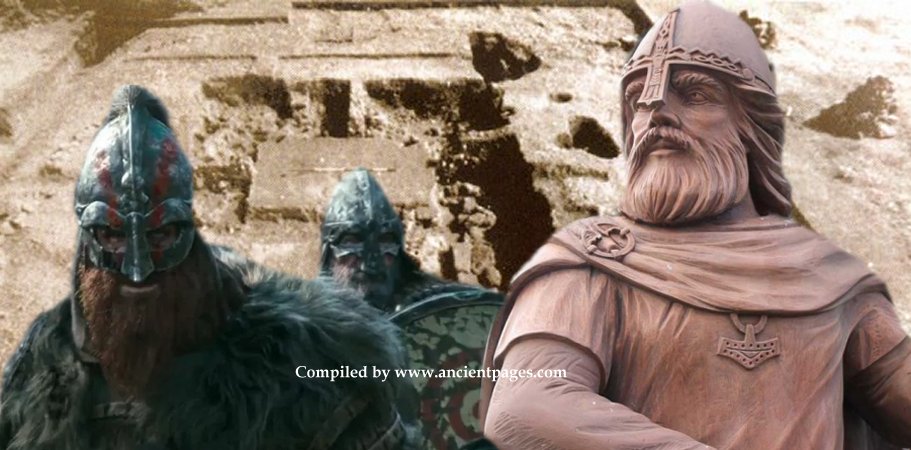
Many significant details about his life and death remain shrouded in mystery.
Can an impressive burial mound in Repton, UK, shed more light on how and where Ivar the Boneless died? One Icelandic Saga reveals that Ivar the Boneless died and was buried in England, but there is no information about the grave’s location. However, one notable burial in Repton reveals a prominent Viking was put to rest there. So, it’s fair to ask if perhaps Ivar the Boneless is buried in Repton.
Before we go into details about Ivar the Boneless’ death, it’s essential to know some facts about this great Viking who changed history in the countries he visited.
As previously discussed on Ancient Pages, Ivar the Boneless was one of Ragnar Lodbrok’s sons, and it could not have been easy. Lodbrok’s relation to his sons was full of contractions. He wanted his children to be brave, strong, and fearsome warriors, but at the same time, he was also afraid his sons could become more popular than he was.
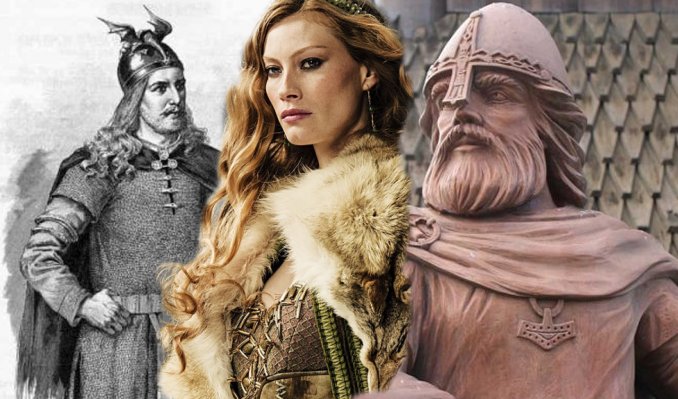
Ragnar Lodrok wanted to kill his son Ivar the Boneless against Aslaug's wishes. Read more
It’s worth mentioning that Ivar the Boneless managed to survive as a tiny baby. On one occasion, Ragnar Lodbrok learned from a seer that he would have many famous sons. He became somewhat obsessed with this prophecy, which almost led to a tragic event when he tried to kill his son, Ivar the Boneless. But small Ivar survived; with time, he grew into a mighty Viking who became famous and feared.
In 865, Ivar the Boneless decided to invade England and launched the largest invasion of the British Isles in recorded history. His brothers Halfdan and Ubba and his colleague Olaf the White Ivar the Boneless sailed from Dublin and landed in East Anglia.
He had command of a force so massive that the English referred to it simply as “The Great Heathen Army.” It was a coalition of Norse warriors from Denmark and Norway (and possibly also from Sweden) who came together under a unified command.
In 871, Ivar the Boneless took the unwieldy but impressive title ‘King of the Northmen of all Ireland and Britain”.
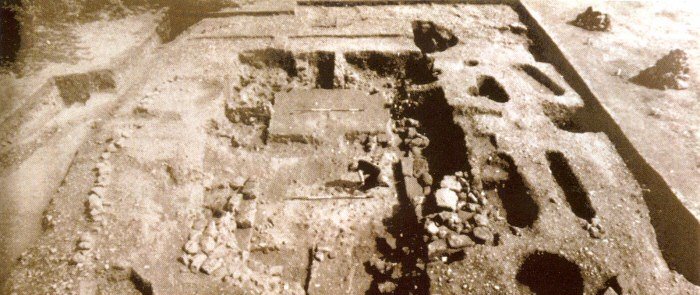
Archaeologists discovered Viking graves in Repton. Credit: Repton Church
It’s unknown where he died, but according to a legend, Ivar the Boneless wanted to be buried in England. His corpse was allegedly transported from Dublin and interred in English soil.
Viking Warriors Of The Great Heathen Army Died In Repton
In November 2017, Ancient Pages reported a Viking camp dating to the winter of 873-4, was unearthed by a team of archaeologists from the University of Bristol.
It is located in the small village of Repton, Derbyshire, and has been known since the 1970s. Repton has long been a subject of excavations.
Historical records state that the Viking Great Heathen Army wintered in Repton, Derbyshire, in 873 A.D.
In 2018, researchers from the University of Bristol re-examined the graves. New dating proves that all remains are consistent with a single date in the 9th century and, therefore, with the Viking Great Heathen Army.
Of particular interest, in this case, is a burial mound that housed a Viking of great importance. The grave contains the intact skeleton of a huge man – supposedly nine feet tall – surrounded by the disarticulated remains of two hundred and fifty Vikings.
As previously discussed on Ancient Pages, Viking burial traditions and rituals were very complex.
The Vikings had no religion but customs, practices, and beliefs. Vikings developed a highly class-conscious and hierarchical society as in many other ancient civilizations.
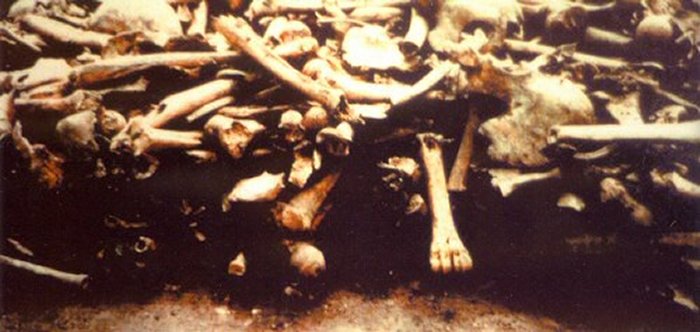
250 warriors were buried next to a great Viking leader. Credit: Repton Church
Many relics in ancient tombs reveal that the type of burial a Viking received depended on his importance in the community. When a Viking died, he could either be buried or burned.
The Viking buried in Repton was put to rest together with 250 warriors. Most likely, they all died during the battle. Vikings took time to place all dead bodies to accompany this one great Viking in the afterlife. Artifacts discovered in the grave reveal special Pagan rites held in honor of the Viking. To receive such an elaborate and complex burial, the Viking must have held high status.
Some have speculated that Ivar the Boneless died and was buried in Repton.
There is also another puzzle dealing with Ivar the Boneless. Our previous article discussed the mystery of Ivar the Boneless and Ímar, a remarkable Viking puzzle that reveals something extraordinary. If true, it could re-write Viking history.
Updated on September 1, 2024
Written by Ellen Lloyd – AncientPages.com
Copyright © AncientPages.com All rights reserved. This material may not be published, broadcast, rewritten or redistributed in whole or part without the express written permission of AncientPages.com
More From Ancient Pages
-
 Pre-Hispanic Carved Stone Monuments Discovered On A Mountaintop In Puebla, Mexico
-
 Isotope Analysis Helps Tell The Stories Of Aboriginal People Living Under Early Colonial Expansion
-
 Gothic Warrior With Rare Sword Unearthed In Thessaloniki, Greece
-
 Tombstone With Ancient Greek Inscription Unearthed Near Nitzana In The Negev, Israel
-
 Huge Viking Hall From Harald Bluetooth’s Time Discovered In North Jutland
-
 Table Manners And First Code Of Correct Behavior Were Introduced In Egypt 2,500 B.C. By Ptahhotep
-
 Mysterious Skull Cult At Göbekli Tepe – Ancestor Worship Or Trophies Of Dead Enemies?
-
 Oldest Preserved Remains Of Bed Bug Found In Paisley Caves, Oregon
-
 What 12 Ancient Skeletons Discovered In A Mysterious Tomb In Petra Could Tell Us About The Ancient City
-
 Tooth Analysis Reveal Nebraska Resembled A Dry Savanna 18 Million Years Ago
-
 Explore The Giant Gjellestad Viking Ship Burial In This Stunning Virtual Tour
-
 Roman-Byzantine Grave Unearthed In Turkey
-
 Merneith: Mysterious Queen In The Land Of The Pharaohs Could Be Earliest Attested Female Ruler
-
 Remarkable Marble Fragment From The Temple Of Zeus In Akragas Found Underwater Off The Coast Of Sicily
-
 Hyperborea Or Atlantis Ruins – Underground Secrets Of The Sacred Lake On The Arctic Circle
-
 Archaeology Sheds Light On Why Some Ancient Societies Were More Unequal Than Others
-
 Curse Of The Dancer – Mysterious 1,500-Year-Old Tablet Finally Deciphered
-
 Tomb Of Pharaoh Seti I Is The Largest Tomb In The Valley Of The Kings
-
 Young Girl Finds Rare Ancient Megalodon Shark Tooth On Maryland Beach
-
 Real-Life Excalibur Found Underwater In Bosnia – Medieval Sword In Stone Pulled Out

